One Club, Three Courts: A Buyer’s Guide to Custom Tennis, Pickleball & Padel Bag Programs
A practical buyer guide for clubs planning a coordinated custom tennis, pickleball and padel bag programme without forcing different player needs into one generic bag.
Links Sports Co
Product Specialist & OEM Consultant · Links Sports Co
10+ years in golf & tennis bag manufacturing. Specialises in OEM/ODM custom branding, material sourcing, and B2B wholesale for brands across 30+ countries.
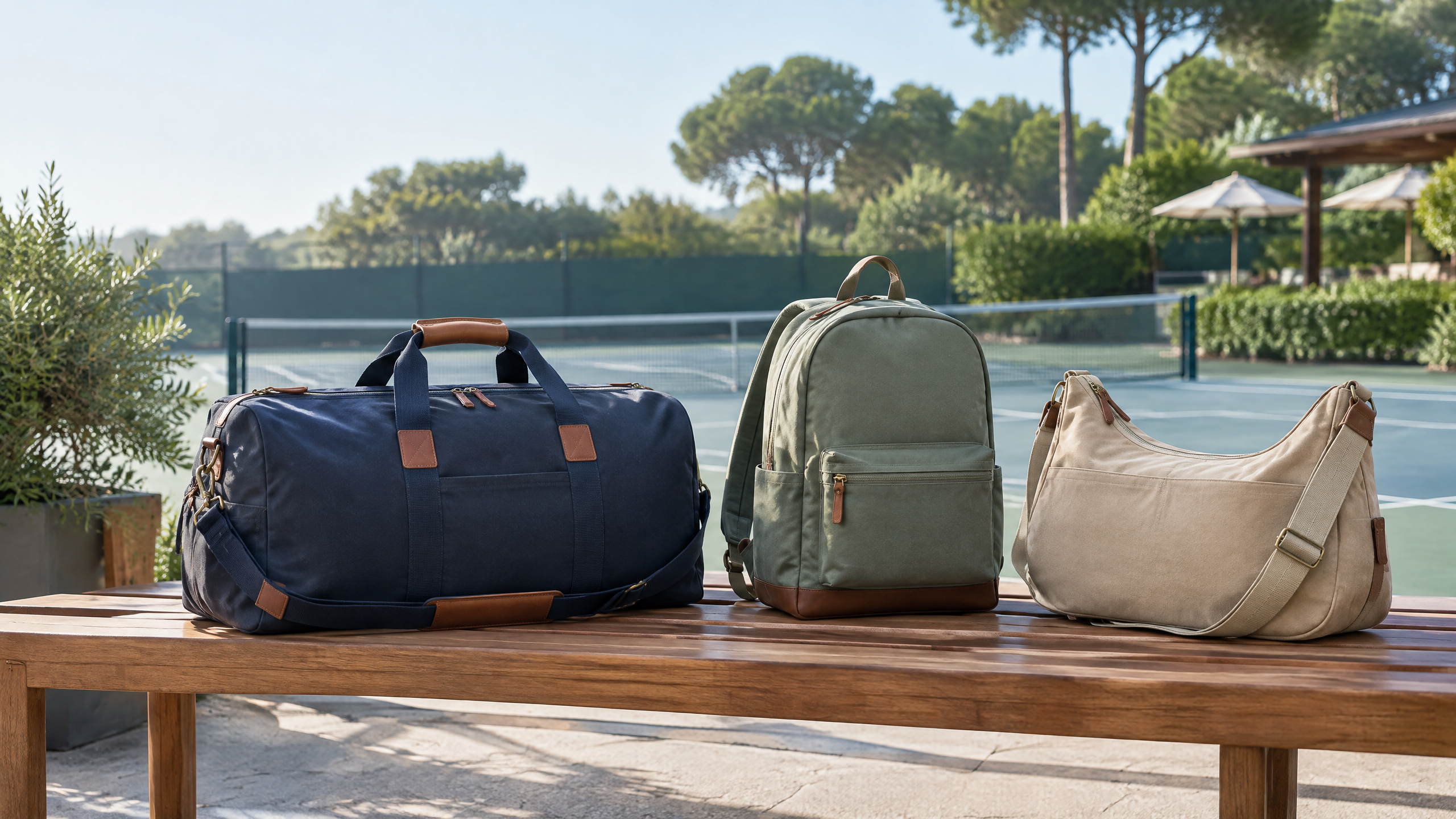
A club-branded racquet-sport bag programme works best when it gives tennis, pickleball and padel players a shared club identity without pretending that their equipment needs are identical. For a private club, resort or multi-court operator, the practical starting point is a small coordinated collection: one visual language, a clear use case for each bag and a sample-review process that confirms the details members will actually handle.
That approach is more useful than choosing a generic sports bag and applying the same logo everywhere. A racquet programme often serves players who move between courts, social events, coaching sessions, travel and the pro shop. Their bags need to hold different equipment, but the club merchandise should still feel like it belongs to one place.
This guide explains how a buyer can plan a custom tennis, pickleball and padel bag programme that is functional, recognisable and realistic to approve.
Why the three-court opportunity is different from a standard pro-shop order
Clubs are increasingly building racquet programmes around more than one sport. The International Padel Federation’s 2025 World Padel Report reflects the sport’s expanding global ecosystem, while pickleball and tennis continue to bring distinct groups of members and guests into club spaces. For a buyer, the important point is not a headline statistic. It is that more facilities now need merchandise that can make sense across several court cultures.
A bag can become part of that experience. It may be a retail item, an event welcome gift, a league award, a coach uniform component or a member-registration benefit. But a programme will feel more considered when it answers three questions before anyone selects a colour:
- Who is carrying it? A committed tennis player, a social pickleball group, a visiting padel player or a coach may each use equipment differently.
- Where is it used? Court-side storage, a walk from the car park, a locker, a café table and a weekend trip all create different needs.
- What does the club want the item to communicate? Heritage, modern hospitality, a junior pathway, wellness or tournament energy are different brand stories.
A good club-branded racquet sport bag programme connects those answers. It does not assume that a larger bag is automatically more premium or that every player wants the same compartment layout.
Start with a collection logic, not a one-bag compromise
The phrase “multi-sport bag” is attractive because it suggests efficiency. In practice, one universal silhouette can become oversized for one player and insufficiently organised for another. The better alternative is a compact collection with shared visual rules.
Those rules might include the same club colours, a related lining tone, one hardware finish, a consistent logo position and a common packaging direction. The bag sizes, carry options and internal layouts can then respond to the sport.
| Player context | Practical carrying priority | A useful bag direction | What can stay consistent across the collection |
|---|---|---|---|
| Tennis | Racquet length, apparel, hydration and match-day changes | Structured racquet duffel or backpack | Club crest position, main body colour, trim and zipper-pull treatment |
| Pickleball | Paddle protection, balls, quick-access essentials and social-session mobility | Compact backpack, sling or court tote | Logo scale, lining colour, webbing and exterior label treatment |
| Padel | Paddle shape, court footwear, balls and post-match use | Shoulder bag or backpack with a stable paddle zone | Material palette, hardware finish, packaging and hangtag family |
| Coach or programme staff | Repeated access to balls, paperwork and small equipment | Utility tote or larger organiser bag | A more discreet version of the same club identity |
The table is not a specification. It is a conversation tool. A buyer should decide which use cases are central to the programme before a factory is asked to solve every possible scenario at once.
The first collection: fewer SKUs, clearer reasons to buy
A first launch does not need a bag for every sport, every age group and every season. For many clubs, an initial range of two or three pieces provides a more manageable test of member interest and operational use.
A practical starting point could be:
- One primary court bag for regular players: this carries the strongest club identity and has the greatest retail presence.
- One compact everyday option for pickleball, casual sessions or members who prefer a lighter carry.
- One programme or event accessory such as a valuables pouch, shoe bag or ball organiser that extends the visual system without requiring another major bag silhouette.
This structure gives a merchandising team a coherent story without creating a large amount of inventory complexity. It also makes the custom bag sample discussion more focused. The team can spend time reviewing the parts that define the programme—materials, logo technique, pocket access, handle comfort and colour relationships—instead of splitting attention between too many prototypes.
For clubs considering a broader equipment offering, browse our custom tennis and racquet-sport bag options and use the range as a starting point for a brief rather than as a fixed catalogue.
Design a shared visual language that survives different bag shapes
Brand consistency does not require placing a large crest on every visible panel. In fact, a shared design system is usually more durable when it uses several restrained signals together.
1. Decide the club’s lead colour and support colours
Choose one principal body colour, then limit the number of supporting tones. A deep navy, forest green, sand, burgundy or charcoal may travel well across different bag formats. A contrast lining, zipper tape or webbing can add recognition without demanding a loud exterior.
The physical sample is essential here. A thread colour, leather-look trim and fabric body may look compatible on a digital screen but feel unrelated under daylight. Place the materials next to one another at normal viewing distance, then review the combination again outdoors.
2. Match logo method to the panel, not only to the artwork
Embroidery can add texture and club character; print or patch applications may better suit a different material or a more graphic programme. The choice should be made with the panel construction in mind. Ask the development team to show the actual proposed location, backing treatment and edge distance on the sample.
A logo is most effective when it remains clear without overwhelming the bag’s function. On a compact pickleball backpack, a small, clean crest can feel intentional. On a larger tennis duffel, the logo might sit on the end panel while the main body remains calm.
3. Use repeatable details with restraint
A zipper-pull shape, a discreet internal label, contrast bartacks or a lining colour can make separate products feel related. These choices help a collection look designed rather than assembled from unrelated blanks.
Write a buyer brief that a development team can act on
A private-label tennis bag manufacturer can only make useful recommendations when the club brief describes the intended use. Before requesting a quote or sample, consolidate the following inputs:
| Brief element | Questions to settle internally |
|---|---|
| Programme purpose | Is this pro-shop retail, an opening-event gift, member recognition, junior programme equipment or staff use? |
| Player priority | Which group is the first audience: tennis, pickleball, padel, juniors, coaches or multi-sport members? |
| Carry context | Will players walk from a car park, use lockers, travel to matches or need quick court-side access? |
| Club identity | Which approved logo file, colour references and brand-use rules apply? |
| Product direction | Which silhouette is primary, and which features are essential versus optional? |
| Sample decision team | Who consolidates feedback and gives the final production release? |
The last point matters. A programme can lose time when the coach, pro-shop manager, marketing team and committee all provide separate revisions. Nominate one person to collect comments and identify whether each note is a must-change, a preference or an item for a future edition.
What to inspect on the custom bag sample
A sample should be handled as a proposed product system, not only photographed for approval. Set aside a short review session in or near the venue where members will use it.
Check the silhouette at a normal distance. Does the bag read as the club’s product rather than a generic carrier with a late-stage logo? Are the colour proportions balanced across the front, side and back?
Load it as a player would. Put representative racquets or paddles, balls, a water bottle, a phone case and a light layer into the proposed spaces. The goal is not a laboratory performance claim; it is to see whether the layout supports the real routine the club had in mind.
Open the access points in sequence. A pocket that looks useful in a flat sample photo can become awkward when a shoulder strap or another compartment is full. Test the opening movement, zipper reach and the way the bag sits while accessed.
Review the identity details under daylight. Look at embroidery, trim, webbing and hardware away from a showroom screen. Confirm that the approved artwork is positioned correctly and that the group agrees on the material relationship.
Document the release version. Capture the approved colour references, logo size and position, material names, pocket plan, hardware direction and any changes agreed in the review. The production quote should attach to this version—not to an earlier mood board.
Plan the retail and event role before finalising quantity
A coordinated collection has more than one way to appear at a club. The intended role affects how many styles a buyer should consider and what packaging may be useful.
- Retail-led programme: Start with the silhouette that has the clearest everyday purpose. Photograph the approved sample in the club setting and prepare simple staff talking points about use, material and the club-exclusive identity.
- Event-led programme: Choose a format that can be distributed and carried easily. Make the item feel connected to the event, but keep the design useful enough that guests will continue to use it later.
- Member-recognition programme: Favour a more restrained club mark and a durable, personal-carry format. The aim is for it to feel like a considered club object rather than promotional packaging.
- Junior or coaching programme: Prioritise manageable size, simple access and a clear storage plan before adding decorative details.
The commercial plan, MOQ and delivery schedule should be confirmed against the approved construction and embellishment method. They are not universal promises; they depend on the specific range, materials, custom details, packaging and production calendar.
A stronger programme begins with a clearer point of view
The opportunity in tennis, pickleball and padel merchandise is not to make every player buy the same bag. It is to give a club one recognisable equipment language that can flex around different court habits.
Start small. Choose the member group the programme is meant to serve first. Set a visual system that can move between bag formats. Review the sample in a realistic club context. Then make the final production decision from a single documented specification.
That sequence gives a club a more credible collection and gives the buying team a cleaner handover. When you are ready to turn a programme idea into a development brief, contact our team with your logo assets, use cases and initial product direction.
Frequently Asked Questions
Q: Can one club use the same brand identity across tennis, pickleball and padel bags?
Yes. A shared body palette, trim direction, logo treatment and packaging can make the collection recognisable, while each silhouette and pocket arrangement is adapted to the sport and intended use.
Q: Should a club start with a single multi-sport bag?
A single bag can be appropriate for a tightly defined use case, but it should not be assumed to fit every player. A small coordinated range often gives clearer utility: one primary court bag and one compact option can cover more routines without losing the club identity.
Q: What should be supplied before requesting a custom racquet-sport bag sample?
Provide the approved logo file, colour references, intended player group, preferred bag direction, key items to carry and the club’s target use for the programme. Identifying one person to consolidate feedback also makes the sample review more efficient.
Q: How should a club approve logo placement on a bag?
Review the proposed logo on the physical sample, at normal viewing distance and in daylight. Confirm its scale, location, technique and relationship to seams, pockets and straps before the bulk specification is released.
Share this article