Why Hardware Matters More Than You Think: A Guide to Golf Bag Zippers, Buckles & Rings
Zipper failures, buckle cracks, and D-ring deformation account for over 60% of golf bag warranty returns. Yet hardware is the last thing most buyers specify. Here is what to ask for — and why it changes everything.
Links Sports Co
Product Specialist & OEM Consultant · Links Sports Co
10+ years in golf & tennis bag manufacturing. Specialises in OEM/ODM custom branding, material sourcing, and B2B wholesale for brands across 30+ countries.
The Part Nobody Talks About Until It Breaks
Every buyer who walks into our factory has strong opinions about fabric weight, stitching density, and logo placement. Almost none of them ask about the hardware. That changes the first time a shipment comes back because a zipper pull snapped on the third round, or a buckle cracked in cold storage during transit.
At Links Sports Co, hardware accounts for roughly 8–12% of the total cost of a premium golf bag. It is also responsible for more than 60% of the warranty claims we see from buyers who sourced bags elsewhere before coming to us. This guide exists to change that ratio.
Zippers: The Most Abused Component on Any Bag
A golf bag zipper opens and closes an average of 400–600 times per season on a bag used twice a week. Over three years, that is roughly 1,200 to 1,800 cycles — under sun, rain, humidity, and the occasional sand trap. The difference between a YKK #8 coil zipper and a generic equivalent is not visible to the eye. It becomes visible around cycle 800.
YKK zippers are manufactured to a published cycle tolerance — their #8 coil is rated for 3,000+ cycles under standard load. Generic zippers from unspecified suppliers are typically rated at 800–1,200 cycles, and that rating assumes ideal conditions. We use YKK exclusively on our premium and mid-range lines, and we document the zipper specification on every production order so buyers can verify it.
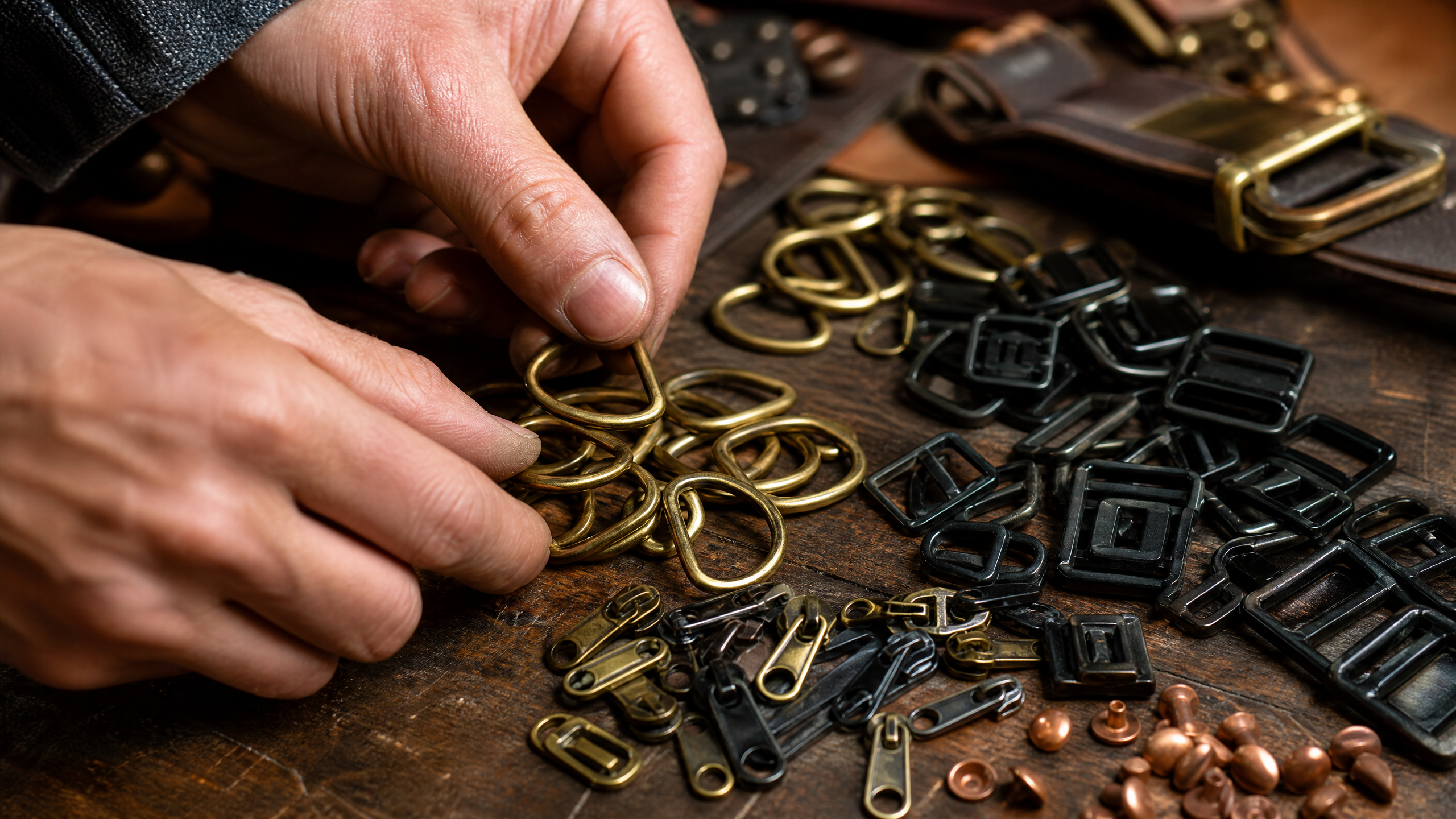
Beyond the zipper tape itself, the slider matters equally. A zinc-alloy slider will develop micro-cracks under repeated lateral stress — the kind that happens when a golfer grabs the pull at an angle while walking. Brass sliders, by contrast, deform rather than crack, which means they fail slowly and visibly rather than suddenly. For bags positioned above the $150 retail price point, we recommend brass sliders as a non-negotiable specification.
Buckles: Where Aesthetics and Engineering Collide
The side-release buckles on a golf bag strap system carry a deceptively simple job: hold the bag closed during transport, release cleanly under pressure, and survive being dropped, sat on, and loaded into car boots for years. The material choice here is not cosmetic.
Zinc alloy (zamak) buckles are the industry standard at the budget end of the market. They photograph well, accept plating easily, and cost roughly 40% less than brass equivalents. They also become brittle below 5°C and can shatter under impact loads — a real concern for bags shipped to Northern European or Canadian markets in winter.
For our Links Classic and Links Pro lines, we specify forged brass buckles with a minimum wall thickness of 2.8mm. The weight penalty is approximately 35g per bag — negligible for a carry bag, irrelevant for a cart bag. The durability improvement is not negligible: in our internal stress testing, brass buckles survive a 15kg drop load from 1.2 metres without deformation. Zinc equivalents fail at approximately 9kg.
When specifying custom orders, we ask buyers to confirm the destination market and intended use. A club bag for a links course in Scotland gets different hardware than a promotional bag for a corporate event in Singapore.
D-Rings and Attachment Points: The Overlooked Load Path
D-rings are the connection points between a bag body and its strap system. On a fully loaded golf bag — 14 clubs, balls, rain gear, and accessories — the total weight can reach 12–15kg. That load is transmitted through two or four D-rings, depending on the bag design. The ring gauge, weld quality, and attachment method determine whether that load is distributed safely or concentrated into a failure point.
We use 304 stainless steel D-rings on all bags with a strap load rating above 8kg. The ring wire diameter is a minimum of 5mm, and all rings are welded rather than bent-and-pinched. Bent rings have a natural stress concentration at the open end of the D; under repeated loading, that point fatigues and eventually opens. Welded rings distribute stress around the entire circumference.
The attachment method matters as well. D-rings riveted directly through a single layer of fabric will eventually tear through under sustained load. We back every D-ring attachment with a reinforcing patch — typically a 4-layer laminate of the primary fabric and a nylon webbing underlayer — and use double-cap rivets rather than single-cap to distribute the clamping load.
A Practical Specification Checklist for Buyers
When placing a custom order, the following hardware specifications should be confirmed in writing before sampling begins. First, zipper brand and model — specify YKK and the series number (e.g., #8 coil for main compartments, #5 coil for accessory pockets). Second, slider material — brass for premium bags, zinc alloy acceptable for promotional or budget lines. Third, buckle material and minimum wall thickness — brass at 2.8mm+ for bags destined for cold climates or heavy use. Fourth, D-ring material and wire gauge — 304 stainless steel, minimum 5mm wire, welded construction. Fifth, attachment method for all load-bearing hardware — double-cap rivets with reinforcing patch backing.
This checklist adds approximately 15 minutes to the initial specification conversation. It eliminates the majority of hardware-related returns.
What This Means for Your Order
At Links Sports Co, every production order includes a hardware specification sheet as a standard document. Buyers receive the exact brand, model, material grade, and test certification for every piece of hardware on their bag before the sample is approved. If a buyer wants to substitute a component — for cost reasons or aesthetic preference — we document the substitution and its implications in writing.
Hardware is not glamorous. It does not appear in marketing photography. It is the reason a bag lasts three years instead of one, and the reason a buyer customers come back for a second order rather than a return. We think that makes it worth talking about.
Share this article