
The Public-Course Opportunity: Redesigning Entry-Level Golf Bags
Explore how 29.1M green-grass golfers shape entry-level, rental-friendly, and lightweight golf bag briefs with buyer validation checklists.
Links Golf Sports
Product Specialist & OEM Consultant · Links Sports Co
10+ years in golf & tennis bag manufacturing. Specialises in OEM/ODM custom branding, material sourcing, and B2B wholesale for brands across 30+ countries.
Quick Answer
The remarkable expansion in participation—highlighted by NGF 2025 reporting 29.1M green-grass golfers and 48M+ total participants—fundamentally transforms the product brief for entry-level, rental-friendly, and lightweight golf bags. B2B buyers sourcing municipal golf course gear and green-grass golf growth products must adapt their technical specifications to meet the rigorous demands of public-course play, cart compatibility, and evolving regulatory expectations such as those outlined by the European Commission regarding textile apparel in the ESPR Working Plan 2025-2030. Rather than relying on generic market assumptions or unverified performance claims, a buyer should agree/test/validate with supplier every performance metric, material characteristic, and compliance milestone.
Understanding Public-Course Dynamics and Green-Grass Growth
The public-course landscape serves as the foundational gateway for millions of new and returning players entering the sport. According to NGF 2025 data, total participation expanded by +41% between 2019 and 2025, reflecting an unprecedented era of widespread engagement that extends across adjacent racquet sports as well, where USTA 2025 documented 27.3M US players with an increase of +1.6M YoY, 14.5M core players, 616M+ play occasions, and 4.9M first-time participants. Within the golf sector specifically, 29.1M green-grass golfers actively frequent public, municipal, and daily-fee facilities, creating intense, daily wear-and-tear cycles for equipment rentals, pushcarts, and walking bags.
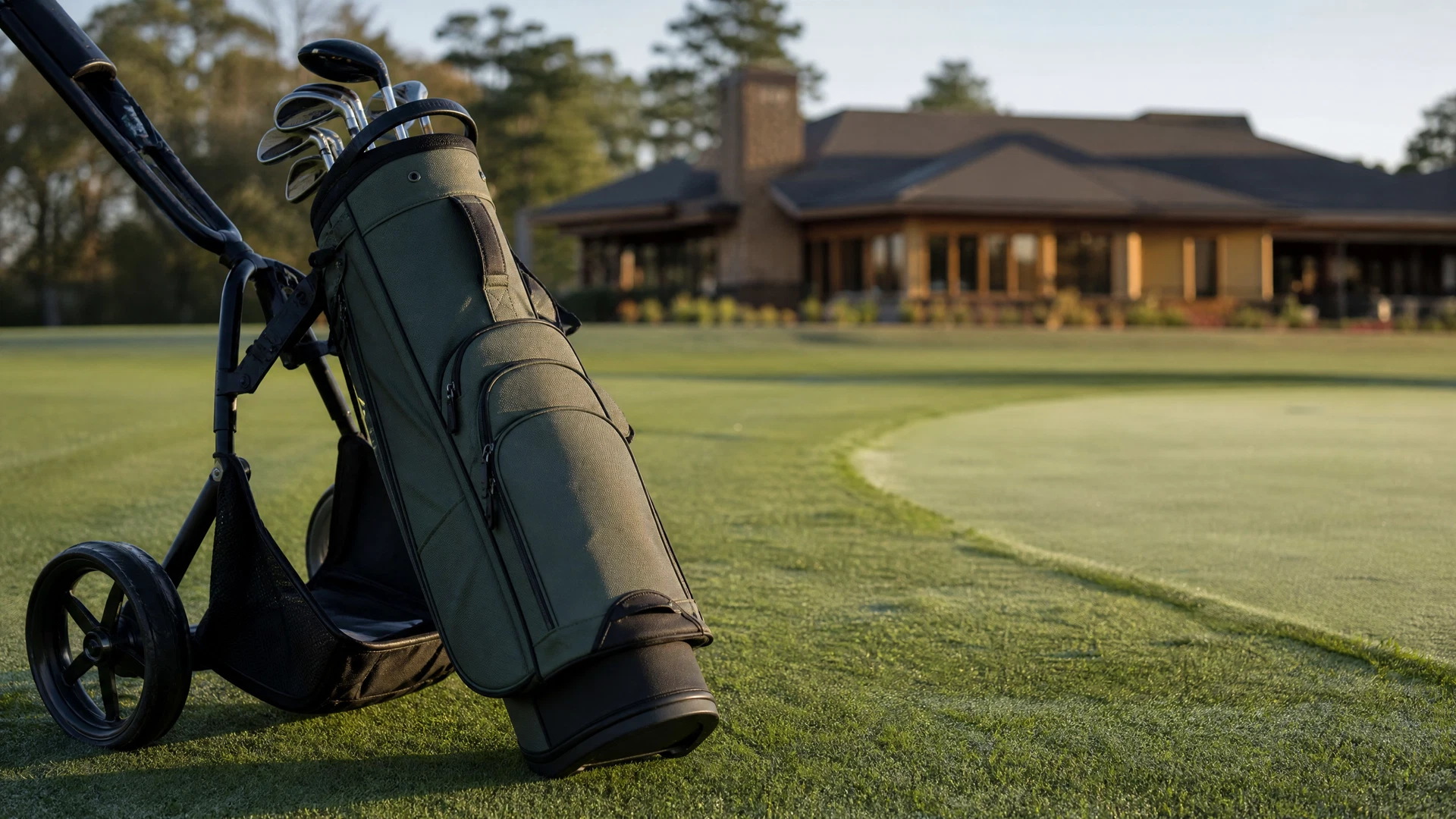
For B2B procurement professionals and brand developers, this high-frequency public usage demands a fundamental shift in how entry-level golf equipment is specified and manufactured. Public facilities experience constant player turnover, where bags are routinely loaded onto motorized carts, stashed in communal rental fleets, and carried across diverse, challenging terrain. Consequently, public course golf bag trends emphasize structural durability, ergonomic strap configurations, and simplified pocket architecture that reduces unnecessary manufacturing complexity while maximizing operational longevity on the course. A buyer should agree/test/validate with supplier all seam reinforcement methods, base stand stability, and zipper pull endurance to ensure finished goods withstand heavy public-facility conditions. Procurement teams must also evaluate whether material suppliers maintain robust quality control systems to ensure batch-to-batch consistency.
Designing for Rental-Friendly and Lightweight Portability
Entry-level and municipal golf course gear must successfully balance lightweight golf bag design with the rugged durability required for intensive rental fleet operations. Unlike private club bags designed for stationary storage in personal lockers or private sheds, rental-friendly bags undergo rigorous handling by diverse player profiles with varying levels of equipment care.
When developing technical specifications for lightweight structures, engineering and sourcing teams must evaluate fabric resilience against constant moisture, friction, and UV exposure. For instance, when assessing fabric resistance to water penetration, a buyer should agree/test/validate with supplier testing protocols aligned with ISO 811 hydrostatic pressure test methods rather than assuming uniform water resistance across generic synthetic textiles. Furthermore, the European Commission notes that textile apparel is a priority product group in the ESPR Working Plan 2025-2030, indicating that future Digital Product Passports (DPP) may eventually cover product identification, fibre composition, repair characteristics, and end-of-life recycling pathways, although exact requirements will come from future delegated acts.
To assist procurement teams in evaluating manufacturing partners and material readiness, the following table outlines key design parameters, technical considerations, and validation steps for entry-level bag briefs.
| Design Parameter | Technical Focus | Public Course Impact | Supplier Validation Requirement |
|---|---|---|---|
| Weight Distribution | Single/dual strap integration & lightweight framing | Eases carrying across 18 holes and speeds up cart loading | Buyer should agree/test/validate with supplier ergonomic load testing protocols |
| Base & Stand Mechanism | High-impact resin base & reinforced hinge plates | Withstands frequent dropping on hard cart paths and driving ranges | Buyer should agree/test/validate with supplier drop-cycle and stability tests |
| Water Resistance | Outer shell coating & seam sealing | Protects contents during unexpected weather on open municipal links | Buyer should agree/test/validate with supplier using ISO 811 hydrostatic pressure method |
| Material Traceability | Fibre composition & circularity readiness | Aligns with upcoming European Commission ESPR Working Plan 2025-2030 guidelines | Buyer should agree/test/validate with supplier raw material documentation standards |
Buyer Discovery Checklist for Entry-Level Golf Bags
When finalizing product briefs for green-grass golf growth markets, procurement managers should utilize a systematic checklist to verify that supplier capabilities align with quality, regulatory, and operational realities. Because municipal facilities require consistent quality without inflated tier-one pricing, verifying each checkpoint prevents post-production discrepancies and costly delays.
- Material Composition & Sourcing Verification: A buyer should agree/test/validate with supplier the exact yarn denier, coating type, and backing materials to ensure consistency across bulk production runs.
- Structural Seam & Stress Point Inspection: A buyer should agree/test/validate with supplier reinforcement stitching density and bar-tacking on high-stress areas like handle attachments and strap anchors.
- Hardware & Fastener Durability: A buyer should agree/test/validate with supplier zipper gauge size, slider alloy quality, and snap button retention strength under repeated opening cycles.
- Regulatory Transparency Alignment: A buyer should agree/test/validate with supplier how material documentation supports future traceability frameworks like the European Commission ESPR Working Plan 2025-2030 directives.
- Sample Testing Protocols: A buyer should agree/test/validate with supplier pre-shipment inspection parameters, ensuring testing methods such as ISO 811 for hydrostatic pressure are formally documented and executed prior to final dispatch.
Frequently Asked Questions
What defines an effective entry-level golf bag for public courses?
An effective entry-level bag prioritizes intuitive pocket layouts, robust base stability, and manageable weight over luxury hardware. With NGF 2025 reporting 29.1M green-grass golfers, public facilities require equipment that withstands high turnover. A buyer should agree/test/validate with supplier specific durability benchmarks for each production batch.
How do rental-friendly design requirements differ from private bag briefs?
Rental-friendly bags require simplified strap management, snag-free exterior profiles, and reinforced grab handles to facilitate rapid loading on motorized carts and storage racks. Unlike private bags, they must endure rigorous handling by diverse players. A buyer should agree/test/validate with supplier strap anchor strength and abrasion resistance.
What role does the European Commission ESPR framework play in golf bag manufacturing?
The European Commission notes that textile apparel is a priority product group in the ESPR Working Plan 2025-2030, suggesting that Digital Product Passports (DPP) may eventually cover fibre composition, repair characteristics, and end-of-life recycling. Exact requirements will come from delegated acts. A buyer should agree/test/validate with supplier the availability of supply chain data transparency.
How should buyers verify fabric waterproofing for municipal gear?
Instead of accepting vague water-resistant claims, procurement teams should test fabric resistance using standardized methods. A buyer should agree/test/validate with supplier testing protocols aligned with ISO 811 hydrostatic pressure method to confirm water penetration resistance.
If you are developing a custom golf or tennis bag, contact Links Sports Co to discuss your brief.
Share this article