The B2B Buyer's Checklist: 7 Non-Negotiables When Sourcing Custom Golf Bags in 2026
A practical 7-point checklist for brand owners and distributors sourcing custom golf bags in 2026. Covers factory vetting, material certification, QC audits, and partnership structuring — with real industry data.
Links Sports Co.
Product Specialist & OEM Consultant · Links Sports Co
10+ years in golf & tennis bag manufacturing. Specialises in OEM/ODM custom branding, material sourcing, and B2B wholesale for brands across 30+ countries.

The global golf bags market reached USD 1.66 billion in 2026 and is on a trajectory toward USD 3.48 billion by 2033. For brand owners, distributors, and corporate buyers entering or expanding in this market, the sourcing decision is the single most consequential choice they will make. A reliable manufacturing partner delivers consistent quality, on-time shipments, and the flexibility to grow with your brand. The wrong partner costs you far more than the price difference on a purchase order — it costs you customer relationships, brand reputation, and months of lost time.
In 2026, supply chains remain complex. Material costs are volatile. Consumer quality expectations are higher than ever, driven by a premium market where Acushnet Holdings reported a 5.5% increase in net sales for its Titleist Golf Gear segment on the back of higher average selling prices alone. In this environment, vetting your custom golf bag manufacturer thoroughly before committing to production is not optional — it is the foundation of a sustainable business.
This checklist distills the seven most critical evaluation criteria into a practical framework you can apply to any factory conversation, whether you are sourcing your first 300-piece run or scaling an established brand to new markets.
1. Verify Genuine Manufacturing Capability — Not a Trading Company
The first and most important distinction in custom golf bag sourcing is whether you are speaking with an actual factory or a trading company that subcontracts production. Trading companies present themselves as manufacturers, use factory photography they do not own, and add a margin layer between you and the people making your bags. This means less quality control, longer communication chains, and higher prices for the same product.
A genuine golf bag factory will have specific tooling for golf bag construction: divider tube systems, stand mechanism assembly jigs, specialized zipper-foot sewing machines for curved seams, and in-house pattern-making capabilities. Ask directly: "Can you show me your production floor on a live video call?" A factory that hesitates or offers only pre-recorded footage is a red flag.
Minimum order quantities are also a useful signal. Genuine factories typically set MOQs at 300–500 pieces per design because that is the minimum run that makes their production scheduling efficient. Very low MOQs (under 100 pieces) often indicate a trading company sourcing from multiple small workshops.
2. Demand Material Certification, Not Just Material Claims
In 2026, material transparency has become a competitive differentiator and a legal requirement in many markets. The European Union's Green Claims Directive, which entered enforcement in 2024, requires that sustainability claims about materials — recycled content, organic certification, biodegradability — be substantiated with verifiable documentation. Brands selling into European markets without this documentation face regulatory risk.
Beyond compliance, material substitution is one of the most common quality failures in golf bag production. You approve a sample made with 1680D ballistic nylon and YKK zippers; production units arrive with 900D nylon and generic zippers. The weight difference is detectable by hand; the zipper failure rate difference becomes apparent after one season.
Ask every prospective manufacturer for: fabric mill certificates showing denier rating and composition, zipper brand authentication (YKK and SBS both provide verification), and — for any sustainability claims — GRS (Global Recycled Standard) or GOTS (Global Organic Textile Standard) certificates with current validity dates. A manufacturer who cannot produce these documents within 48 hours of your request does not have them.
3. Audit Quality Control Systems at Every Production Stage
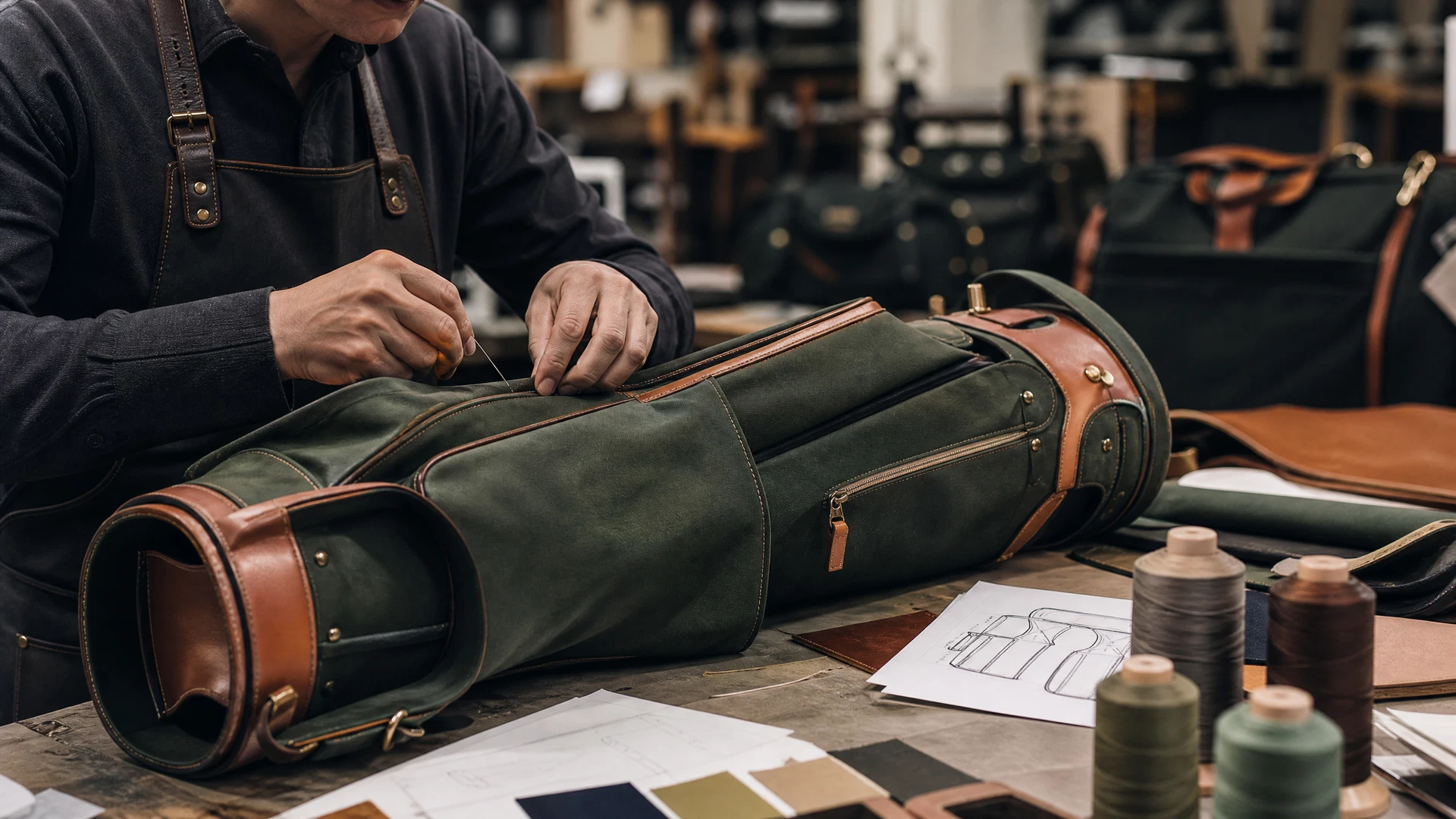
Quality control in golf bag manufacturing is not a final inspection — it is a process that runs through every stage of production. The most reliable manufacturers operate three distinct QC checkpoints: incoming material inspection before cutting begins, in-line inspection during assembly (checking stitching tension, zipper alignment, and pocket construction), and final random sampling before packing.
The industry standard defect rate for premium golf bag production is under 1.5%. Ask any prospective manufacturer for their documented defect rate from the past 12 months and for third-party inspection reports from recent orders. A manufacturer confident in their quality will provide these without hesitation. One who deflects or offers vague reassurances ("our workers are very experienced") is telling you something important.
For custom orders, pre-production sample approval is non-negotiable. Never approve full production based on a digital rendering or a photograph of a similar bag. Insist on a physical pre-production sample that matches your exact specifications — materials, hardware, stitching, logo placement — and test it yourself before signing off. Load it with clubs. Pull every zipper 50 times. Check every seam under tension. The cost of a pre-production sample is a fraction of the cost of a defective bulk order.
4. Assess Customization Depth — In-House vs. Outsourced
Custom golf bag production involves multiple specialized processes: embroidery, screen printing, heat transfer, woven label production, custom zipper pulls, and hardware finishing. The critical question is which of these processes your manufacturer performs in-house versus outsourcing to third parties.
Every outsourced process adds a handoff — and every handoff adds delay, quality variability, and communication risk. A manufacturer who embeds your logo in-house controls the thread count, color matching, and placement precision. One who sends your bags to an external embroidery shop introduces a variable they cannot directly manage.
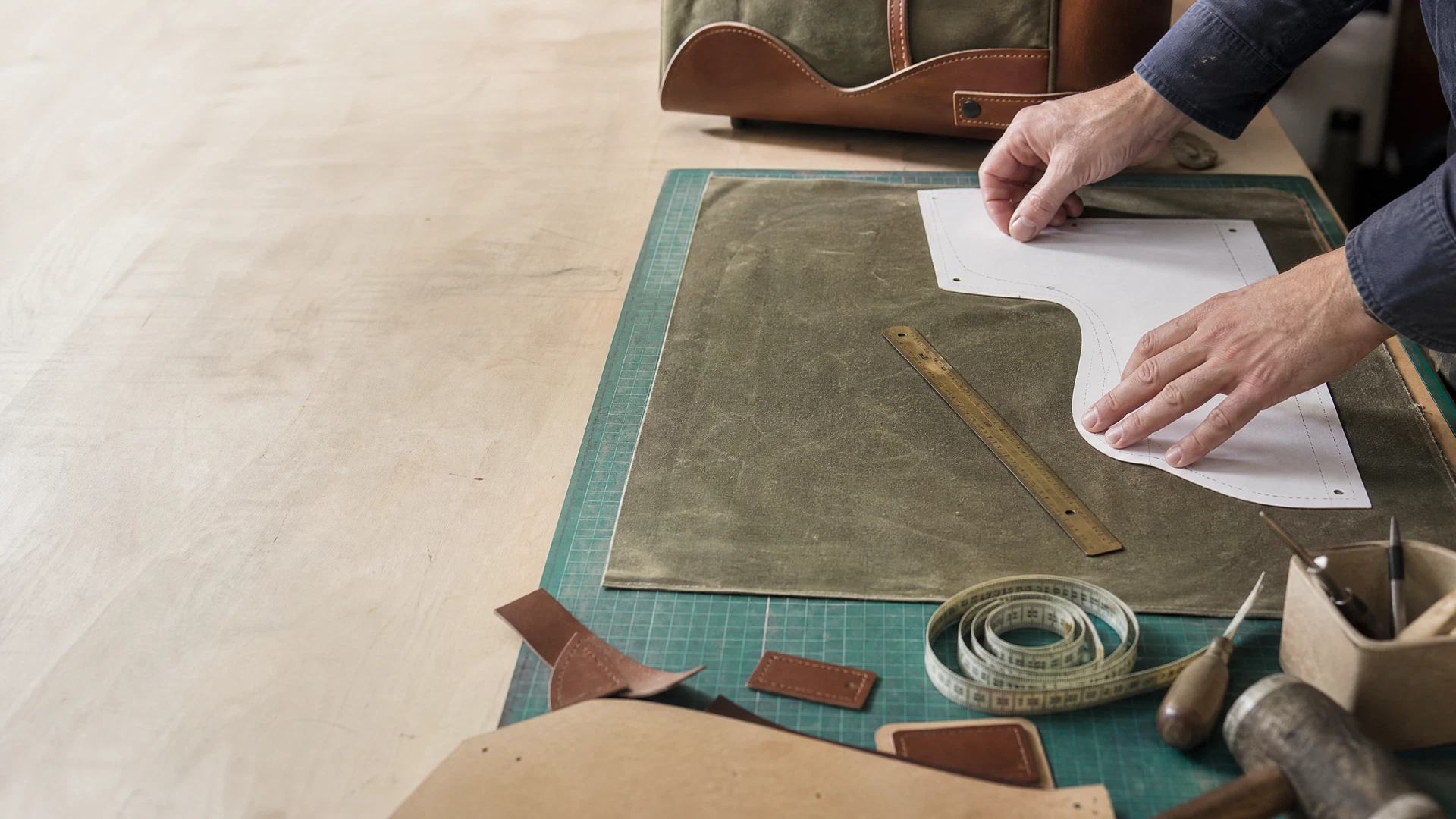
Ask for a specific list of in-house capabilities and request to see the relevant equipment during your factory tour or video call. For waxed canvas and leather constructions specifically, ask whether the factory has experience with saddle stitching, leather skiving, and wax-canvas seam sealing — these are specialized skills that general luggage factories often lack.
5. Evaluate Communication Quality Before You Pay Anything
A manufacturer's communication behavior before you place an order is the most reliable predictor of their communication behavior when problems arise during production. Send a detailed inquiry — specific materials, dimensions, pocket configuration, hardware requirements, target price range — and evaluate the response on three dimensions.
Completeness: Did they answer every question, or did they give a generic capabilities overview? Speed: Did they respond within 24–48 hours, accounting for time zone differences? Problem-solving: Did they identify any potential challenges with your specifications and suggest solutions, or did they simply confirm they can do everything?
A manufacturer who responds quickly, answers specifically, and proactively flags potential issues is demonstrating the operational discipline that will serve you well when a zipper shipment is delayed or a color match needs adjustment. One who takes five days to send a brochure will take five days to respond to a quality complaint.
6. Confirm Certifications Match Your Target Markets
Different markets require different compliance documentation. Selling custom golf bags in the United States, Europe, and Southeast Asia involves distinct regulatory frameworks, and your manufacturer must hold the relevant certifications for your target channels.
| Certification | Relevance | Key Markets |
|---|---|---|
| BSCI | Ethical labor practices and social compliance audit | Europe, UK, Australia |
| ISO 9001 | Quality management system certification | Global |
| REACH | Restricted substances compliance | European Union |
| Prop 65 | California chemical safety | United States (California) |
| GRS | Global Recycled Standard for recycled material claims | Global |
| OEKO-TEX Standard 100 | Harmful substance testing for textiles | Europe, North America |
Request current copies of all relevant certificates — not screenshots, but PDF documents with validity dates and certificate numbers you can verify independently. Certificates expire; a manufacturer who last updated their BSCI audit in 2022 may not reflect current labor practices.
7. Structure the Partnership for Long-Term Success
The most expensive mistake in custom golf bag sourcing is treating every order as a one-time transaction. The brands that achieve consistent quality and competitive pricing over time are those that invest in genuine manufacturing partnerships — sharing forecasts, providing design feedback, and building mutual trust over multiple production cycles.
A well-structured initial partnership agreement should cover four areas. First, confidentiality: your designs, specifications, and customer information should be protected by a signed NDA before you share any proprietary details. Second, defect liability: define what constitutes a defect, what the acceptable defect rate is, and what remedies apply (replacement, credit, or refund). Third, payment terms: industry standard is 30% deposit upon order confirmation and 70% balance before shipment, with payment released against inspection approval. Fourth, exclusivity: if your designs are genuinely proprietary, negotiate design exclusivity for your key markets.
Start with a trial order — typically 300–500 pieces — to validate quality and on-time delivery before scaling. A manufacturer who performs well on a trial order has demonstrated the capability and reliability that justify a long-term commitment. One who struggles with a small run will not improve at volume.
Putting the Checklist to Work
The seven criteria above are not a sequential process — they are parallel filters. A manufacturer who fails on material transparency (Criterion 2) should not advance to communication evaluation (Criterion 5), regardless of how impressive their factory tour appears. Apply each criterion as a gate, not a score.
The golf bag market's growth trajectory — from USD 1.66 billion in 2026 toward USD 3.48 billion by 2033 — creates genuine opportunity for brands that source well. The manufacturers who will help you capture that opportunity are those who welcome scrutiny, provide documentation without prompting, and treat your first order as the beginning of a relationship rather than a transaction.
Links Sports Co. operates a 3,000㎡ dedicated manufacturing facility with 220 skilled craftspeople, in-house design and QC teams, and active certifications across BSCI, ISO 9001, and REACH. We welcome factory tours, pre-production sample requests, and detailed capability discussions. If you are evaluating manufacturers for your next custom golf bag collection, we invite you to apply this checklist to us — and to every other factory on your shortlist.
Links Sports Co. specializes in premium OEM/ODM golf and tennis bag manufacturing for wholesale buyers across North America, Europe, and Asia-Pacific. Request a capability consultation and free sample quote through our contact page.
Share this article