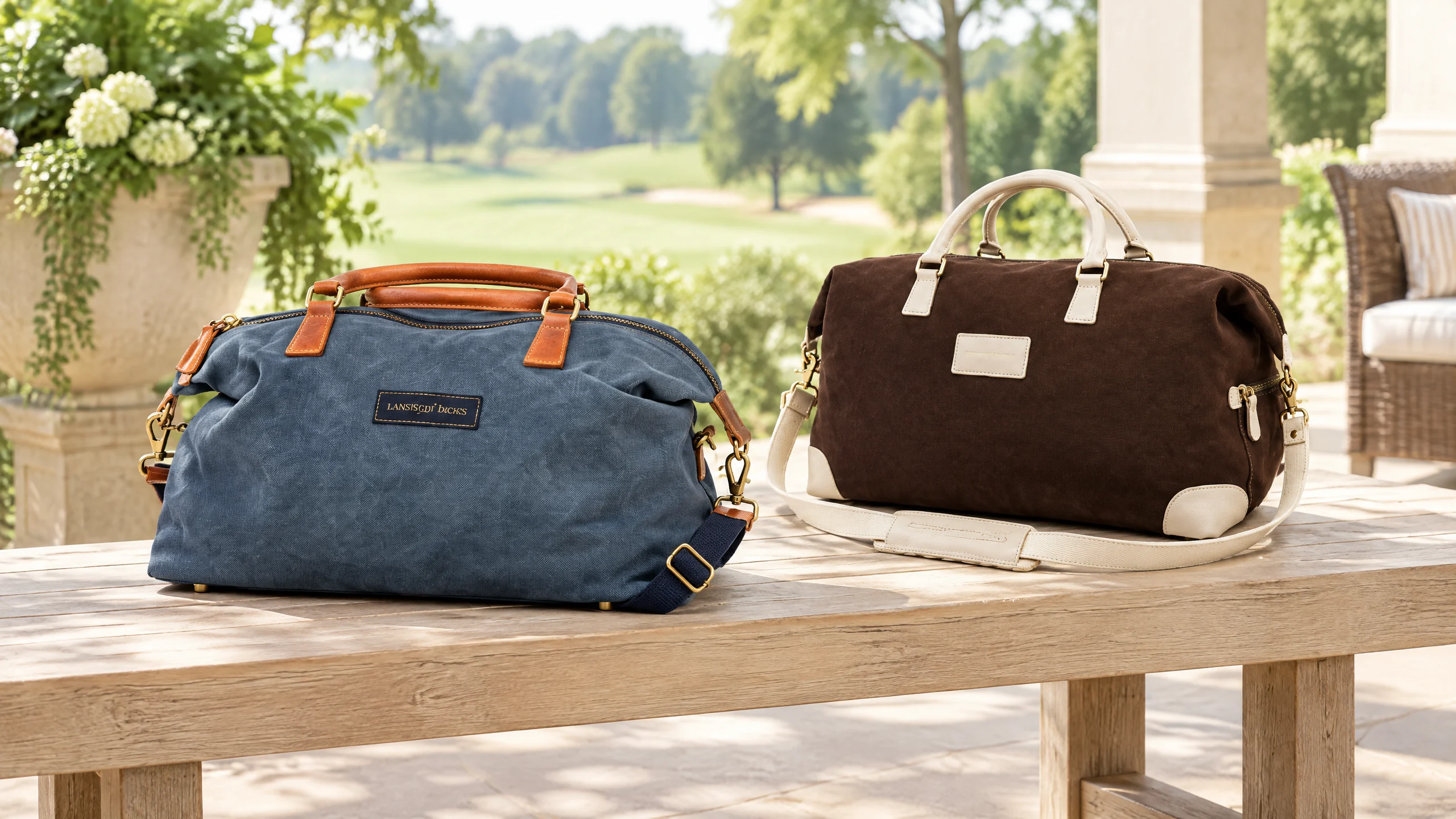
Beyond the Shoe Pocket: How to Design a Golf Duffel Bag for Club Weekends
A golf weekender needs more than a shoe pocket. Compare removable shoe bags, internal compartments and real clothing space before defining your club's custom duffel.
Links Sports Co
Product Specialist & OEM Consultant · Links Sports Co
10+ years in golf & tennis bag manufacturing. Specialises in OEM/ODM custom branding, material sourcing, and B2B wholesale for brands across 30+ countries.
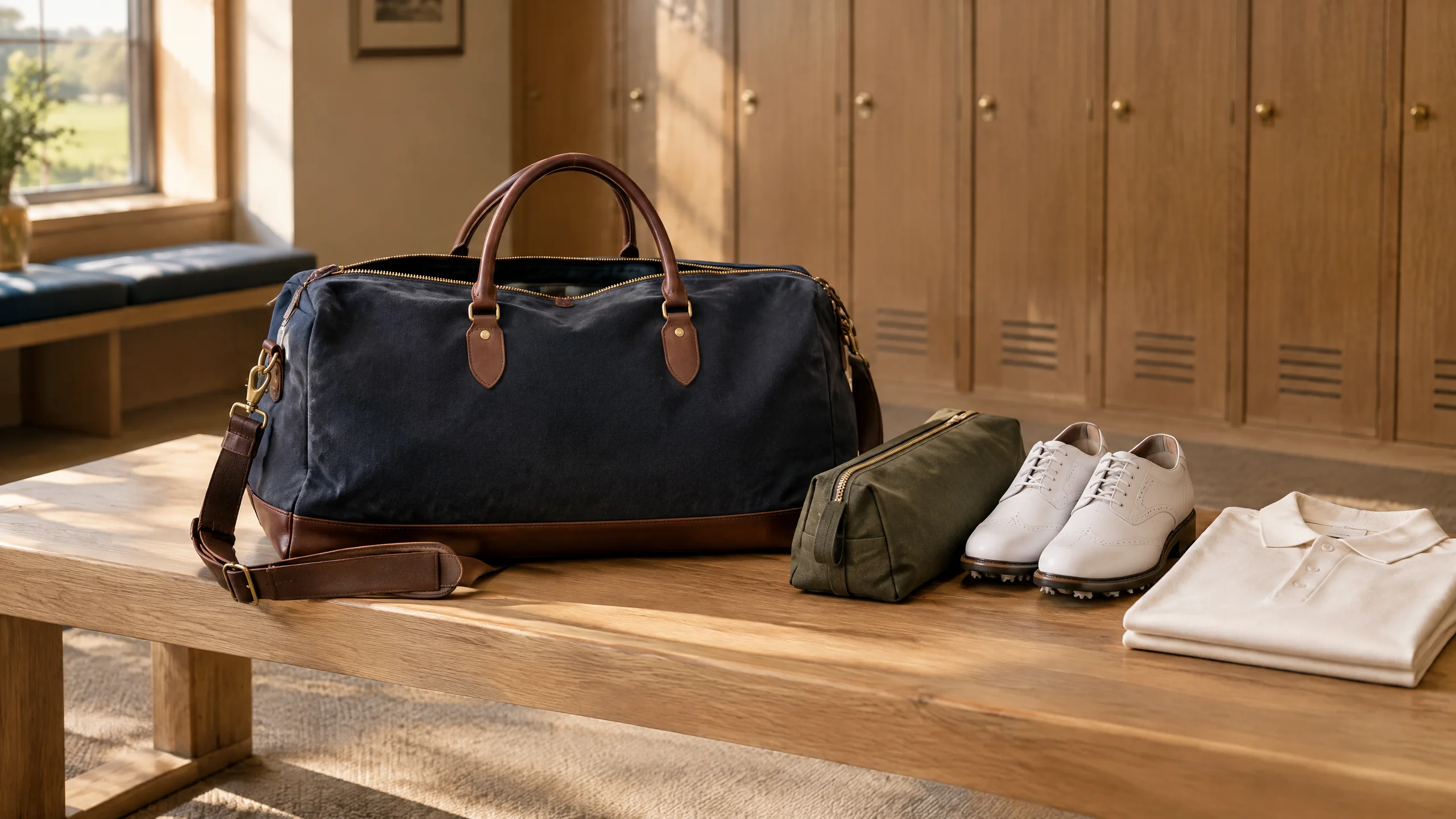
Imagine a hypothetical club weekend: a member arrives on Friday with a change of clothes, golf shoes, trainers and a wash bag. By Sunday afternoon, the clean shirt has been worn, the golf shoes carry grass and grit, and the toiletries still need to sit upright. The same golf duffel bag must now accommodate a different mix of belongings without making the member unpack everything in the clubhouse car park.
For a club buyer, that return journey is a better design starting point than a photograph of a neatly packed bag. A shoe pocket can look convincing when empty. The useful question is what happens when actual shoes, clothing and toiletries all occupy the bag together—and who has to clean the storage area afterwards.
Start with the weekend, not the flight
This is a bag for personal belongings on a short overnight golf trip, not a padded travel cover for transporting a full set of clubs. Its job is to move comfortably between home, car, accommodation and clubhouse, with the contents needed for a round and the time around it.
There is a practical reason to account for more than golf clothing. Myrtle Beach Golf Trips’ packing guide includes extra clothes, golf shoes and footwear for time away from the course. That is one operator’s destination advice, not a rule for every golfer, but it illustrates why a weekend brief should include off-course belongings.
Three shoe-storage layouts, three different compromises
A golf duffel bag with shoe storage does not have to mean a permanently sewn-in pocket. A removable shoe bag, an internal tunnel and a lower compartment can each suit a different club assortment. The tradeoff is not simply “separated” versus “unseparated”: it includes occupied space, access and maintenance.
| Layout | Space and packing consequence | Access and maintenance consequence |
|---|---|---|
| Removable shoe bag | Can be positioned or left behind; still uses room when packed inside | Can be carried and emptied separately; may sit beneath clothing |
| Internal shoe tunnel | Shoes extend into the main cavity and displace clothing | Dedicated access is possible; the fixed tunnel must remain reachable for cleaning |
| Base compartment | Reserves a lower section and may increase overall height | Shoes can be reached without opening the clothing area; the low opening needs usable clearance |
Travel + Leisure’s weekender-bag guide also notes that some shoe sections take room from the main compartment, while bottom compartments can add bulk. Examine the occupied layout, not just the compartment count.
A removable shoe bag: flexible, but not space-free
A separate shoe bag lets members take their shoes to a locker while leaving the duffel elsewhere. It can also be removed for emptying and cleaning according to its care instructions. On a trip without golf shoes, the main bag retains a more flexible cavity.
The limitation is positional. A shoe bag placed at the bottom may require clothing to be lifted before the shoes can be reached. Placed at one end, it can occupy the space intended for toiletries. Its closure and handles add to the packed outline, too.
Define a preferred position and an access sequence rather than relying on members to discover one. If you propose internal retaining points, make them an explicit customization request. A removable bag alone does not make the surrounding duffel waterproof, odorproof or hygienically isolated.
An internal tunnel: dedicated access with displaced volume
An internal tunnel can give shoes their own opening while retaining a conventional exterior silhouette. Once filled, however, the tunnel projects into the clothing space. Packing shirts around an empty fabric tunnel tells you little about the room left when shoes are inside it.
Maintenance deserves equal attention. Ask how the member reaches the tunnel’s far end and removes loose debris. A fixed compartment that is difficult to inspect or empty creates a different ownership task from a removable shoe bag.
A base compartment: clearer stacking, less flexibility
A lower compartment establishes an obvious packing order: shoes below, clothes above. It can suit members who want to reach footwear without disturbing their clothing, provided the bag can be positioned so the lower zip opens fully.
That separation has a cost. An empty lower section may remain reserved space rather than becoming useful clothing room, depending on its construction. Adding height can make the bag feel bulkier beside a locker or under a bench. A divider may also receive pressure from items packed above it.
Specify the intended shape and support of the base, then review it loaded. Do not describe a lower compartment as a waterproof barrier or promise protection from damp shoes unless the construction and supporting evidence justify that claim.
Measure the shoes, not just the bag’s liters
Nominal capacity is a poor substitute for shoe fit. A liter figure does not reveal the dimensions of the opening, the usable length at the base or the height available beneath a divider. Shoe-size labels are not enough either: two shoes carrying the same size marking can have different outsole lengths and upper profiles.
Choose actual footwear representing the club’s intended size range. Record each shoe’s maximum outsole length, width and height, then measure the pair in the orientation you expect members to use. Side-by-side, heel-to-toe and stacked arrangements create different packed shapes. Include any shoe trees, covers or other accessories that belong in the brief.
Translate those measurements into usable internal dimensions and opening requirements. Allow clearance for insertion and removal, but agree that clearance against the physical footwear rather than adding an arbitrary percentage. For removable storage, measure the filled shoe bag’s outside dimensions as well.
A useful requirement reads: “Accommodate this reference pair in the agreed orientation, with the closure fully shut and access maintained when the clothing area is packed.” It is more actionable than “large shoe compartment.”
Define the Sunday pack-out before approving the layout
The outward pack is usually the tidy one. A buyer-defined return pack reveals whether the layout works after the weekend has changed the contents. This should be an agreed review scenario, not a claim that every member packs identically.
Write the scenario in terms of actual items and their condition:
- One pair of worn golf shoes in the selected storage arrangement, with loose grass or grit considered in the cleaning plan.
- The agreed change of clothing, including worn items held in a separate laundry pouch.
- Off-course footwear, either worn for the journey or packed in the position specified by the brief.
- A closed toiletries pouch, plus any outer layer included in the original weekend pack.
- A small item needed at departure, such as keys, reachable without unloading shoes or clothing.
Then define the sequence: pack the shoes after the final round, put away worn clothing, close the bag, retrieve the departure item and carry it to the car. Identify anything that must be removed to complete those steps.
If the brief includes damp belongings, specify their temporary containment and subsequent removal. Do not treat a closed shoe compartment as a drying system. The review should also show how the member empties debris and opens the relevant areas for care after returning home.
Keep toiletries and clean clothing in the discussion
Shoe storage is only useful if the remaining interior still works. Reserve a position for the toiletries pouch and confirm that its filled shape fits through the opening. If upright packing matters, define it; a generic interior pocket does not automatically hold a wash bag securely in that orientation.
A wide main opening can help members see where clothing and shoes meet. Smaller zip or slip pockets can organize loose essentials, but they should not be counted as replacements for the main clothing space. Check whether retrieving an item from a wall pocket becomes difficult when a filled shoe tunnel presses against it.
Review the loaded golf duffle bag with its handles and shoulder strap in use. An end-mounted shoe section and a base section distribute the pack differently. Ask whether the bag tilts, whether its opening remains convenient when set down, and whether removing the shoes changes the way the remaining contents settle. These are review questions, not assumed performance results.
Start with a catalog shape, then define the shoe-storage change
The Heritage Clubhouse Duffle Bag provides a relevant starting point for discussing a wax-canvas and leather-trim appearance, a wide opening, interior zip and slip pockets, and a removable strap. Those listed details do not establish an integrated shoe pocket. Any dedicated shoe section should be treated as a separate development requirement unless confirmed.
For a contrasting catalog reference, the waxed-canvas weekender bag lists a built-in side shoe compartment. Use it to discuss the construction, then confirm shoe fit and remaining clothing space with the agreed sample pack.
For a removable-storage discussion, the Links Canvas Leather Golf Shoe Bag offers a truthful catalog reference for a separate shoe-bag format. Its suitability inside a proposed duffel still depends on the filled dimensions of both products; a matching style is not proof of fit.
For a lower-compartment construction reference, review the Links Travel Canvas Commuter Duffel. Its product description lists a separate bottom compartment; confirm the usable dimensions, opening clearance and fit with the club’s reference footwear before adopting that layout.
Links Sports Co can be approached with these catalog references alongside a clearly defined request for custom material, pocket and layout development. Keep the reference product and the requested change distinct, especially when preparing private-label descriptions for approval.
For a broader comparison of catalog starting points, browse the Travel Bags collection. Treat any chosen style as a construction reference, and confirm the proposed shoe-storage layout in the sample brief.
Turn the choice into a clear club brief
For a custom golf duffel bag for clubs, the most useful brief joins appearance to a specific packing arrangement. State the weekend contents, reference footwear, selected shoe-storage format, usable dimensions, access sequence and care expectations. Distinguish required features from optional alternatives so the design does not accumulate three competing storage solutions.
When comparing OEM canvas golf duffel bag manufacturers, ask how each proposed layout meets that brief—not merely whether a supplier can add a shoe pocket. Material and branding choices still matter, but they should follow a layout that accommodates the agreed weekend pack.
Use the Links Sports Co contact page to discuss those defined customization requirements. For an assortment aimed at members who return home the same day, the clubhouse-to-workday golf tote design guide addresses a different carrying brief. The overnight duffel earns its place by accommodating the belongings that a same-day bag does not need.
Frequently Asked Questions
Q: Is a golf duffel bag the same as a golf travel cover?
No. A golf duffel bag carries personal belongings such as clothing, shoes and toiletries for a short stay. A golf travel cover is intended to carry a golf club bag and clubs. Buyers should define these as separate product briefs rather than expecting one design to serve both purposes.
Q: Which shoe-storage layout is best for a club weekend duffel?
There is no universal best layout. A removable shoe bag offers flexible positioning and separate handling; an internal tunnel takes space from the main cavity; a base compartment reserves a lower section. Choose against the club’s reference footwear, clothing pack, access needs and cleaning expectations, then review the occupied layout.
Q: How should buyers specify shoe-compartment size?
Use actual reference footwear rather than a shoe-size label or the duffel’s nominal capacity. Measure maximum outsole length, width and height, then the pair in its intended packing orientation. Specify usable internal dimensions, opening clearance and closure requirements. Include the filled outer dimensions when a separate shoe bag will sit inside.
Q: Can a catalog duffel be specified with custom shoe storage?
Buyers can request a shoe-storage layout as part of a custom development brief, but should not assume an existing catalog duffel already includes it. Confirm the proposed construction, dimensions, access and care requirements with the supplier. Keep requested features separate from verified product specifications and avoid unsupported waterproof or odor-control claims.
Share this article