What Stays Packed? A Golf Drawstring Valuables Pouch Design Guide
Keys stay packed, markers move out before play, and a removed watch needs separation. Turn a golfer’s routine into a useful drawstring pouch sample brief.
Links Sports Co
Product Specialist & OEM Consultant · Links Sports Co
10+ years in golf & tennis bag manufacturing. Specialises in OEM/ODM custom branding, material sourcing, and B2B wholesale for brands across 30+ countries.
At the locker, the small decisions happen quickly: keys come out of a trouser pocket, a watch might come off, and a ball marker moves somewhere easy to reach. They can all start beside the same open pouch, but they do not need to spend the round together. The useful design question is not simply what goes inside. It is what stays packed, what comes out before play, and what you will want to retrieve when you return.
A golf valuables pouch works best when its opening, closure and internal arrangement follow that routine. For club buyers reviewing samples with Links Sports Co, the right starting point is the journey from locker to golf bag to departure—not a longer list of objects the pouch might hold.
The short answer: design around when you need access
Keep belongings that are not needed during play, such as keys, packed in the pouch. Move a ball marker to an accessible location before the round if you expect to use it. If you choose to remove a watch, keep it separated from keys rather than relying on a lining to prevent contact.
Then judge the golf drawstring pouch at three moments: loading it at the locker, leaving it closed inside a larger bag, and reopening it after the round. An attractive shape matters, but the opening must be usable, the gathered closure must suit the smallest object you intend to leave inside, and the cords must feel comfortable to operate.
| Moment | What happens to the belongings | What to check in the sample |
|---|---|---|
| Before the round | Keys go in; a marker moves to an accessible location; a watch comes off only by choice. | Loading through the lined opening and keeping keys away from the watch. |
| On the course | Keys normally stay packed; the marker is available separately. | How the closed pouch sits inside the chosen larger bag and whether unwanted hardware contact occurs. |
| After the round | Belongings come out before departure. | Opening the cords, finding each item and checking the emptied pouch. |
At the locker: make the first opening count
A pouch that looks generous when spread open can behave differently once its lining and drawstring channel are involved. Test the effective lined opening: the usable entry through both the outer material and the lining, without forcing them apart. Notice whether the lining follows the outer opening or folds inward where your hand needs to pass.
Load the objects in the order a golfer would actually handle them. Put the keys away, move the marker to its chosen accessible location, then place a removed watch in its separate space. This reveals whether the opening supports an ordinary routine or needs repeated adjustment. It also shows whether you can place an item deliberately rather than dropping everything into one shared compartment.
For a watch, measure the whole object in its intended strap position, including the crown and clasp. Case diameter alone does not describe the shape that must pass through the opening or rest inside. Test the sample with the strap fastened, open or folded as it will actually be stored, and do not assume a different strap position will work equally well.
The same principle applies to keys. Use the actual key set rather than a single loose key chosen for an easy demonstration. A ring, key edges and attached pieces can change how the set enters the pouch and where it rests. The aim is to understand handling and contact, not to produce a generic packing list.
Give keys and a removed watch different places
A golf valuables pouch for keys and watches needs a clear separation plan if both will be stored together. A lining changes the surface around the contents; it does not isolate one metal object from another. Keys and a watch placed loose in the same lined compartment can still meet as the pouch moves inside a golf bag.
There are two practical approaches to discuss during sampling. One is a separate watch sleeve placed inside the pouch. The other is a closed inner pocket designed to keep the watch apart from the keys. These are optional custom proposals, not features to assume are present in either reference product. Ask for the proposed arrangement to be shown in the sample before deciding whether it suits the routine.
A sleeve should be tested as part of the complete loading sequence, not in isolation. Check whether it is easy to place and retrieve through the lined opening and whether it stays in the intended position during ordinary handling. For a proposed closed inner pocket, check its opening, fastening and location with the whole watch in its intended strap position.
Do not turn separation into a claim that contact or damage can never occur. Instead, make the arrangement visible and repeatable: keys in one place, the removed watch in another, with neither placement dependent on careful balancing. If the watch stays on the golfer's wrist, this extra arrangement may be unnecessary for that user's routine.
Before play: move the marker out of storage
The pouch can be a useful home for a ball marker between rounds without being its best location during play. At the locker or beside the bag, transfer the marker to a trouser pocket or another familiar, accessible location. That avoids reopening a pouch containing keys each time the marker is needed.
This is a workflow choice, not a claim that every golfer must carry a pouch or a particular marker. The R&A's Rule 14 guidance explains marking a ball's spot when lifting and replacing it. For pouch design, the useful distinction is between storing an item between rounds and accessing it while playing.
If a small object will remain inside, use that actual object in the closure test. Pull the cords as a user normally would, then inspect the puckered closure gap. Gathering fabric is not the same as creating a completely sealed opening. Check the remaining gap from different angles rather than treating a photograph of a tightly gathered top as proof of suitability.
Structured vs flat: judge the pouch inside the larger bag
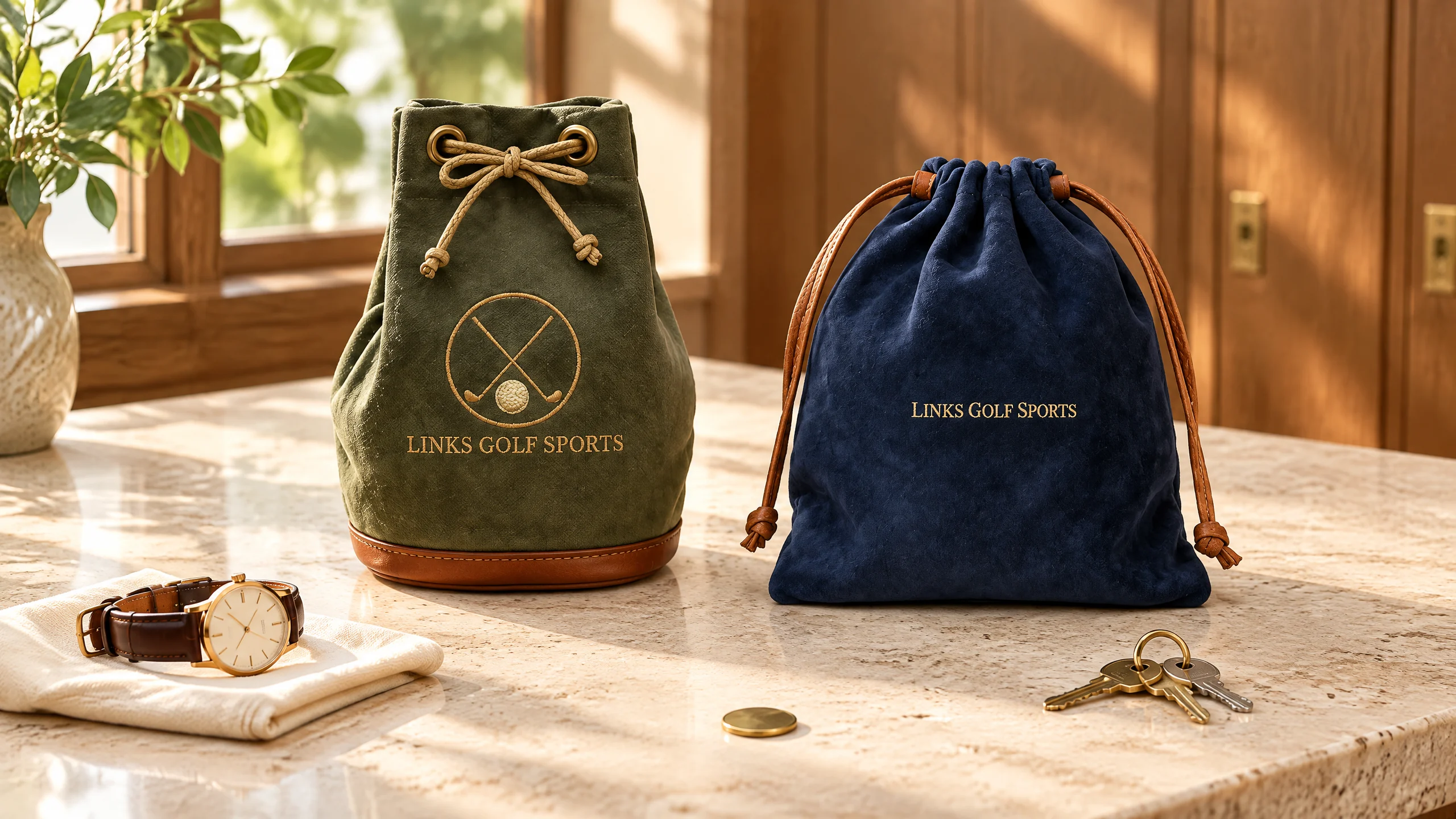
The two reference shapes offer different starting points. The olive canvas-and-leather LA-052 golf valuables pouch has a defined base and metal grommets. The navy LA-070 suede golf valuables pouch has a soft gathered form, tan leather cords and a satin lining. Neither description alone tells you which will suit a particular storage routine.
For a structured vs flat golf valuables pouch comparison, begin with each sample empty. Lay it flat and observe how much shape it retains. Then load the intended belongings and place it inside the actual larger bag or compartment. A defined base may preserve more shape, while a soft gathered bag may settle differently around its contents. Check the result rather than assuming either behaviour is always preferable.
Do not assume a defined base means the pouch will stand steadily wherever it is placed. Contents, nearby bag contents and the supporting surface all affect its position. During sampling, see how it rests on the locker bench and how it behaves in its intended storage location. Its main job may be to stay packed inside a larger bag, not to stand on display.
Handle the drawstrings repeatedly, both open and closed. Notice the feel of the cords, whether the two sides gather evenly, and whether reopening takes an awkward grip. On the grommeted reference, inspect where the metal hardware sits relative to your hand and the stored objects. On the soft gathered reference, check how the folds and cord ends settle. Record any hardware contact instead of assuming it cannot occur.
After the round: retrieval should be uncomplicated
Back at the locker, the pouch should support a simple reversal of the morning routine. Open it, retrieve the keys, take out the watch if one was stored, and check for small objects before leaving. A sample review should include this moment, especially if a proposed inner pocket or separate sleeve adds another place to inspect.
Look at the empty pouch again. Can you see and reach the areas where belongings were placed? Does the lining bunch when items are removed? Can the proposed separation arrangement be checked without turning retrieval into a search? These questions matter more than how neatly a new sample photographs when it has never been used.
Keep care decisions tied to the actual materials and the supplier's instructions. Do not treat canvas, leather, suede or satin lining as evidence of waterproof construction or as permission for a particular cleaning method. Before returning the pouch to the bag, check its condition and follow the care guidance confirmed for that sample.
A sample-fit mini-brief for club buyers
A useful custom golf valuables pouch brief describes actions as well as appearance. Links Sports Co can review a request more meaningfully when the intended routine and the acceptance checks are clear.
For a custom golf valuables pouch for clubs, a concise buyer brief might read:
- Use sequence: loaded at the locker, left closed inside a larger bag during play, reopened before departure. Keys normally remain packed; the marker transfers out before the round.
- Watch arrangement: optional storage for a watch removed by choice. Evaluate a separate sleeve or closed inner pocket as a custom proposal, using the whole watch in its intended strap position.
- Shape comparison: review the defined-base canvas-and-leather reference alongside the soft gathered suede reference, empty and loaded in the intended larger bag.
- Acceptance checks: usable lined opening, puckered closure gap with the actual smallest stored object, drawstring feel, hardware contact and straightforward retrieval.
Send that routine with the reference shape through the Links Sports Co contact page. Ask for the sample to demonstrate any proposed separation feature explicitly. This golf drawstring valuables pouch design guide is a starting framework; the decision should come from handling the sample as it will be used, from the first locker visit to the final check before departure.
Frequently Asked Questions
Q: Should keys stay in a golf valuables pouch during the round?
Normally, yes. Keys are generally needed again at departure rather than during play. Pack them before the round and keep them separate from a watch if one is also stored. Test the actual key set when reviewing the opening and internal arrangement.
Q: Should a ball marker stay inside the pouch on the course?
If you expect to use it, transfer it to an accessible location before play. The pouch can remain its storage place between rounds. If a small object stays packed, inspect the gathered closure gap with that actual object rather than assuming the opening closes completely.
Q: Does a lining separate a watch from keys?
No. A lining surrounds the contents but does not divide loose objects. A separate sleeve or closed inner pocket can be proposed during custom development. Neither should be assumed to be included in the two reference products.
Q: How should I compare the defined-base and soft gathered shapes?
Try both empty, then loaded inside the larger bag you intend to use. Check the effective lined opening, cord handling, remaining closure gap and hardware contact. Include retrieval after use, and do not assume a defined base will always stand steadily.
Share this article