Open-Top, Clear Purpose: Designing a Custom Canvas Golf Shag Bag
An open-top shag bag is a practice-ball container, not a collector. Explore rim depth, handle clearance, base support and lining choices for custom designs.
Links Sports Co
Product Specialist & OEM Consultant · Links Sports Co
10+ years in golf & tennis bag manufacturing. Specialises in OEM/ODM custom branding, material sourcing, and B2B wholesale for brands across 30+ countries.
A practice bag earns its place through small, repeated actions: set it down, find a ball, reach inside, and move to the next spot. An open top makes those actions immediate. It also leaves the contents exposed, which means the design should be judged by its intended use rather than by expectations borrowed from closed luggage.
For a custom canvas shag bag, the useful starting point is not a decorative detail. It is the relationship between the opening, the hand, the handle, and the ground. A generous mouth can improve access while making retention less forgiving. A firmer base can help the bag settle while making empty storage less compact. Each choice changes how the object behaves.
Use the intended practice routine as the starting brief when discussing custom development with Links Sports Co. Canvas and leather can establish the visual character, but the structure must support a clear purpose: an accessible container for balls during permitted local practice and short-distance carrying.
What Is an Open-Top Canvas Golf Shag Bag For?
An open top canvas golf shag bag is a hand-access container for holding practice balls where practice is permitted and carrying them over short distances. It is not a sealed vehicle-shipping container or a mechanical pickup device. Its value is easy access; its limitation is that an uncovered opening cannot provide closed-container retention.
The same object may be described as a golf ball bucket bag or a canvas golf ball bag. Whatever the term, explain the routine: whether the bag stays beside the player or moves between nearby positions, and how the hand approaches the opening.
Start with the Opening: Wider and Shallower, or Deeper?
A wider, shallower form brings more of the interior into view. The hand has less distance to travel, and reaching near the base may feel less constrained. For a bag that spends much of its time resting beside a permitted practice area, that directness can be appealing.
The trade-off is exposure. A lower rim gives the contents less containment when the bag tilts or is carried unevenly. A wider footprint also needs consideration wherever the bag will be placed. Easy access should not be confused with resistance to spills.
A deeper form raises the rim around the contents. That may suit someone who frequently moves between nearby positions, but depth alone does not make an open bag secure. Balls can still leave through the opening if the bag tips. Reaching to the bottom also becomes more demanding, particularly when the handle occupies the path of the hand.
The decision is therefore about priorities, not a universally better silhouette. Prefer a more open, shallow arrangement when visibility and stationary access lead the brief. Consider a deeper rim when surrounding containment matters more, while acknowledging the remaining exposure and the longer reach.
Handle Architecture Is Part of the Access Design
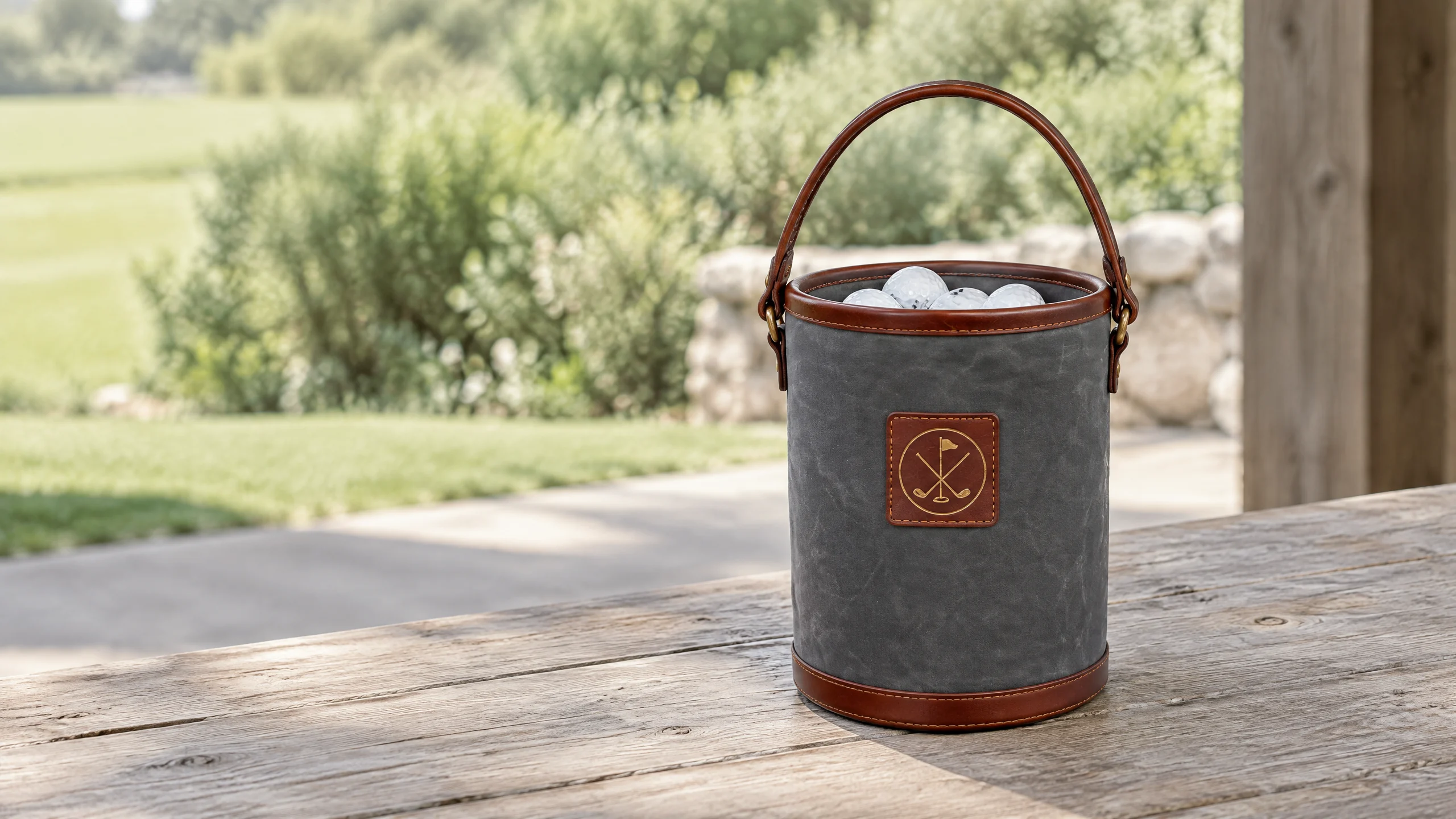
A fixed arch handle gives the bag a recognizable carrying gesture. Leather can provide a visual contrast against canvas and make the handle a prominent part of the silhouette. Yet an arch across the opening also occupies space through which the user must reach.
Consider the hand path from both sides of the arch, the grip, and the handle attachments. A pleasing profile is not enough if retrieving each ball requires an awkward reach.
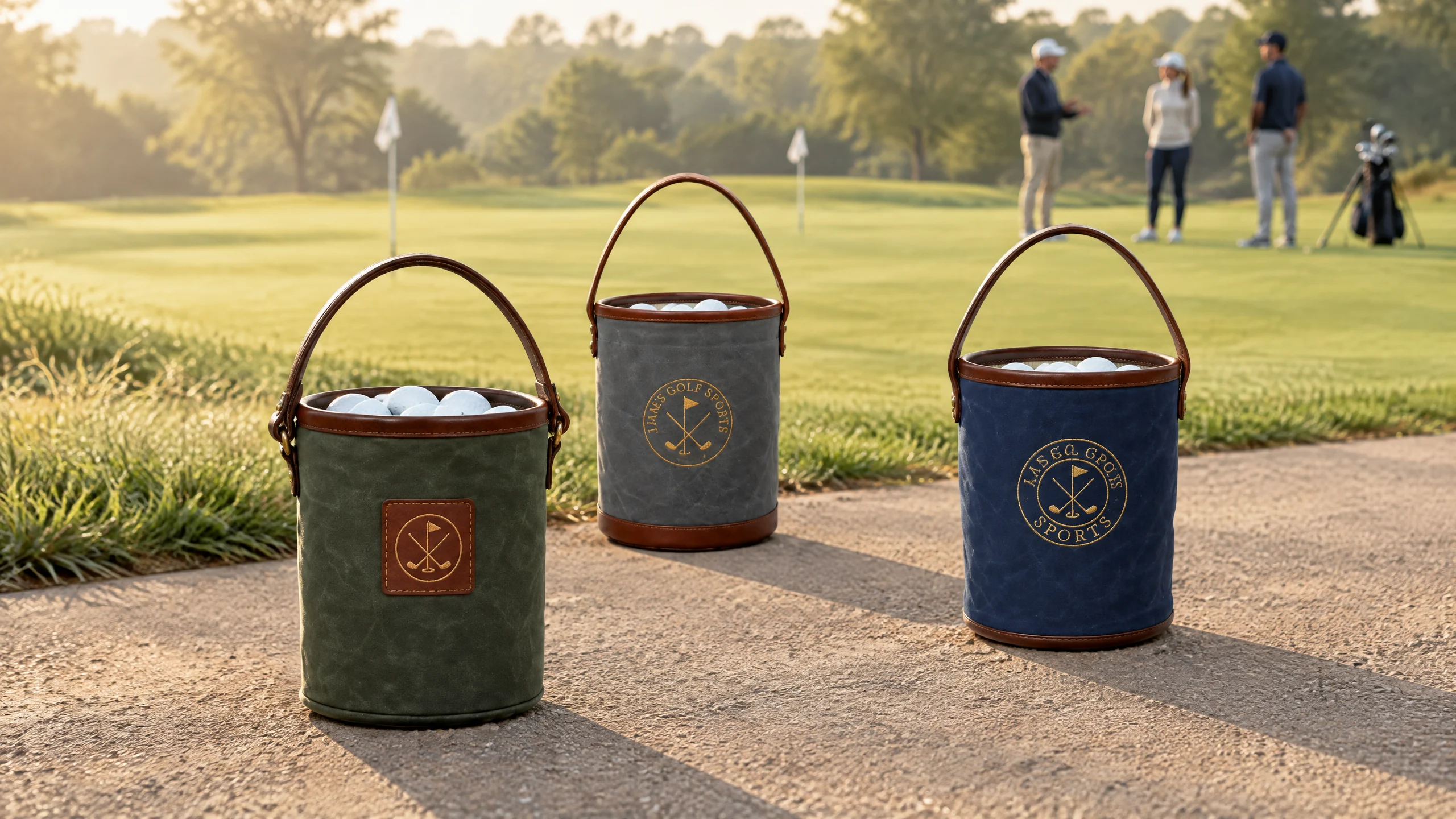
For visual reference, the current Heritage canvas and leather shag bag and waxed canvas golf shag bag provide useful starting points for a conversation about canvas-and-leather styling. They should not be treated as proof that every proposed structural option is already available.
A handle that can be moved aside is a development possibility, not an assumed catalog feature. A flexible handle arrangement or a repositionable attachment might clear the mouth during practice, but would also introduce decisions about connection strength, control during carrying, and where the handle rests. Any movement must avoid trapping fingers or obstructing the opening in a different position.
For a canvas golf ball bucket with leather handle, specify both the carrying position and the access position. If a fixed arch is preferred, prioritize usable clearance rather than introducing complexity simply to make the handle move.
Give the Rim a Defined Job
The rim is the transition between a flexible textile body and an opening that needs to remain usable. A softer edge may allow the bag to compress more readily when empty. It may also fold inward, narrowing the opening or making the hand push fabric aside.
A more defined rim can preserve a clearer entry and reinforce the bucket-like form. That definition can come from construction choices considered during development; it should not be described as a hidden rigid component unless such a component is actually specified.
State how much shape the mouth must retain. Links Sports Co can use that requirement to guide a custom canvas golf shag bag design discussion. Consider comfortable seams and edges alongside shape; a firmer appearance is not automatically better.
Balance Base Support with Empty Storage
The base influences how the bag settles on the ground and how its shape changes when lifted. Greater support may help distribute the contents and reduce sagging, but it does not guarantee that an open container will remain upright on uneven or sloping ground.
Less structured construction may be easier to flatten or fold when the bag is empty. In return, the user may need to arrange the body before setting it down. That can be acceptable for an occasional practice bag and frustrating for someone who wants immediate, repeatable placement.
Do not promise both a defined base and completely flat packing. Compact empty storage likewise does not establish a freestanding shape.
If separate base support is proposed, its construction, positioning, and effect on care remain development questions. Do not assume an existing removable insert. The brief should first state the desired behavior, then allow the supplier to propose a compatible construction.
Interior Visibility: Light and Dark Liners
A lining changes the visual experience of looking into the bag. A lighter interior may make shadows and debris easier to notice, although pale balls may have less contrast against it. A darker interior can provide stronger contrast with pale balls, while making some dirt or small objects harder to see in subdued light.
Consider the usual balls, available light, and viewing angle. Shadows from the rim and handle matter alongside lining color.
A separate or removable liner could be discussed as an optional development direction. It is not a feature to claim for an existing product without confirmation. Such a proposal raises questions about attachment, bunching, drying, and whether the liner remains clear of the hand path. It would also need its own care instructions.
Match the Design Choice to the Practice Routine
| Use case | Design direction to consider | Trade-off to acknowledge |
|---|---|---|
| Bag stays beside the player | Wider, shallower opening | Less surrounding containment |
| Frequent short-distance moves | Deeper rim with clear hand access | Longer reach; opening remains exposed |
| Repeated access from above | Fixed arch with deliberate clearance | Handle still occupies the mouth |
| Compact storage when empty | More flexible rim and body | Less retained shape when set down |
| Clear view of pale balls | Darker lining considered in actual light | Some debris may be harder to see |
These are starting directions, not confirmed product configurations. The final combination should serve the same routine rather than assemble unrelated desirable features.
A Hypothetical Practice Routine
Imagine Maya, a club member who practices short chips alone in a designated area where that activity is permitted. She carries her canvas golf ball bag from a nearby storage point, sets it beside her, and reaches into it between shots. Afterward, she gathers the balls by hand and carries the bag back.
For Maya, a relatively open, shallow shape could suit the frequent reach better than a deeper form. A fixed arch might remain appropriate if she can approach comfortably around it. Because the bag stays beside her during practice, preserving an accessible mouth could take priority over compact empty storage.
This is a hypothetical example, not a customer account or a claim about an existing model. If Maya instead walked farther between practice positions, the brief would need to reconsider the rim and carrying behavior. The open top would still not become a closed transport system.
Design Decision: Preserve Access Before Adding Movement
For an access-led brief, a sensible initial decision is to retain a fixed arch handle with deliberate hand clearance and a sufficiently defined rim. This keeps the carrying action understandable while addressing the opening directly.
Develop handle movement if the required hand path cannot be accommodated by a fixed arch. Otherwise, movement adds attachment and positioning questions without necessarily improving access.
This is a proposed design direction rather than a declaration of current product construction. Links Sports Co should confirm the feasible combination before it becomes an order specification.
A Concise Buyer Brief
A useful brief might read: “We need an open-top canvas shag bag for permitted local practice and short-distance hand carrying. Prioritize easy access around a leather handle, a mouth that remains clear while resting, and enough base definition for our usual placement surface. Discuss interior contrast and explain the compromise between shape retention and empty storage.”
Add whether access or carrying dominates the routine, and describe how the bag will be stored. Identify any movable handle, separate base support, or removable liner as a proposal requiring development confirmation, not an included feature.
Bring that brief to Links Sports Co alongside the relevant product reference. It gives the supplier a practical problem to resolve without confusing visual inspiration with an agreed construction.
Care Belongs to the Confirmed Construction
Request supplier-specific care instructions for the outer canvas, leather parts, and lining. These materials may require different treatment, and the instructions should address the finished bag rather than canvas in isolation.
Do not assume machine washing is appropriate or transfer a heating or re-waxing routine from another type of product. A proposed removable liner would need separately confirmed cleaning and drying guidance; removability alone would not establish how it should be washed.
Before storage, follow the supplier’s guidance for removing loose debris, dealing with moisture, and drying the complete bag. An open top is useful for access, but it is not protection from rain or a substitute for suitable storage.
Frequently Asked Questions
Q: Is an open-top canvas shag bag suitable for transporting balls in a vehicle?
It is not a sealed vehicle-shipping container. Its intended role here is permitted local practice and short-distance hand carrying. Use a suitable closed transport solution when retention during vehicle travel is required.
Q: Does a deeper rim make the bag spill-proof?
No. A deeper rim provides more surrounding containment, but the opening remains exposed. Tilting or tipping can still release the contents, and additional depth can make reaching less convenient.
Q: Can a custom design include a movable leather handle or removable liner?
Those can be proposed for development, subject to supplier confirmation. Neither should be assumed to exist on the referenced products. Handle clearance, attachments, liner positioning, and care all need resolution.
Q: How should the canvas, leather, and lining be cleaned?
Follow the supplier-specific instructions for each part of the confirmed construction. Do not assume shared cleaning methods, machine washing, or a particular heating or re-waxing routine is appropriate.
Share this article