From Sketch to Shipment: How a US Golf Club Designed Their Custom Bag in 6 Weeks
A private club in the American Southeast needed 150 custom stand bags for their centennial season — with their crest embroidered, their colours matched exactly, and a six-week window before the member event. Here is the complete timeline of how we made it happen.
Links Sports Co
Product Specialist & OEM Consultant · Links Sports Co
10+ years in golf & tennis bag manufacturing. Specialises in OEM/ODM custom branding, material sourcing, and B2B wholesale for brands across 30+ countries.
The Brief
In early spring, we received an enquiry from the general manager of a private golf club in the American Southeast. The club was approaching its centennial season and wanted to mark the occasion with a limited run of custom stand bags — one for each of their 150 full members. The bags needed to carry the club crest in embroidered form, match their official colours (a specific navy and a warm cream), and arrive in time for the member appreciation event six weeks away.
Six weeks is tight for a custom OEM order. The standard timeline for a new custom bag — from approved specification to delivered goods — runs eight to ten weeks when sampling, revision, and ocean freight are factored in. We agreed to take the project on the condition that the club could commit to a 48-hour turnaround on all approval stages. They agreed. What followed is a useful illustration of how a well-managed custom order actually works.
Week 1: Specification and Design Lock
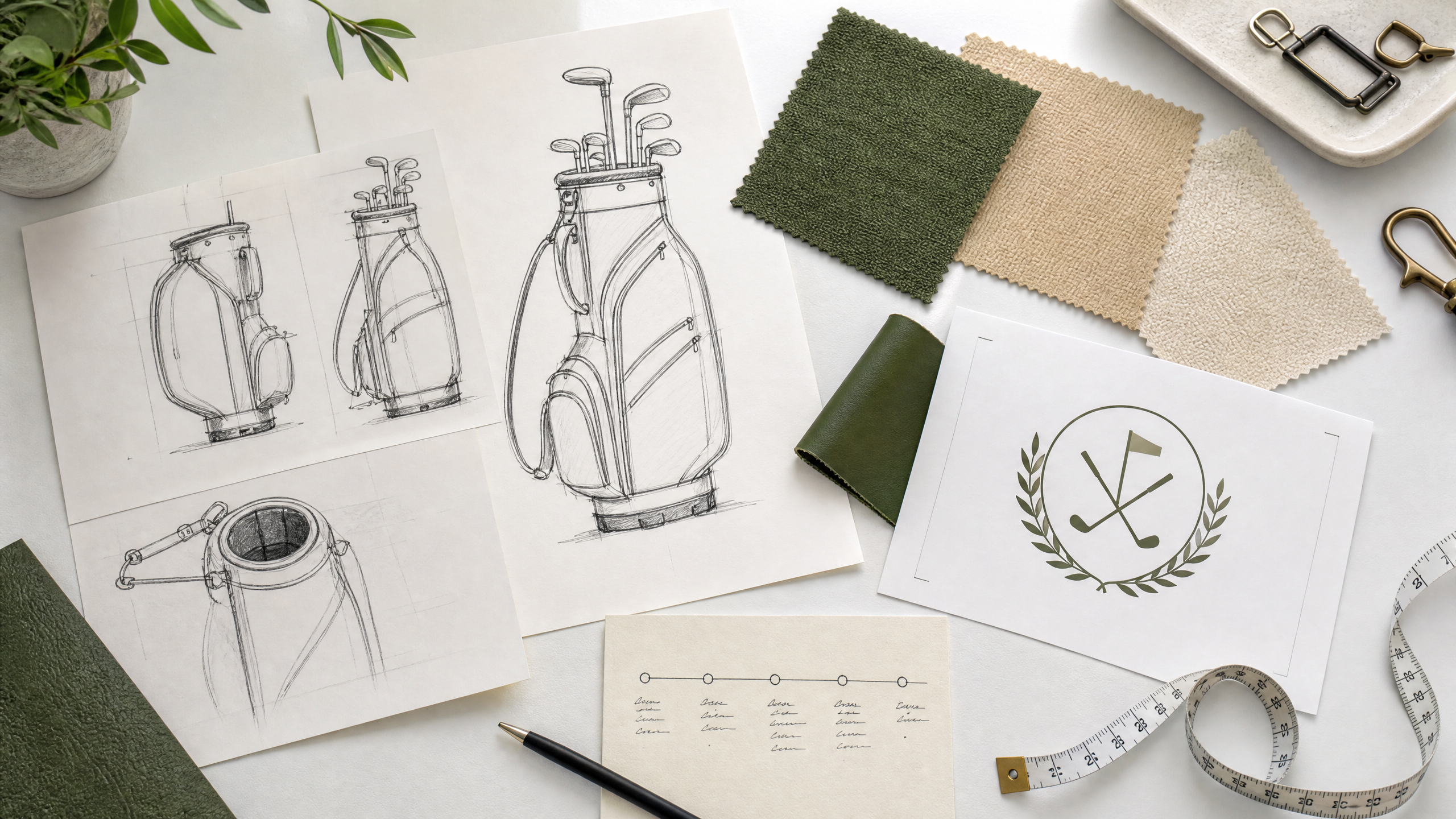
The first task was translating the club brief into a production specification. The club logo existed only as a low-resolution file used for printed materials — not suitable for embroidery digitisation. We requested the original vector artwork and received it within 24 hours. Our embroidery team digitised the crest at 45,000 stitches, which gives sufficient detail for the club crossed-club motif and wreath border at the intended badge size of 85mm x 90mm.
Colour matching required a physical swatch exchange. The club official navy was close to Pantone 289 C but not identical — their historical records referenced a custom mix used on their original clubhouse signage. We produced three fabric samples at slightly different dye concentrations and shipped them via express courier. The club confirmed their preferred swatch within two days.
By the end of Week 1, we had a locked specification: a 14-way stand bag in 900D polyester with wax canvas accent panels, navy body with cream trim, embroidered crest on the front pocket, and the club founding year embossed on the base plate.
Week 2: Sampling
With the specification locked, our sampling team produced a single pre-production sample. This is not a prototype — it is built using the actual production materials, hardware, and construction methods that will be used for the full run. The purpose is to identify any discrepancies between the specification document and the physical result before 150 units are cut.
The sample was completed in four working days and shipped via express freight. The club received it on Day 10 of the project. Their feedback arrived within 24 hours: the embroidery thread colour on the crest border was slightly warm against the navy body — they requested a cooler white. The stand leg mechanism was approved without comment. The pocket layout was approved. One revision, clearly specified.
Week 3: Revised Sample and Production Approval
The revised sample — with the corrected embroidery thread — was completed in two working days and shipped immediately. The club approved it on Day 17. Production approval was issued the same day.
At this point, the project entered the production queue. The full run of 150 units was scheduled across five working days of cutting and assembly, with embroidery running in parallel on a dedicated machine to avoid bottlenecking the main assembly line.
Weeks 4 and 5: Production and Quality Control
Production ran from Day 18 to Day 28. Our QC process on a custom order of this type involves three inspection points: a fabric and hardware check before cutting begins, an in-line check at the assembly stage covering stitching density and pocket alignment, and a final inspection of every completed unit before packing.
Of the 150 units produced, four were flagged at final inspection — two for minor embroidery misalignment outside our tolerance, two for a slight colour variation in the accent panels from a different fabric roll. All four were remade within the production window. The club received 150 units, all within specification.
Week 6: Shipping and Delivery
The completed order was packed in individual poly bags and master-cartonned on Day 29. We used express air freight rather than ocean freight to meet the deadline — a cost the club had pre-approved as part of the project budget. The shipment arrived at the club receiving dock on Day 38, four days before the member event.
What Made This Timeline Possible
Six weeks is achievable for a custom order, but it requires specific conditions. The buyer must be able to make decisions quickly — 24 to 48 hours at each approval stage, not a week. The specification must be locked before sampling begins, not revised during it. And the manufacturer must have the capacity to prioritise the order within their production schedule.
We are transparent with buyers about what is and is not achievable within a given timeline. For orders where the timeline is genuinely tight, we build in explicit decision windows and communicate clearly when those windows are missed and what the impact will be. The centennial project worked because both sides held to the agreed schedule. That is the actual product we deliver — not just the bag.
Share this article