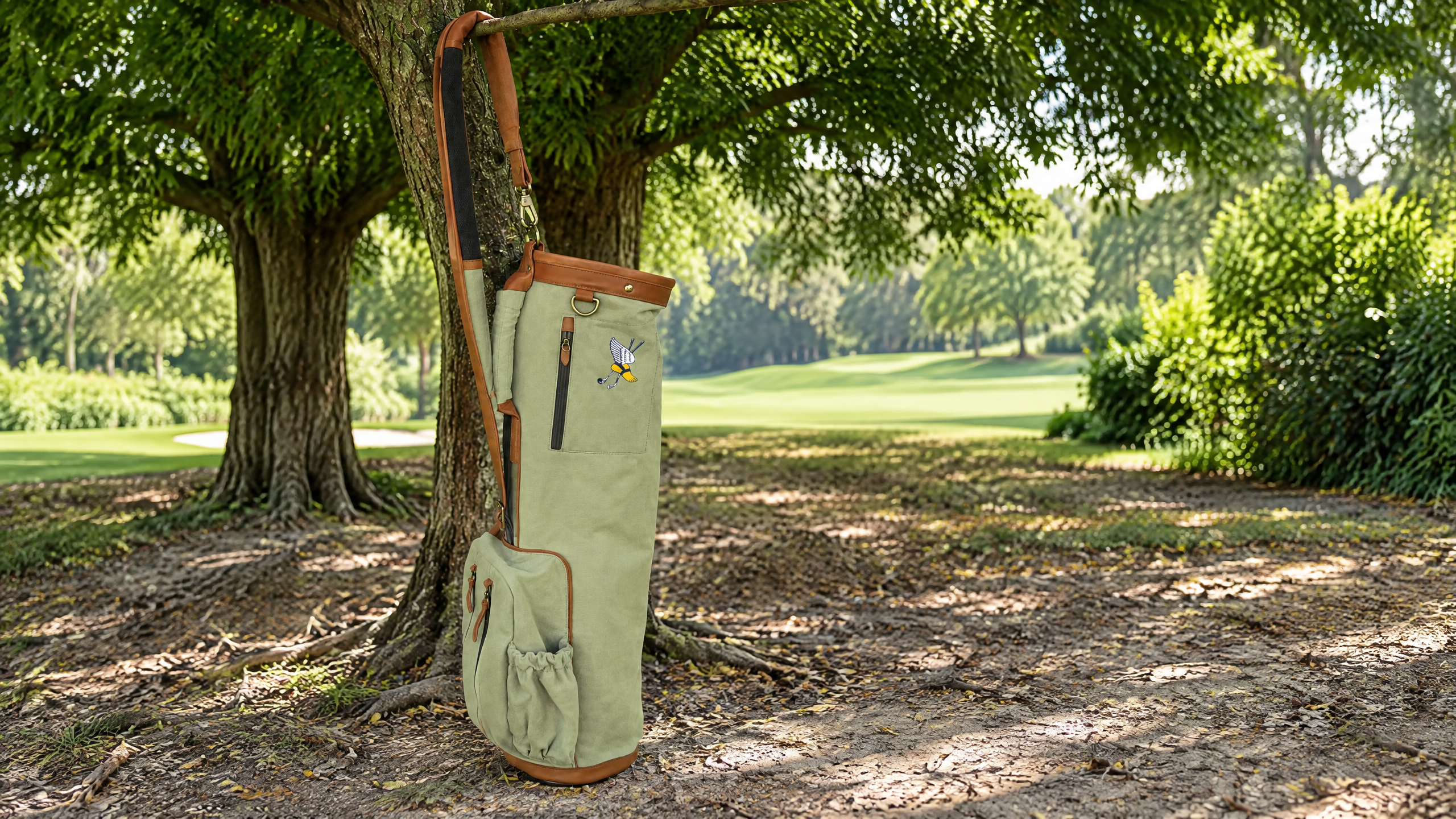
The Bag-Drop Test: How Clubs Should Specify Custom Golf Bags for Storage, Carts and Member Handover
A practical club-operations guide for specifying custom golf bags around bag drop, storage, cart handover and member service—not just product appearance.
Links Sports Co
Product Specialist & OEM Consultant · Links Sports Co
10+ years in golf & tennis bag manufacturing. Specialises in OEM/ODM custom branding, material sourcing, and B2B wholesale for brands across 30+ countries.

A custom golf bag is not only a player’s carry item. At a busy club, it moves through a bag drop, cart barn, storage bay, starter area and clubhouse handover—often before the golfer picks it up. The Bag-Drop Test is a planning method for country clubs, resorts and private-label buyers who want the custom bag specification to work across that full operational journey.
Most golf bag briefs begin with colour, logo and pocket count. Those details matter, but they do not answer what happens when several bags arrive at once, when staff need to identify a member’s bag quickly, when rainwater reaches the cart-barn threshold, or when a guest picks up a bag for the first time. A more useful brief starts with the handover workflow.
This is a practical custom golf bag operations guide for clubs that want their golf bags to support member service as well as on-course use.
Start at the bag drop, not at the product photo
A product photo shows one bag in a controlled scene. A bag-drop team sees several bags, different carry straps, different member identifiers, wet wheels, club covers, valuables pockets and a queue that needs to keep moving.
The specification changes when that operational view becomes the starting point. A club buyer can ask:
- How will a staff member pick up the bag when it is loaded?
- What visual cues help identify the correct bag without placing large names across the entire body?
- Where will the bag stand while it waits for a cart?
- Which exterior pockets must stay closed or protected during handling?
- Does the base suit the storage surface and the way the club normally stages bags?
- What should look consistent when several member or guest bags are visible together?
These questions are not about creating more features. They are about giving each feature a reason to exist. A premium custom bag should feel deliberate in the hand of a golfer and in the hand of the staff member responsible for the next stage of the guest experience.
The Bag-Drop Test: trace the bag through five moments
A club does not need an elaborate process map. It needs a short walk-through using the real places and people involved in a typical round. Review the proposed golf bag across the following five moments before approving a final construction.
1. Arrival: first handle, first impression
At arrival, the top handle and carry strap are often the first contact points. The bag may be lifted from a vehicle, placed on a cart path or carried a short distance. Ask the team to use the proposed sample with a representative club load.
Look for practical observations:
- Is the main handle clearly positioned and comfortable to locate without searching around the top opening?
- Do shoulder-strap ends or loose webbing create visual clutter when the bag is moved by a staff member?
- Is the club crest or private-label identity visible enough to be recognisable, but restrained enough for a premium arrival experience?
- Does the bag remain composed when it is set upright beside another bag?
The purpose is not to make a universal handling claim. It is to define the club’s preferred arrival routine and to see whether the sample supports it.
2. Staging: where the bag waits matters
A bag may wait near a cart area, in a storage bay, on a rack or just inside a clubhouse entrance. The storage environment can be dry and polished, or it can have changing weather, hard flooring and limited space. In these environments, bulky bags need organisation, security, visual order and practical proximity to carts.
For the custom bag brief, translate those operational realities into a few clear decisions.
| Staging question | Specification decision to discuss |
|---|---|
| How close will bags sit together? | Avoid protruding decorative elements that snag or make a group of bags look disorderly. |
| What surface will the base touch? | Review base material and shape on the relevant floor, turf edge or cart-barn surface. |
| Does the club use labels or tag systems? | Leave a considered location for a discreet temporary identifier rather than covering the main club mark. |
| Are bags stored near outdoor thresholds? | Discuss material choices, pocket closures and the specific environment rather than assuming a generic weather claim. |
| Who retrieves the bag? | Prioritise obvious lift points and a clean silhouette from the back and side. |
A custom golf bag for country clubs should not be over-designed for storage. It should simply avoid making day-to-day staging unnecessarily difficult.
3. Cart handover: visual order meets access
The cart is a working part of the club experience. When a bag is placed on it, the buyer should confirm what happens to the important pockets, logo placement and strap arrangement.
Mount the sample on the cart or trolley style the club actually uses. Secure it as staff normally would. Then test a simple sequence: retrieve a ball, access the valuables pocket, take out a water bottle, replace an item and remove the bag.
This is where a subtle construction point can become important. A pocket may be attractive in a sketch but awkward once a cart strap crosses it. A logo may sit well on a standing bag but disappear when the bag is mounted. A practical golf cart bag specification should assess these conditions before the buyer treats the sample as final.
If the programme uses multiple formats—perhaps a walking bag, a cart-oriented bag and a guest bag—keep the club identity coordinated but test each format in its own setting. Uniform branding does not require identical pocket layouts.
4. Handover: the member should recognise a considered system
At the moment of handover, the bag becomes part of the club’s hospitality language. A staff member may present it to a member, welcome a guest to a resort round or return it to a storage position after play. The strongest club merchandise reflects a real, distinctive identity instead of treating every player as the same customer.
For a golf bag, identity can be expressed through a shared material palette, a quietly positioned crest, a liner colour, a leather or leather-look trim direction, a hardware finish or a restrained woven label. The club does not need all of them. Two or three connected decisions are usually clearer than many competing custom details.
This is also where Links Sports Co custom golf bags can be developed as a system rather than a blank item with a late-stage logo. The custom-development brief can cover use context, material direction, logo location and handling priorities in the same conversation.
5. Return and reset: make the next round easier
After a round, a bag may arrive with damp accessories, extra items in pockets and a strap that has been adjusted. The club’s reset process is not glamorous, but it can reveal whether the bag is easy to return to its standard presentation.
Observe the simple actions: stand the bag, close the intended pockets, straighten the strap and place it in the normal position. If the result looks orderly without special effort, the bag is more likely to support a consistent operation. If it requires several adjustments every time, make a note for the next sample revision.
Design the identity system for a group of bags, not one hero sample
A single sample can look excellent on a table. A club should also imagine how ten or twenty bags will look in a line near carts, in a retail display or at a member event. Group visibility changes the design decision.
A few practical principles help.
Use one dominant body tone. A deep green, navy, charcoal, stone or warm neutral can make a row of bags feel calm and intentional. Secondary colours should frame the design rather than divide it into many unrelated parts.
Place the crest where it can be recognised in the likely handover view. This might be the front panel, upper side panel or a restrained patch. Test it beside a cart and in the storage position, not only when the bag is facing a camera.
Keep temporary identification separate from permanent identity. If the club uses bag tags, name cards or event markers, provide a clear, discreet place for them. Avoid allowing daily logistics to cover the approved crest or distort the bag’s visual hierarchy.
Let the material plan do some of the branding work. A colour relationship between canvas, trim, webbing and hardware often gives a premium club bag more character than a very large logo.
A buyer brief for bag-drop-ready custom golf bags
Before requesting a sample or quotation, the buyer can send a short brief built around operations as well as aesthetics.
| Brief input | What to explain |
|---|---|
| Club use case | Member storage, guest rounds, resort programme, pro-shop retail, caddie service or a mix of these. |
| Handling journey | Where the bag arrives, waits, mounts, returns and is stored. |
| Primary user | Member, guest, rental programme, staff or event participant. |
| Existing carts or trolleys | The model or a photo of the typical mounting setup. |
| Identity direction | Approved crest, colour references and the preferred level of visual restraint. |
| Non-negotiable functions | The pockets, handles, strap behaviour or club capacity that must be reviewed on the sample. |
| Decision owner | One person who consolidates comments before the revision list is sent. |
A clear brief does not lock a club into every answer on day one. It gives the development team a practical frame for proposing options. For example, if storage order and quick handover are priorities, the sample review can focus on handle placement, back-panel clarity and exterior-pockets rather than adding decorative elements that are not useful.
For broader product directions, browse the Links Sports Co custom golf bag collection and use the selected silhouette as a starting point for the club’s own handling journey.
A sample review that staff can join
Club buyers often invite only the merchandise or marketing team to review a custom bag. Including one person from bag drop, cart operations or guest services can add useful perspective without making the process complicated.
Run a short review beside the relevant operating area. Ask one staff member to handle the loaded sample as they would during a normal shift. Ask a golf professional or retail manager to review the identity and player-facing details. Ask the final decision owner to capture only three types of notes:
- Approve: the detail supports the agreed workflow and identity.
- Revise: the detail interrupts access, handling or the stated visual goal.
- Later option: the idea may suit a future edition but is not necessary for the current production release.
This keeps the feedback usable. A factory can respond to a clear request such as “move the lift handle 20 mm to avoid covering the crest zone” more easily than “make it easier for staff.”
The bag that works before tee time earns its place after it
A golf bag can be personal equipment, club merchandise and a hospitality touchpoint at the same time. The Bag-Drop Test gives buyers a way to recognise that reality before the final production specification is approved.
Start with the handover journey. Use it to decide which features matter, how the club identity should appear and what the sample must prove in context. Then document the approved version in one brief that covers materials, crest placement, pocket plan and operational observations.
That process is not about adding complexity. It is about creating a private-label golf bag that feels as considered at the club entrance and cart barn as it does on the fairway. To discuss a custom development brief, contact Links Sports Co.
Frequently Asked Questions
Q: What is a bag-drop-ready custom golf bag?
It is a bag specified with the club’s real handling journey in mind: arrival, staging, cart mounting, member handover and return. The term does not describe a fixed product type. It is a way to review handles, pocket access, identity placement and the bag’s overall order in the club setting.
Q: Should a club choose a different bag for members and guests?
Not always. Some programmes can use one core silhouette with a shared club identity. Others may need a lighter guest or walking format alongside a member-oriented cart bag. The decision should follow the use case and handling journey rather than a generic rule.
Q: How should a club test a sample near its bag drop or cart barn?
Use a representative club load and let staff perform the normal lift, stage, cart-mount and handover actions. Record observations about handle location, pocket access, crest visibility and how the bag sits beside other bags. Send one consolidated revision list to the development team.
Q: Can Links Sports Co develop the bag around a club’s own colours and crest?
Yes. A custom brief can combine the club’s approved artwork and colour direction with selected materials, trim, pocket layout and handling priorities. The physical sample is the stage for reviewing those choices together before a production version is approved.
Share this article