
The 90-Second Changeover: A Custom Tennis Coach Bag Brief for Clubs and Academies
A practical brief for clubs and academies developing a custom tennis coach bag around court-side access, drill changeovers and organised equipment flow.
Links Sports Co
Product Specialist & OEM Consultant · Links Sports Co
10+ years in golf & tennis bag manufacturing. Specialises in OEM/ODM custom branding, material sourcing, and B2B wholesale for brands across 30+ countries.
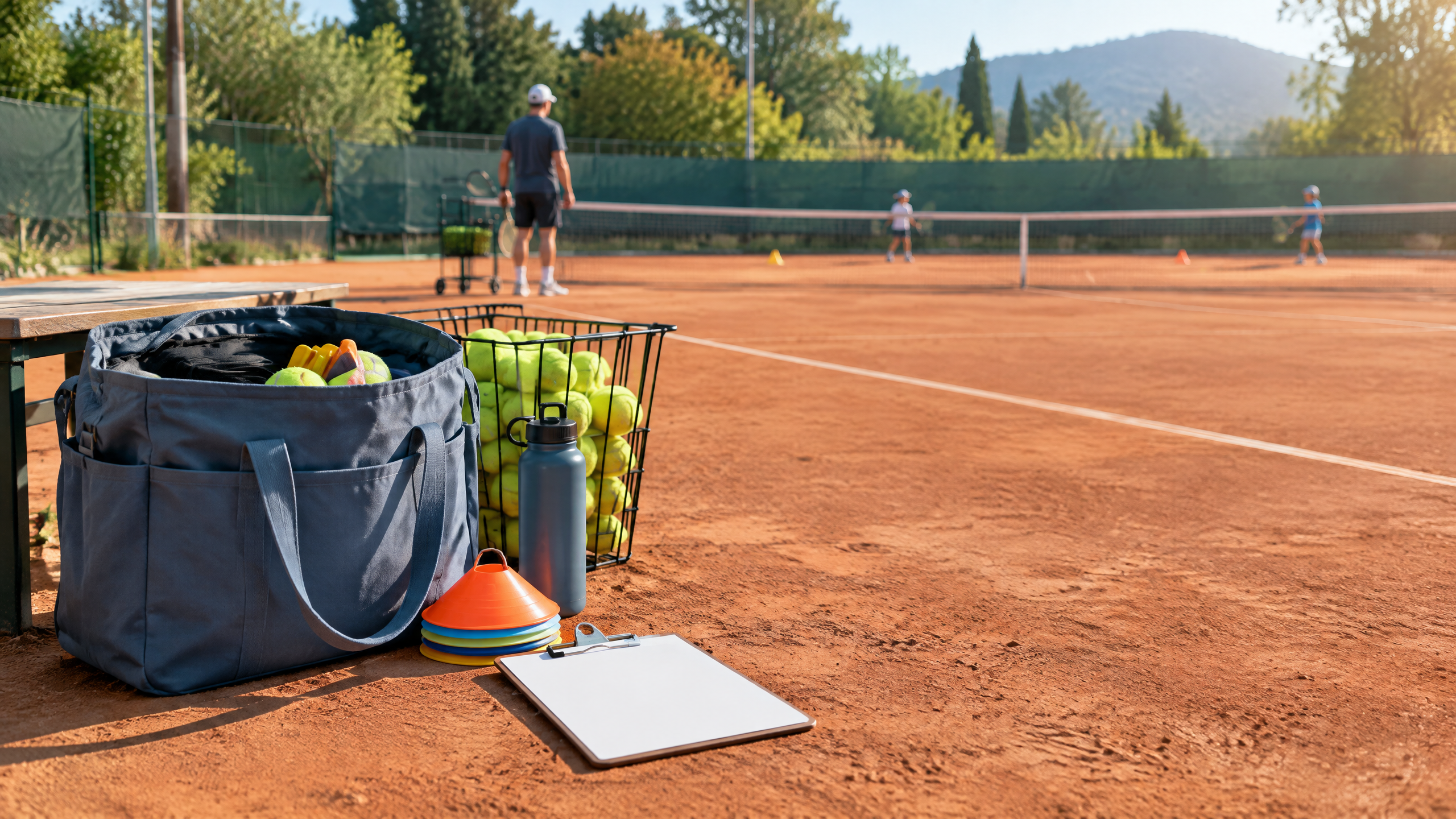
A tennis coach does not need a larger version of a player’s racquet bag. They need a court-side organiser that lets a session change direction without sending the coach back to the equipment room. The useful question is not how much gear can be crammed into a bag. It is how quickly the right item can be found, used and returned while the group remains engaged.
That makes the coach organiser a small operational tool for clubs, academies, schools and parks programmes. It can hold essentials for a short clinic, a private lesson, a junior session or an after-school block. It can also carry the club’s identity in a way that looks organised on court rather than promotional.
This guide introduces the 90-Second Changeover: a practical method for briefing and testing a custom tennis coach bag around the moments between drills.
The gap between a player bag and a coach organiser
A player normally packs for one person: racquets, apparel, water, shoes, balls and personal items. A coach may need to move between a lesson plan, ball basket, training cones, phone or tablet, attendance note, water bottle, first-aid kit supplied by the facility and a few demonstration tools. Some of those items remain with the coach; others are taken out and put back repeatedly.
The difference is not simply capacity. It is access rhythm.
A player can stop and search a large compartment. A coach is often answering a question, moving players to a new court position or starting the next activity. A bag that has everything in one deep pocket can create a slow, cluttered transition even if it technically holds enough equipment.
That is why a custom tennis coach bag should be designed from the outside in: what needs to be reachable first, what needs a stable home and what should stay separate from court dust or loose balls.
The 90-Second Changeover
A coaching session does not always follow the plan exactly. A drill may finish early, a group may need a simpler option or weather may move the session under cover. The 90-Second Changeover is a short, observable test for whether the equipment bag supports the coach’s next decision.
Ask the coach to complete a realistic shift from one activity to another in roughly 90 seconds. For example:
- Close the current drill and collect the immediate training items.
- Retrieve the next set of cones, ball tube, notebook or demonstration aid.
- Take out the next object without placing the entire bag on the ground and emptying it.
- Return unused items to their intended places.
- Move the organiser with the group to the next court position.
The test does not certify a bag’s performance. It reveals friction points in the layout. If the coach has to unclip several straps, remove loose objects or search a dark main compartment, the buyer has useful feedback for the sample revision.
Begin with three access zones
A strong tennis coach organiser does not need many pockets. It needs distinct zones that match the coach’s sequence of use.
| Zone | Typical purpose | Buyer questions |
|---|---|---|
| Quick-access zone | Phone, whistle, session card, small note pad, sunscreen or personal essentials | Can the coach reach the item while standing? Does it have a clear closure? |
| Active-drill zone | Cones, bands, small training aids, a ball tube or other frequently used session items | Can the coach see what belongs here and return it quickly? |
| Protected or reserve zone | Extra apparel, a tablet, a change of grip, paperwork or other items that should not mix with loose equipment | Is this area separated and easy to open without disturbing the active zone? |
Not every coach needs the same items. The point is to make the club decide what belongs in each zone before asking for a custom tennis bag sample.
This is also a useful way to avoid copying a generic equipment bag. A club can describe its own programme: adult social tennis, junior development, school sessions, performance coaching or multi-court clinics. The organiser can then reflect the team’s real rhythm instead of an imagined all-purpose load.
A coaching programme has its own identity
Tennis coaching is not only a private-lesson activity. Clubs may support school coaches, volunteer and emerging coaches, professionals, and wider organisations or facilities. That variety is one reason a club should treat its coach equipment as part of programme operations, not just staff merchandise.
A coach bag can be a subtle signal that the programme is prepared. It does not need a large logo on every side. A consistent club colour, a small embroidered mark, a durable handle treatment and a practical court-side silhouette can be enough.
For a junior programme, bright accent lining or colour-coded zipper pulls may help staff keep zones clear. For a private club, a deeper body colour and restrained embroidery may fit the surrounding environment better. For a school programme, a high-visibility trim may be a deliberate operational choice. The right answer comes from the users and setting, not from a generic trend.
Map the court-side routine before selecting a silhouette
A buyer can learn more in one observation session than from a long list of features. Watch a coach prepare, run and close a normal programme block. Then record the following.
Arrival and setup
How far does the coach walk from the office or storage area to the court? Do they carry a ball basket separately? Are there gates, stairs or uneven surfaces? Does the bag need to rest on a bench, hook or court-side chair while the session begins?
During the drill
What items are taken out most often? Are they small, loose or awkward to organise? Does the coach need both hands free at particular moments? Are personal items kept safely away from training equipment?
Changeover
When the group changes activity, which objects must be returned, replaced or counted? Does the coach need a clear place for a phone or tablet? Is the bag moved between courts?
Close and reset
What needs to be packed away at the end? Does the coach have a predictable check so that cones, notes and small tools do not stay on court? Is the bag stored with other staff equipment?
These observations lead to a better tennis academy equipment bag brief than a shopping list alone. They help distinguish what must be immediate-access equipment from what can remain in a reserve compartment.
Choose a silhouette that respects the session
Different coaching formats may call for different forms. The aim is not to make every coach carry the same product.
| Coaching context | Potential organiser direction | What to evaluate on the sample |
|---|---|---|
| One-to-one or small-group lessons | Compact tote or backpack | Quick access, a stable standing shape and easy movement between courts. |
| Junior clinic | Larger organiser tote or backpack with defined zones | Visibility of training aids, repeated access and simple end-of-session reset. |
| Multi-court programme | Tote with adaptable dividers or modular pouch system | Separation of tools, handover between staff and clean storage after use. |
| Travel or away fixtures | Structured duffel or hybrid backpack | Handles, protected paperwork or electronics zone and compatibility with other equipment. |
The buyer should not promise that one layout will serve every coaching style. Instead, choose the highest-priority use case and test it honestly. A compact organiser may be ideal for an individual coach but unsuitable for a full camp. That insight is valuable before production—not after a club has committed to a single format.
To see product directions for a wider programme, explore Links Sports Co tennis bag options. The selected style can then be adapted into an original club or academy brief.
The field test: set up, teach, move, reset
A sample review should happen near a court, with a few representative items, rather than only on a desk.
Set up. Ask the coach to place the organiser where it would normally sit during a lesson. Does it stay upright? Can the key pocket be opened without the bag falling over? Does the coach have to kneel or bend unnecessarily to find the first item?
Teach. Remove the objects used in a typical drill. Place them back while the coach continues speaking or moving. The goal is not to score the coach. It is to spot whether the layout creates interruptions.
Move. Carry the organiser a short distance, through the relevant gate or around the net post. Observe handle comfort, strap behaviour and how loose equipment stays contained.
Reset. At the end, perform a simple count of the intended tools and repack the bag. If the club wants a repeatable staff system, this can be as straightforward as one colour-coded pouch per activity type.
Record only the comments that point to a concrete revision. “Move the quick-access zip away from the carry strap” is more useful than “make it easier to use.”
Build the brand into the operating system
A branded coach bag is most convincing when its identity has a role in the operational system.
For example, a club may use a navy organiser body across all staff, a small embroidered crest on the upper panel and a distinct lining colour for tennis. A multi-sport programme might keep the shared crest and body material but give tennis, pickleball and padel organisers different zipper-pull colours. The branding is then doing two jobs: presenting the club and helping staff recognise the right equipment.
This is a more durable approach to private-label tennis bags than placing a large logo on an existing blank. The development brief can cover the logo, but it should also define the coach’s access zones, carry route, sample test and storage routine.
When you request a custom programme from Links Sports Co, include the intended use, artwork files, preferred silhouette, important objects to carry and any team colour system. That gives the development conversation a stronger starting point than asking for “a coaching bag” without context.
A buyer brief for custom tennis coaching equipment bags
Use this short brief before requesting a prototype or sample.
| Input | What the club or academy should decide |
|---|---|
| Primary coaching format | Private lessons, junior clinics, camps, schools, adult social sessions or away fixtures. |
| Essential carry items | The items that must be accessible during a normal changeover. |
| Access hierarchy | Which objects must be reached immediately, often or only at the beginning and end of a session. |
| Court environment | Clay, hard court, indoor, shared benches, gates and the distance from storage. |
| Staff identity | Club crest, approved colours and whether colour coding has an operational purpose. |
| Sample reviewers | One coach, one programme manager and one final decision owner are often enough. |
The production quantity, commercial terms and delivery calendar should be confirmed only after the exact construction, materials, custom treatment and approved sample version are clear. This keeps the programme connected to the bag that was actually tested.
Better coaching flow begins with fewer searches
A coach organiser should make the session feel more prepared, not more complicated. The 90-Second Changeover is a simple way to keep the development brief grounded in that goal.
Observe the normal programme. Divide equipment into access zones. Test the sample on court. Ask the coach what slowed them down and turn those notes into one clear revision list. The result can be a useful, club-specific tool rather than a generic sports bag with a logo added at the end.
For a custom tennis coach bag or court-side organiser programme, contact Links Sports Co with the coaching routine, artwork and the first sample priorities.
Frequently Asked Questions
Q: What is the difference between a tennis coach bag and a player racquet bag?
A player bag is normally organised around one person’s racquets and personal gear. A coach organiser is planned around repeated access to session tools, quick transitions, court-side movement and a simple reset at the end of the programme.
Q: Should a tennis coach organiser have many pockets?
Not necessarily. A few clear access zones are usually more helpful than many small pockets. The right layout depends on the items the coach uses most often and the order in which those items are needed during a session.
Q: How should a club test a custom tennis coach bag sample?
Review it beside the court using representative session items. Have a coach set up a drill, switch to another activity, move the bag a short distance and reset it at the end. Record only the layout issues that need a specific revision.
Q: Can Links Sports Co customise a tennis coach organiser with club colours and a crest?
Yes. A custom development brief can include an approved crest, body and trim colours, logo technique, access-zone requirements and the coaching use case. The physical sample is then reviewed before the production-ready specification is approved.
Share this article