From the Par 3 to the Clubhouse: A Family Golf Equipment Brief for Clubs and Private Labels
A buyer brief for clubs and private labels building a premium family golf equipment programme—from adult and junior carry needs to original club identity and sample approval.
Links Golf Sports
Product Specialist & OEM Consultant · Links Sports Co
10+ years in golf & tennis bag manufacturing. Specialises in OEM/ODM custom branding, material sourcing, and B2B wholesale for brands across 30+ countries.
Quick answer for buyers
A family golf equipment programme should feel like a club culture expressed through useful objects, not a collection of unrelated adult and junior bags. The strongest starting point is a small, coordinated family: an adult carry bag, an age-appropriate junior option, a child-friendly smaller format and an original club or private-label identity that can travel across them. For a club, resort, academy or emerging label, the commercial question is not simply whether children will use smaller bags. It is whether the equipment makes a family feel that there is a place for every player in the same golfing story.
The 2026 Masters Par 3 Contest offered a timely reminder of that story. Before the competitive week began, players shared the short course with children, partners and grandchildren—a family-centred tradition that Golfweek traces to 1960. The scenes matter not because they turn family golf into celebrity theatre, but because they show something familiar to clubs everywhere: golf becomes more durable when a child is invited to participate rather than simply watch.
This is a practical brief for buyers who want to build that invitation into a premium club programme or an original private-label range.
The moment before the tournament is the signal
At the 2026 Par 3 Contest, the images were intentionally unguarded: children putted, families walked together, and the usual tournament intensity gave way to a few hours of shared play. USA Today’s coverage documented players with children and relatives around the course, while reporting from Augusta noted that one young child was keen to bring her own putter rather than merely borrow an adult’s equipment.WRDW
That detail—a child wanting equipment of their own—is more instructive than it first appears. In a family setting, participation is rarely created by a logo alone. It is created by proportion, ownership and ritual. A bag that is comfortable to carry, a club crest that belongs to the family’s home course, and a colour that a young player can recognize from across the practice ground all help make the game feel available.
For a premium club, this does not mean adding a novelty junior item to the pro-shop wall. It means designing a family pathway with the same care used for a member guest, a ladies’ day or a seasonal tournament. The visual language can be understated: a deep club colour, warm leather touchpoints, quiet hardware and a shared crest system. The emotional result can still be memorable. A parent sees a child carrying a bag that feels related to their own; the child sees that they are not borrowing a place in the game.
Why family golf deserves a more considered equipment brief
The participation context supports the cultural signal. The National Golf Foundation reports that more than 48 million Americans engaged with golf in 2025, with 29.1 million playing on course. Beyond the United States and Mexico, The R&A’s 2025 Global Participation Report records 47.1 million junior participants across golf formats; in Great Britain and Ireland, 70% of households with children aged 6–17 had taken part in some form of golf activity in the previous 12 months.
Those figures are not a reason to make an oversized sales forecast. They are a reason for clubs and private labels to ask a better planning question: when families do participate, what does a welcoming equipment experience look like at the course, the range and the clubhouse?
The answer is not one universal bag. A toddler exploring the putting green, a junior beginning lessons, a teenager joining a parent for nine holes and an adult who walks the course all have different needs. What can be shared is a design code: recognizable materials, a calm palette, a clear hierarchy of function and a thoughtful way to add a name, initials or club mark. This is where a family programme becomes more than a size run.
Read the supplied bag image as a family system
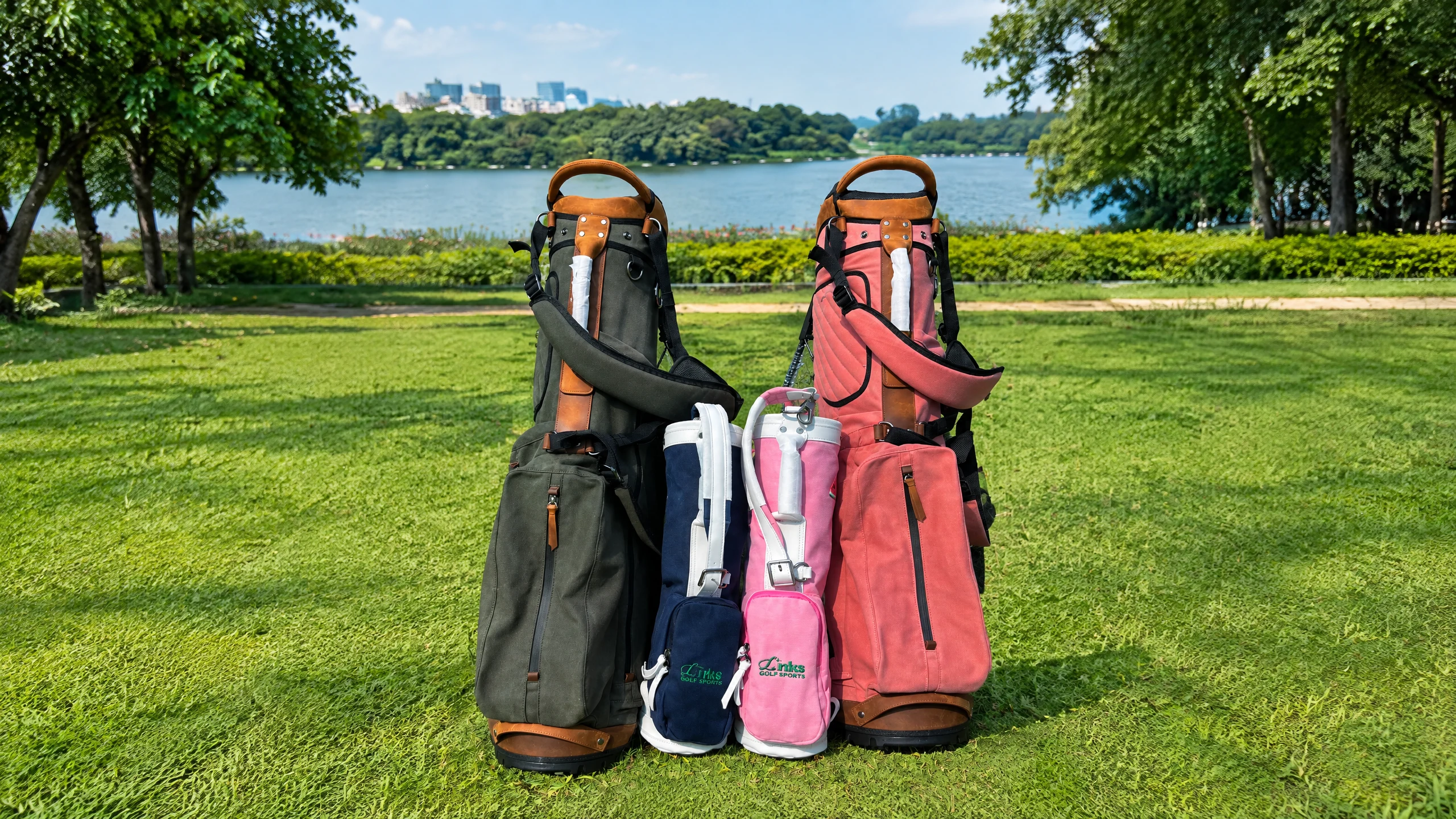
The cover image shows four distinct golf bags arranged together on grass: larger dark-green and coral carry bags sit behind smaller navy and pink bags. The image is useful because it communicates a family structure before a single word is read. The pieces are not identical, and they should not be. Their scale and use can differ. But the repeated material contrast, leather-toned touchpoints and considered colour choices allow them to be read as one group.
For buyers, that is the design lesson. A family collection should coordinate rather than miniaturize. The junior piece does not have to imitate every adult compartment. The child’s bag does not need adult-level storage. Instead, each format should keep the functional details that make participation easier, while carrying enough of the wider visual language to make the collection feel intentional.
| Family role | Equipment objective | Design decision to approve on a sample |
|---|---|---|
| Adult walking player | Carry a normal round with a refined, club-appropriate presence. | Test strap balance, handle comfort, stand stability and easy access to the essentials. |
| Older junior | Build independence without giving the player an overgrown adult bag. | Check length, club organization, strap adjustment, stand use and pocket access with the intended club set. |
| Younger child | Make the first carrying experience simple, light and personally meaningful. | Confirm the child can reach the handle, manage the strap and use the opening without adult assistance. |
| Family event or gifting programme | Create a shared memory that still looks credible in a premium club setting. | Approve crest scale, name or initial placement, packaging and the colour relationship across formats. |
The table is a brief, not a specification sheet. Exact dimensions, materials and construction should be decided against the player profile and an actual sample. A responsible supplier should not claim that a scaled-down adult pattern will work for every age group without that physical review.
What a high-end club programme can borrow from family rituals
The most successful family experiences in golf are often small in scale. It may be a parent and child arriving early for the range, a grandparent watching a first putt, or a family group walking a few holes after lunch. The club does not need to turn every moment into a large event to make it feel considered. It needs to remove the signals that say “this space was made for someone else.”
Equipment can quietly help. A well-organized smaller bag means fewer loose clubs and less dependence on an adult’s cart. A clearly positioned name panel reduces mix-ups at an academy session. A restrained club crest lets the bag work at the home course, at a holiday venue or in a family photograph without becoming overly promotional. Durable contact points and practical pocket placement matter because family rounds are often slower, more social and full of small transitions between practice, play and rest.
For a private label, the same thinking can produce a concise family capsule rather than an unfocused product catalog. Begin with a coherent adult carry bag and one or two junior formats. Decide which material and colour notes repeat. Define a logo system that can scale down legibly. Then review the collection as it will actually be seen: carried by people of different heights, lined up by the practice ground, placed in a car and photographed at a family event.
Club principle: The premium quality of a family range is measured by how naturally every member can take part—not by how many adult features are forced into the smallest bag.
A buyer’s four-part brief before sampling
The visual direction in a family golf programme should be original. A club or brand may collect inspiration from the wider world of heritage golf, walking culture and classic materials, but a sample request should always translate that inspiration into its own original artwork, colour choices and functional priorities. It should never ask a factory to copy another brand’s product, branding or proprietary construction.
Before requesting a quotation, organize the brief around four decisions.
| Brief area | Questions for the buying team | What to document before sampling |
|---|---|---|
| Players | Which ages, skill stages and family moments does the programme serve? | The intended user for each format and a realistic club-load or accessory-use scenario. |
| Visual family | Which colours, materials and details should make the range feel related? | Approved swatches, trim direction, hardware preference and an original mood board. |
| Club identity | Should the logo be discreet, commemorative or retail-facing? | Vector artwork, placement hierarchy, personalisation policy and approval owner. |
| Operating context | Will the bags be used for academy activity, member gifting, retail, resort travel or a family day? | Quantity estimate, packaging expectation, destination and required delivery window. |
This structure protects both the buyer and the development process. It gives the factory enough information to assess feasibility, while preventing early conversations from becoming a loose collection of visual references with no agreed purpose. It also keeps club identity where it belongs: in the buyer’s own crest, colours, members and stories.
The sample review should include the family, not only the committee
An adult-only review can miss the point of a family programme. The strongest sample approval combines the club manager’s eye for quality, the buyer’s attention to construction and feedback from the people who will actually use the equipment. That may mean asking a parent, an older junior and a younger child to interact with the relevant samples in a controlled setting.
The test does not need to be elaborate. Observe whether a child can lift the bag from the ground, recognize their own item, manage the closure and carry it comfortably for an appropriate period. Ask a parent whether the smaller format is easy to supervise alongside an adult bag. Inspect adult and junior pieces together for colour consistency, logo scale and the way materials meet at handles, straps and high-contact areas. Photograph accepted details and place them on a dated approval sheet.
The aim is not to make a performance claim that has not been tested. The aim is to uncover preventable friction before a broader club programme or retail release. A premium family collection earns trust when the smallest user is treated as a real participant in the approval process.
The opportunity is cultural, not only commercial
Clubs often think of family golf as a membership benefit, a junior academy responsibility or a seasonal event. It can be all three. But it is also a design opportunity: to give a family a visible way to belong together without making every player look the same.
The Masters Par 3 Contest is powerful because it makes this belonging visible before the sport returns to competition. A player becomes a parent, a child becomes a participant and a course becomes a shared setting. Clubs and private labels cannot recreate Augusta National, nor should they try. They can take the more useful lesson: when the equipment feels welcoming, correctly considered and connected to a place, it helps turn an occasional family outing into a club tradition.
For teams ready to develop their own programme, the next step is a clear original brief, a sample reviewed by the intended users and an equipment system built around the family moments the club wants to create. Explore the family golf design opportunity, review the current golf bag collection, or discuss an original custom golf bag development brief with the Links Sports Co. team.
Frequently Asked Questions
Q: What makes a family golf equipment programme different from simply adding a junior bag?
A family programme plans the experience across users and moments. It coordinates adult and junior formats through a shared visual language while allowing the smaller formats to prioritize their own carrying, club organization and access needs. It also considers club identity, personalization and where the equipment will be used.
Q: How can a golf club make a family bag collection feel premium rather than promotional?
Start with disciplined colours, materials and hardware, then keep the club identity intentional rather than oversized. Approve the crest, name treatment and packaging alongside the physical function. A premium result should look coherent in the clubhouse while still making a child or junior feel that the bag is theirs to use.
Q: Should a junior bag be a smaller copy of an adult stand bag?
Not automatically. A junior format should be evaluated for the intended player’s height, club set, handling ability and use setting. Keeping every adult feature can add complexity without adding value. The sample should be reviewed with the relevant age group before production decisions are made.
Q: What should a private-label buyer prepare before asking for a family golf bag quotation?
Prepare the intended user groups, original artwork, preferred colours, material direction, quantity estimate, target use, packaging expectation, destination and required delivery window. A short, decision-ready brief gives the factory a better basis to assess construction and quote the selected configuration accurately.
Share this article