The First Four SKUs: Building a Custom Golf Bag & Headcover Capsule for the Pro Shop
Plan a focused custom golf bag, headcover and accessory capsule for a pro shop with practical guidance on product roles, design consistency, samples and replenishment.
Links Sports Co
Product Specialist & OEM Consultant · Links Sports Co
10+ years in golf & tennis bag manufacturing. Specialises in OEM/ODM custom branding, material sourcing, and B2B wholesale for brands across 30+ countries.
A first pro-shop collection does not need to begin with a wall of products. In fact, a focused range is often easier for a club, resort or emerging golf brand to explain, photograph, sample and replenish. The challenge is choosing a small group of products that looks connected while allowing each item to do its own job.
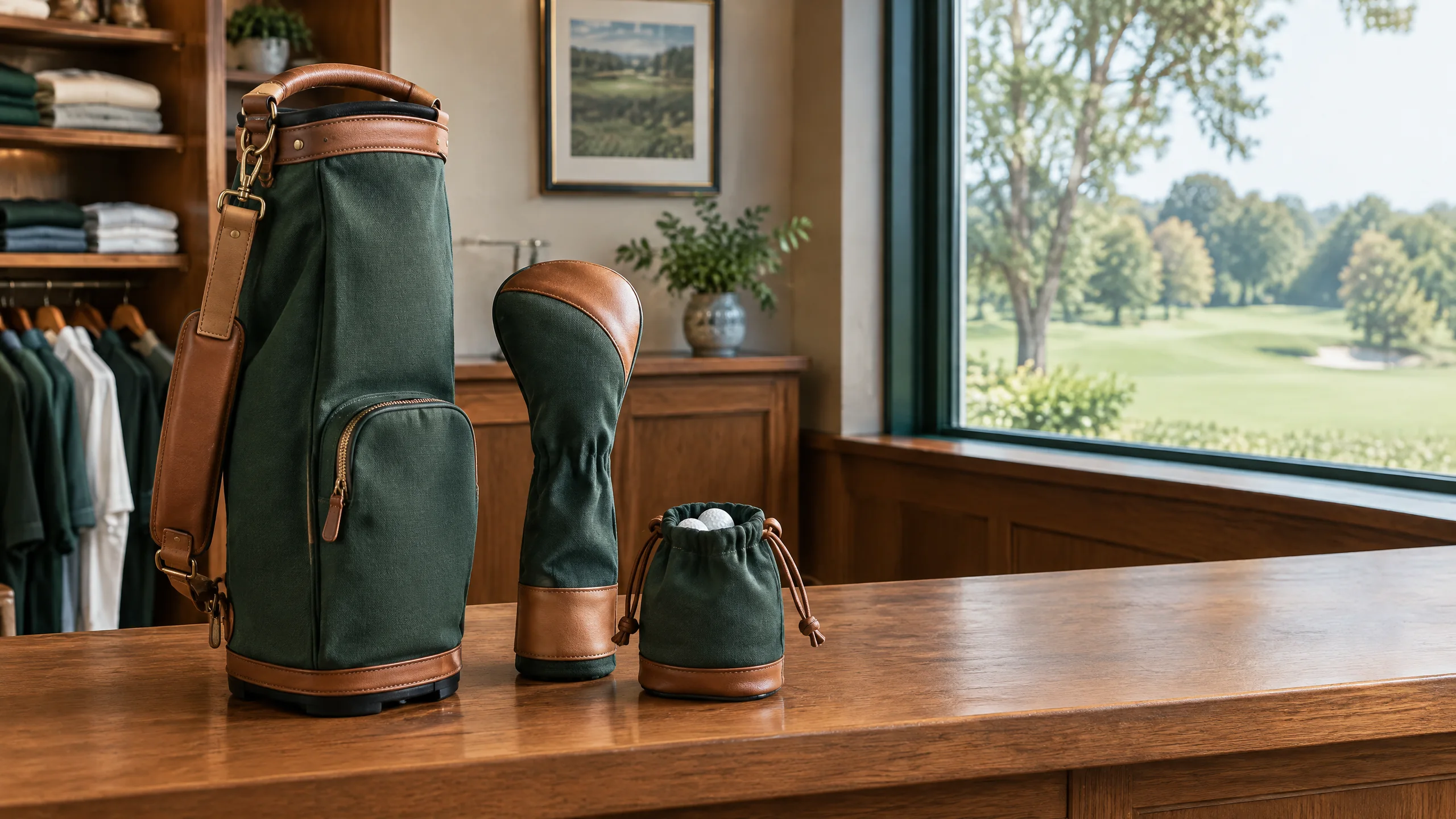
This is where a custom golf bag and headcover collection can be more useful than a single isolated product. A carry bag creates the largest visual statement. A headcover makes the identity portable on the course. A small pouch or accessory gives the customer an accessible entry point. Together, they can form a coherent first story for the pro shop without requiring every item to have the same construction or price position.
The aim is not to create more SKUs for the sake of it. It is to build a small system with a clear reason for each piece.
Start with four roles, not four random products
For a first capsule, think about roles in the collection. A practical starting structure can be:
- Lead object: One custom golf bag that carries the main material, silhouette and club or brand identity.
- Course companion: One or two coordinating headcover formats that repeat the visual language on a smaller scale.
- Useful accessory: A compact pouch, shoe bag, valuables pouch or similar item that can stand alone but still belongs to the family.
- Story element: A packaging note, small hangtag approach or product-page photography direction that explains the relationship among the pieces.
The first three are physical products. The fourth is the way the collection is understood. Without it, a matching bag and headcover can look coincidental rather than intentional.
For the useful-accessory role, the LA-024 Heritage zipped valuables pouch can serve as a construction reference when planning a coordinated pro-shop capsule. Use the sample brief to decide which material, embroidery and hardware details should echo the lead bag.
Choose one product to carry the strongest design statement
A full golf bag has more surface area and more construction choices than a headcover or pouch. That makes it the right place for the main design decisions: material field, silhouette, major trim, primary crest position and the overall balance between heritage and contemporary use.
Before adding accessories, write down what the bag must communicate. Is it a lightweight walking bag for member rounds? A cart-oriented club bag? A limited retail piece for a resort pro shop? A private-label carry bag for a new golf brand?
The answer guides the collection. A compact walking bag may pair naturally with understated headcovers and a small ball pouch. A bold tournament or resort bag may support a more visible accessory story. The products do not need matching pockets; they need an identifiable shared point of view.
For a framework on making original design decisions before decoration, read The Reference, Not the Replica. The capsule should extend your own visual language, not reproduce another brand’s collection.
Decide what repeats and what varies
A coherent private-label golf collection uses a small number of repeatable signals. The mistake is trying to repeat everything on every item.
Choose two or three elements that travel through the collection:
| Design signal | Lead bag | Headcover | Small accessory |
|---|---|---|---|
| Main club colour | Dominant canvas or nylon field | Front panel or binding | Small panel, lining or tab |
| Secondary trim | Handle, pocket edge or strap detail | Edge binding or label | Zipper pull or tab |
| Club mark | Primary placement | Simplified or secondary placement | Discreet mark or interior label |
| Material character | Full visual expression | Focused texture | Functional touchpoint |
This gives the buyer room to vary scale and construction. The bag can be the visual anchor; the headcover can use a smaller version of the material contrast; the accessory can repeat only the trim or mark. The result often feels more considered than a collection that tries to make every object identical.
Build the range around a real customer journey
A pro-shop collection is more useful when each item fits a recognisable moment.
A member may first notice the full bag during a club event or on a display floor. A shopper who is not ready for a larger item may choose a headcover or pouch. A regular customer may return later to add a matching piece. The range does not need to predict every purchase path, but it should give the shop more than one way to introduce the design language.
Ask these questions as a buying team:
- Which item makes the collection immediately recognisable from across the shop?
- Which item can a customer use as a first contact with the brand or club identity?
- Which accessory is genuinely useful rather than merely decorative?
- What will look good together in a simple shelf or counter display?
- Which details should appear in product photography to make the relationship visible?
Do not invent retail conversion rates or margins to answer these questions. Use the club’s own historic sales information and customer knowledge. The collection brief is about product coherence; the commercial plan belongs to the buyer’s actual shop data.
Keep material decisions connected but proportionate
Material repetition can make a capsule feel unified, but it should respect each item’s use. Full-grain leather on a small pull tab may be enough to echo leather used more visibly on a carry bag. A waxed canvas field on a headcover may work differently from a canvas body on a bag. A lining colour can become a quiet recurring signature without appearing on every exterior panel.
For a leather accessory within the capsule, use this leather scorecard and yardage book holder as a construction reference. Its pebbled full-grain leather, elastic pencil holder and clear PVC scorecard sleeve offer concrete details to review when preparing the accessory brief.
Write the material rule in a short sentence. For example:
Forest-green canvas is the main collection field. Warm natural leather is reserved for touchpoints. Cream thread is used for the primary club mark. Black webbing and zipper tape remain functional neutrals.
A line like this helps a supplier understand which choices are essential and which can flex for the specific construction. For a deeper material consistency review, use our canvas, leather and embroidery colour approval guide.
Sample the family in the right order
A capsule does not always need every product sampled at once. The most effective sequence usually begins with the item carrying the largest number of decisions.
First, approve the lead bag. Confirm silhouette, key materials, logo hierarchy, major trim and overall use case.
Second, approve one accessory prototype. This tests whether the visual language scales down successfully. A headcover is often a good second object because it uses the identity in a smaller and more visible form.
For a leather mallet-cover construction reference, review the Links Heritage Boann ZT Mallet Putter Cover. Confirm fit for the intended putter and the collection-specific material details through sample approval.
Third, review the collection together. Put the bag, headcover and pouch beside each other under normal shop light. Look for the relationship between materials, marks and proportions.
Fourth, document the repeatable rules. Save final material references, approved logo placement, photo angles and any notes on which elements are mandatory across future accessories.
This sequence avoids a common problem: approving several isolated products, then discovering late in the process that they do not look as though they belong together.
Let the collection photograph like a family
A buyer may use product images online, in a line sheet, on social channels or near a pro-shop display. The photography should make the collection relationship immediately clear.
A simple shot list can include:
- The lead bag in a natural course or clubhouse setting.
- The headcover and accessory beside the bag, showing shared colour or trim.
- A close material view that shows texture without overemphasising hardware.
- One functional image that shows the item’s actual role, such as a headcover on a club or a pouch attached or placed near a golf bag.
Keep the setting believable and uncluttered. A private club may prefer warm wood and course greenery; a younger golf brand may use a clean contemporary practice setting. The products should remain the focus.
Illustrative buyer scenario
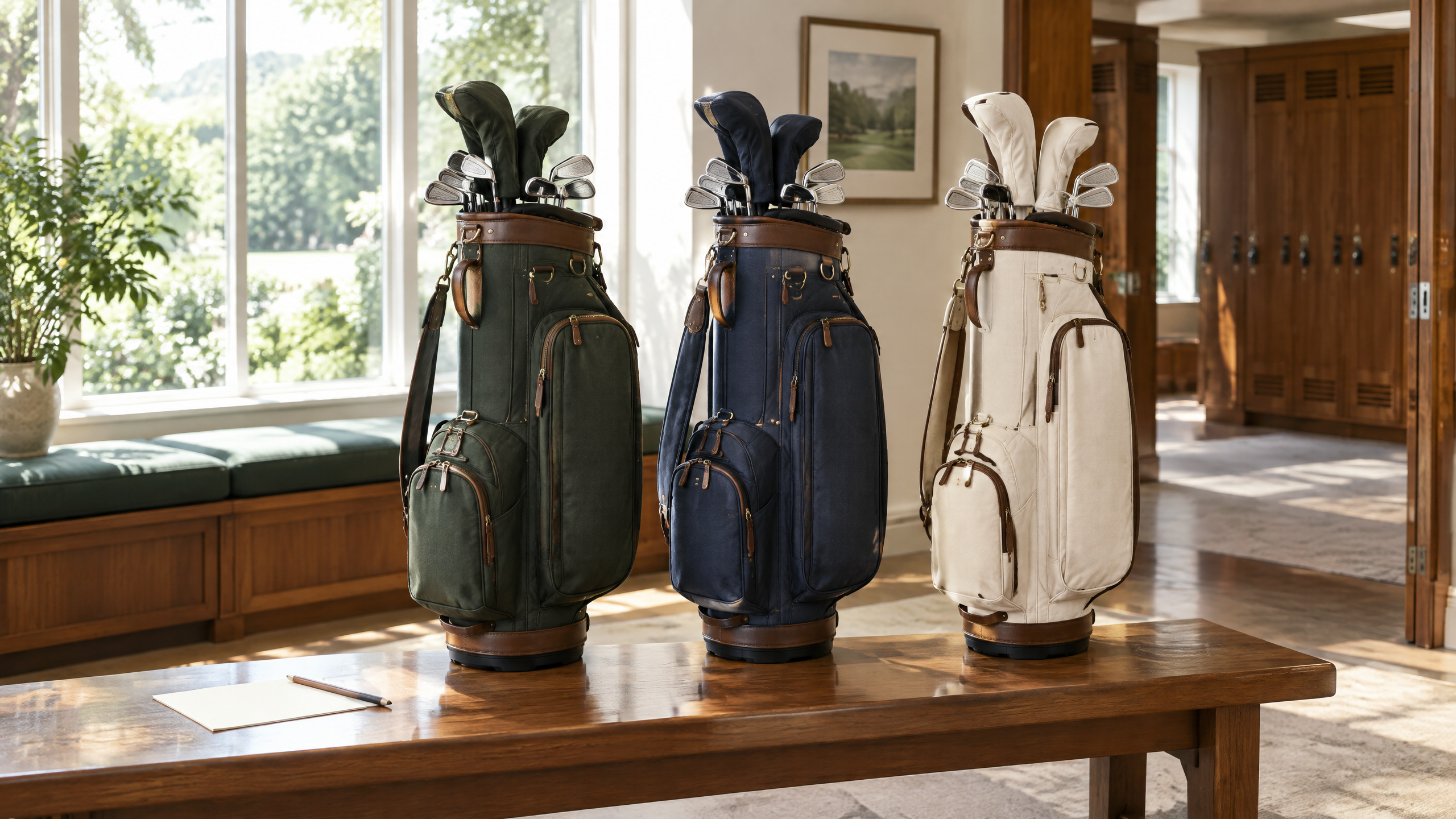
Imagine a club pro shop planning a limited first collection around an understated forest-green carry bag. The team chooses a matching driver headcover and a small valuables pouch rather than launching a dozen unrelated accessories. The bag carries the full green canvas field and leather touchpoints. The headcover uses the same green with a simpler leather tab. The pouch repeats only the cream embroidery and a small leather zipper pull.
On the first collection review, the pouch is visually too busy because it repeats the crest, leather trim and contrast binding at a small scale. The buyer reduces it to one mark and one trim detail. The bag remains the anchor, while the smaller products support it.
This is an illustrative scenario, not a record of an existing project. It demonstrates why a capsule benefits from deciding what each product should contribute rather than copying every detail everywhere.
Plan replenishment questions before the first launch
A capsule is easier to extend when its core decisions are recorded from the beginning. Before an order is discussed, the buying team should decide which questions it will revisit later:
- Will the lead bag remain the same while accessories rotate seasonally?
- Which material or trim must remain consistent if a headcover is reordered?
- Can a new accessory join the family by repeating only one or two visual signals?
- Where will final artwork, material references and approved sample photos be stored?
- Which item should be sampled first if the club later adds a shoe bag, travel cover or small gift?
This does not guarantee availability of every material indefinitely. It creates a clear record so future conversations begin with approved logic rather than a collection of unlabelled old samples.
For current minimum-order context around headcovers and accessories, see our 2026 MOQ policy update. It explains a company policy direction, while your own quotation should still be based on the selected construction, materials and quantities.
Prepare a supplier-ready capsule brief
When approaching a custom golf bag manufacturer, include the following in one document:
- The intended customer and retail setting for the lead bag.
- The first three or four product roles in the capsule.
- The two or three design signals that must repeat.
- Product-specific choices that should vary rather than match.
- Final club or brand artwork and placement hierarchy.
- Material direction, including what is essential and what can be proposed.
- The first sample decision for each item.
- The intended display or photography setting, if that changes the design priority.
This gives the supplier something much more useful than “make a matching set.” It makes it possible to propose a collection with consistent identity and product-specific function. Explore custom golf bag options and start a product conversation with Links Sports Co when the first brief is ready.
Frequently Asked Questions
Q: What is a golf pro-shop capsule collection?
It is a small, connected set of products designed to be understood together. A first capsule might include a lead golf bag, one or two headcovers and a useful small accessory, all sharing a controlled material, colour or branding system.
Q: Should a custom golf bag and headcover match exactly?
They should feel related, but they do not need identical construction or decoration. Usually two or three repeated design signals—such as a main colour, trim rule and mark hierarchy—create a stronger collection than copying every detail.
Q: Which product should be sampled first in a golf merchandise collection?
Begin with the lead bag because it contains the largest number of design and material decisions. Then test one smaller accessory to confirm that the visual language scales successfully.
Q: How can a pro shop add future accessories without losing consistency?
Save the approved material references, colour hierarchy, logo-placement rules and product photography. Future accessories can repeat selected elements from that record while retaining their own practical purpose.
Share this article