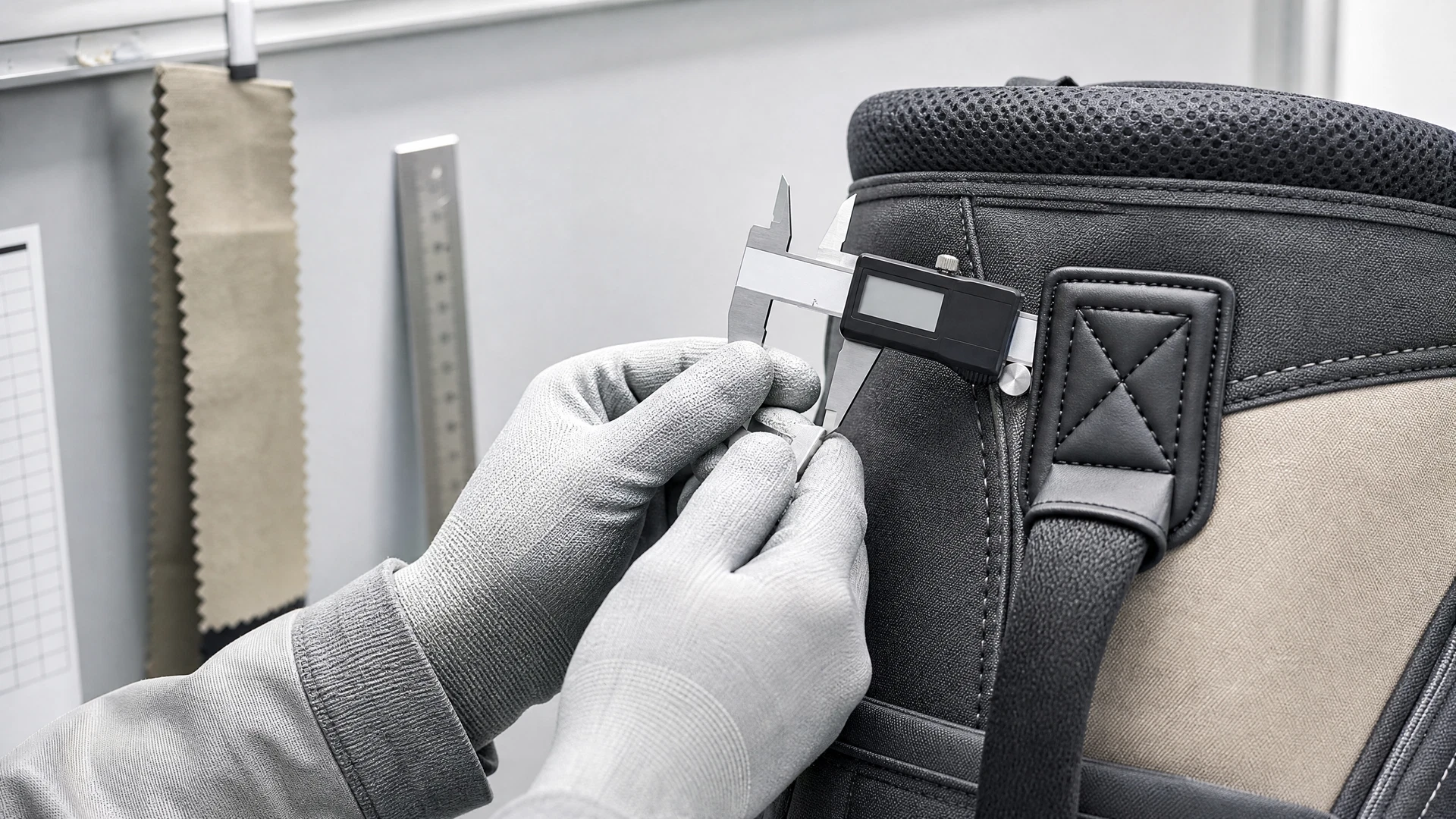
How to Read a Golf Bag Factory Audit Report: A B2B Buyer's Field Guide
Before placing your first OEM golf bag order, learn how to interpret a factory audit report. This field guide covers the 7 critical sections, 7 red flags experienced buyers never ignore, and practical steps for commissioning your own independent audit.
Links Sports Co Sourcing Team
Product Specialist & OEM Consultant · Links Sports Co
10+ years in golf & tennis bag manufacturing. Specialises in OEM/ODM custom branding, material sourcing, and B2B wholesale for brands across 30+ countries.

Every year, dozens of golf bag brands place their first overseas OEM order based on a supplier's polished website, a responsive sales rep, and a sample that looked perfect. Six months later, the bulk shipment arrives with inconsistent stitching, off-color panels, and zippers that fail after three rounds. The factory audit report — if one existed at all — was either never requested or never properly understood.
This guide exists to change that. Whether you are sourcing 300 custom stand bags for a regional golf club or 5,000 cart bags for a national retail chain, knowing how to read and interpret a factory audit report is the single most valuable skill a B2B buyer can develop before committing to a manufacturer.
What Is a Factory Audit Report, and Why Does It Matter?
A factory audit report is a third-party or buyer-commissioned document that evaluates a manufacturing facility across four primary dimensions: production capacity, quality management systems, labor and social compliance, and environmental and safety standards. The audit is typically conducted by an independent inspection body — SGS, Bureau Veritas, Intertek, or QIMA are the most commonly used in the golf equipment supply chain — and results in a scored report that grades the factory against a defined standard.
The most relevant audit frameworks for golf bag sourcing are:
| Framework | Focus | Who Requires It |
|---|---|---|
| ISO 9001:2015 | Quality management systems | Premium brands, US/EU retailers |
| BSCI | Social compliance (labor, wages, hours) | European retail chains |
| SA8000 | Advanced social accountability | Ethical sourcing programs |
| SEDEX/SMETA | Supply chain transparency | UK and Australian buyers |
| REACH / CPSIA | Chemical compliance | All US and EU market products |
A factory can hold multiple certifications simultaneously, and the combination it holds tells you a great deal about which markets it has historically served and how seriously it takes compliance as a business function rather than a checkbox exercise.
The Seven Sections Every Golf Bag Audit Report Contains
1. Factory Profile and Capacity Data
This section establishes the basic facts: total floor space, number of production lines, monthly output capacity, and the split between OEM and own-brand production. For golf bags specifically, you want to see a dedicated cutting room, a separate sewing floor, and an assembly and QC area — the three-zone layout that separates professional bag manufacturers from general luggage factories that occasionally accept golf bag orders.
What experienced buyers look for: Monthly output capacity stated in the report should be at least 3× your annual order volume. A factory producing 8,000 bags per month that accepts a 500-unit order will treat your project as a low-priority fill-in job between larger runs. Factories that produce 20,000–50,000 bags per month and accept orders from 300 units typically have the systems and staffing to manage small runs without quality degradation.
2. Quality Management System (QMS) Documentation
The QMS section covers incoming material inspection, in-process quality checkpoints, and final inspection procedures. A well-documented QMS will specify the acceptable quality level (AQL) the factory operates to — typically AQL 2.5 for major defects and AQL 4.0 for minor defects in the golf bag industry — along with the sampling methodology used.
Red Flag: If the audit report shows that the factory's QMS documentation was created within the 12 months prior to the audit, treat this as a warning sign. Factories that build documentation specifically for audits rather than as a genuine operational tool tend to revert to informal practices once the auditor leaves.
3. Equipment List and Maintenance Records
For golf bags, the critical equipment includes industrial sewing machines (flatbed, cylinder arm, and post-bed variants), ultrasonic welding units for seam sealing, heat press machines for logo application, and tensile testing equipment for zipper and strap load testing. The audit report should list the age, quantity, and maintenance schedule for each category.
A factory with 200 sewing machines, 80% of which are more than 12 years old with no documented maintenance schedule, is operating with equipment that will produce inconsistent stitch tension — the leading cause of seam failures in the field.
4. Labor and Social Compliance
This section is increasingly important for US and European buyers, not only for ethical reasons but for supply chain risk management. The 2026 Uyghur Forced Labor Prevention Act (UFLPA) enforcement has made labor compliance documentation a legal requirement for goods entering the US market, not merely a preference.
Key data points to verify:
- Working hours: Legal maximum in China is 36 overtime hours per month. Audit reports showing consistent 60–80 overtime hours per month indicate a factory under production pressure that may cut corners on quality.
- Wage documentation: Workers should be paid at or above the local minimum wage, with documented payroll records.
- Worker turnover rate: A turnover rate above 30% annually means the factory is constantly training new workers. Skilled sewing operators take 6–12 months to reach full proficiency on complex bag construction.
5. Fire Safety and Facility Conditions
Golf bag manufacturing involves significant quantities of synthetic fabrics, foam padding, and chemical adhesives — all flammable materials. The audit report should document fire suppression systems, emergency exit accessibility, and chemical storage compliance.
6. Environmental Compliance
The EU's Corporate Sustainability Due Diligence Directive (CSDDD), which came into force in 2024, requires European importers to document their suppliers' environmental practices. For golf bags, this primarily covers wastewater treatment from dyeing operations, chemical disposal from adhesive processes, and energy consumption documentation.
7. Corrective Action Reports (CARs)
This is the section most buyers skip, and it is arguably the most informative. Every audit identifies non-conformances — issues that need to be corrected. The corrective action report documents what was found, what the factory committed to fixing, and whether those fixes were verified in a follow-up audit.
A factory with zero non-conformances in its audit report is not a perfect factory. It is a factory that has learned to prepare for audits. A factory with 12 documented non-conformances, all of which have verified corrective actions, is a factory that takes compliance seriously enough to be honest about its weaknesses.
The Seven Red Flags That Experienced Buyers Never Ignore
After reviewing hundreds of factory audit reports across the golf equipment supply chain, the following patterns consistently predict quality and compliance failures:
Red Flag 1: Audit conducted by a firm the factory selected and paid directly. Legitimate third-party audits are commissioned by the buyer or by a neutral platform. When a factory presents an audit it commissioned itself, the independence of the findings is compromised.
Red Flag 2: Audit date more than 18 months old. Factory conditions change rapidly. A two-year-old audit may reflect a facility that has since changed ownership, relocated, or significantly altered its production focus.
Red Flag 3: No documented incoming material inspection process. Golf bag quality failures most frequently originate in raw materials — substandard zipper tape, off-spec fabric weight, or inconsistent hardware plating.
Red Flag 4: Capacity utilization consistently above 85%. A factory running at near-full capacity has no buffer for quality rework, rush orders, or unexpected material delays.
Red Flag 5: Multiple open non-conformances with no verified closure. Non-conformances that appear in successive audit cycles without resolution indicate a factory that treats audit compliance as a documentation exercise.
Red Flag 6: No documented product-specific training records. Golf bag construction requires specialized skills. Factories without product-specific training programs produce inconsistent results when worker turnover occurs.
Red Flag 7: Subcontracting without disclosure. Some factories accept orders they cannot fulfill in-house and subcontract portions of production to smaller workshops without buyer knowledge.
How Links Sports Co Approaches Factory Transparency
At Links Sports Co, we operate from a single 18,000 m² facility in Conghua, Guangzhou — a location we have occupied since our founding in 2015. We do not subcontract production. Every golf bag and tennis bag that carries our name is cut, sewn, assembled, and inspected within our own walls.
Our facility holds ISO 9001:2015 certification and SGS verification, and we welcome buyer-commissioned audits at any stage of the sourcing process. We maintain open documentation on our QMS, our AQL inspection protocols, and our material supplier certifications — because we believe that buyers who understand our processes become long-term partners rather than one-order customers.
Practical Steps: Commissioning Your Own Audit
Step 1 — Define your audit scope. Decide which frameworks matter for your target market. US-focused buyers should prioritize CPSIA compliance and UFLPA labor documentation. European buyers should add REACH and BSCI.
Step 2 — Select an accredited inspection body. SGS, Bureau Veritas, Intertek, and QIMA all operate in the Guangdong manufacturing corridor and can typically schedule an audit within 2–3 weeks. Budget approximately USD 800–1,500 for a standard one-day factory audit report.
Step 3 — Request the factory's most recent self-assessment. A factory that has never conducted a self-assessment against any recognized framework is unlikely to pass a third-party audit without significant preparation time.
Step 4 — Review the corrective action history. Ask the factory to provide audit reports from the previous two audit cycles, not just the most recent one. The trajectory of compliance improvement is more informative than any single audit snapshot.
Step 5 — Verify certifications independently. ISO 9001 certificates can be verified through the issuing certification body's public registry. SGS and Bureau Veritas both maintain searchable online databases of current certificate holders.
Frequently Asked Questions
Q: What is the minimum audit I should require before placing a first golf bag OEM order?
For orders under 500 units, a buyer-commissioned one-day social compliance audit (BSCI or equivalent) combined with a material certification review is a practical minimum. For orders above 1,000 units, add an ISO 9001 QMS review and a product-specific quality protocol assessment.
Q: How much does a factory audit cost, and who pays for it?
Independent factory audits typically cost USD 800–1,500 for a standard one-day visit, depending on the inspection body and factory location. The cost is borne by the buyer commissioning the audit.
Q: Can I trust a factory's self-reported certifications?
ISO 9001 and SGS certificates should always be verified through the issuing body's public registry. Self-reported certifications without verifiable documentation should be treated as unconfirmed until independently verified.
Q: How often should I re-audit a supplier I have worked with for multiple years?
Industry best practice for established supplier relationships is a full re-audit every 24 months, with an annual self-assessment review in the intervening year.
Q: What happens if a factory fails an audit?
A failed audit does not automatically disqualify a factory. Review the non-conformances in detail: minor procedural issues are typically correctable within 30–60 days. Structural issues require longer remediation and should pause your sourcing process until verified closure is confirmed.
Q: Does Links Sports Co allow buyer-commissioned audits?
Yes. We welcome third-party audits commissioned by buyers at any stage of the sourcing process. Our standard audit facilitation package includes pre-visit documentation, unrestricted floor access for accredited inspectors, and a written corrective action response within 14 business days of receiving the audit report.
The Bottom Line
A factory audit report is not a guarantee of quality. It is a structured snapshot of a facility's systems, capacity, and compliance posture at a specific point in time. Buyers who learn to read these reports critically — who know which sections to scrutinize, which patterns to distrust, and which red flags to treat as disqualifiers — consistently source better products, experience fewer shipment failures, and build more durable supplier relationships.
The golf bag industry is not short of manufacturers. It is short of manufacturers who can demonstrate, through verifiable documentation, that their quality systems are real rather than aspirational. That distinction is worth the cost of an audit.
Links Sports Co is a factory-direct OEM and ODM manufacturer of golf bags and tennis bags, operating from Conghua, Guangzhou since 2015. We hold ISO 9001:2015 and SGS certifications and welcome buyer-commissioned audits. Contact our sourcing team to request our factory documentation package.
Share this article