Golf Bag MOQ Guide for Pro Shops: How to Order Smart and Maximize Margin
Confused by MOQ requirements when ordering custom golf bags? This practical guide explains how MOQ works, how to negotiate it, and how pro shops can maximize margin on small initial orders.
Links Sports Co
Product Specialist & OEM Consultant · Links Sports Co
10+ years in golf & tennis bag manufacturing. Specialises in OEM/ODM custom branding, material sourcing, and B2B wholesale for brands across 30+ countries.
Golf Bag MOQ Guide for Pro Shops: How to Order Smart and Maximize Margin
If you've ever requested a quote for custom golf bags and been stopped cold by a "minimum order quantity" requirement, you're not alone. MOQ is one of the most misunderstood concepts in golf bag sourcing — and one of the most negotiable.
This guide is written specifically for pro shop managers, golf club buyers, and small-to-medium golf retailers who want to stock custom-branded bags without committing to warehouse-filling quantities.
What Is MOQ, and Why Does It Exist?
MOQ (Minimum Order Quantity) is the smallest number of units a manufacturer will produce in a single order. It exists because manufacturing has fixed costs — pattern making, material procurement, machine setup, quality control — that must be spread across enough units to remain economically viable.
A manufacturer producing 10 bags of a custom style will lose money. The same manufacturer producing 50 bags of the same style can price competitively while covering fixed costs and maintaining quality standards.
The key insight: MOQ is not arbitrary. It reflects real production economics. Understanding this gives you leverage in negotiations.
Standard MOQ Ranges by Golf Bag Type
MOQ varies significantly by product complexity and material. Here are industry-standard ranges from reputable OEM manufacturers:
| Product Type | Material | Typical MOQ | Notes |
|---|---|---|---|
| Sunday / Pencil Bag | Canvas + Leather | 30–50 units | Simplest construction, lowest MOQ |
| Stand Bag | Canvas + Leather | 50–100 units | Auto-deploy legs add complexity |
| Cart Bag | Nylon / Synthetic | 100–200 units | More components, higher MOQ |
| Staff Bag | Full-Grain Leather | 100–300 units | Premium materials, complex construction |
| Shoe Bag | Canvas / Leather | 30 units | Accessories have lowest MOQ |
| Headcovers (set of 3) | Leather | 30 sets | Popular entry point for pro shops |
| Travel Cover | Nylon | 50–100 units | Bulky shipping increases cost |
Links Sports Co MOQ: We start at 30 units for most styles, including stand bags and Sunday bags. Accessories (headcovers, shoe bags, valuables pouches) also start at 30 units.
How Pro Shops Can Work With (and Around) MOQ
Strategy 1: Start With Accessories, Not Bags
Headcovers, shoe bags, and valuables pouches have the lowest MOQ (typically 30 units) and the highest perceived value relative to cost. A set of custom leather headcovers retailing at $120–180 with a MOQ of 30 units is an excellent entry point for testing a manufacturer relationship and your members' appetite for branded merchandise.
Once you've validated demand with accessories, scaling to custom bags with a higher MOQ becomes a much lower-risk decision.
Strategy 2: Use Mixed-Color Orders to Hit MOQ
Many manufacturers — including Links Sports Co — allow mixed-color orders within a single MOQ threshold. This means you can order 30 units across 3 colors (10 units each) and still meet the MOQ requirement.
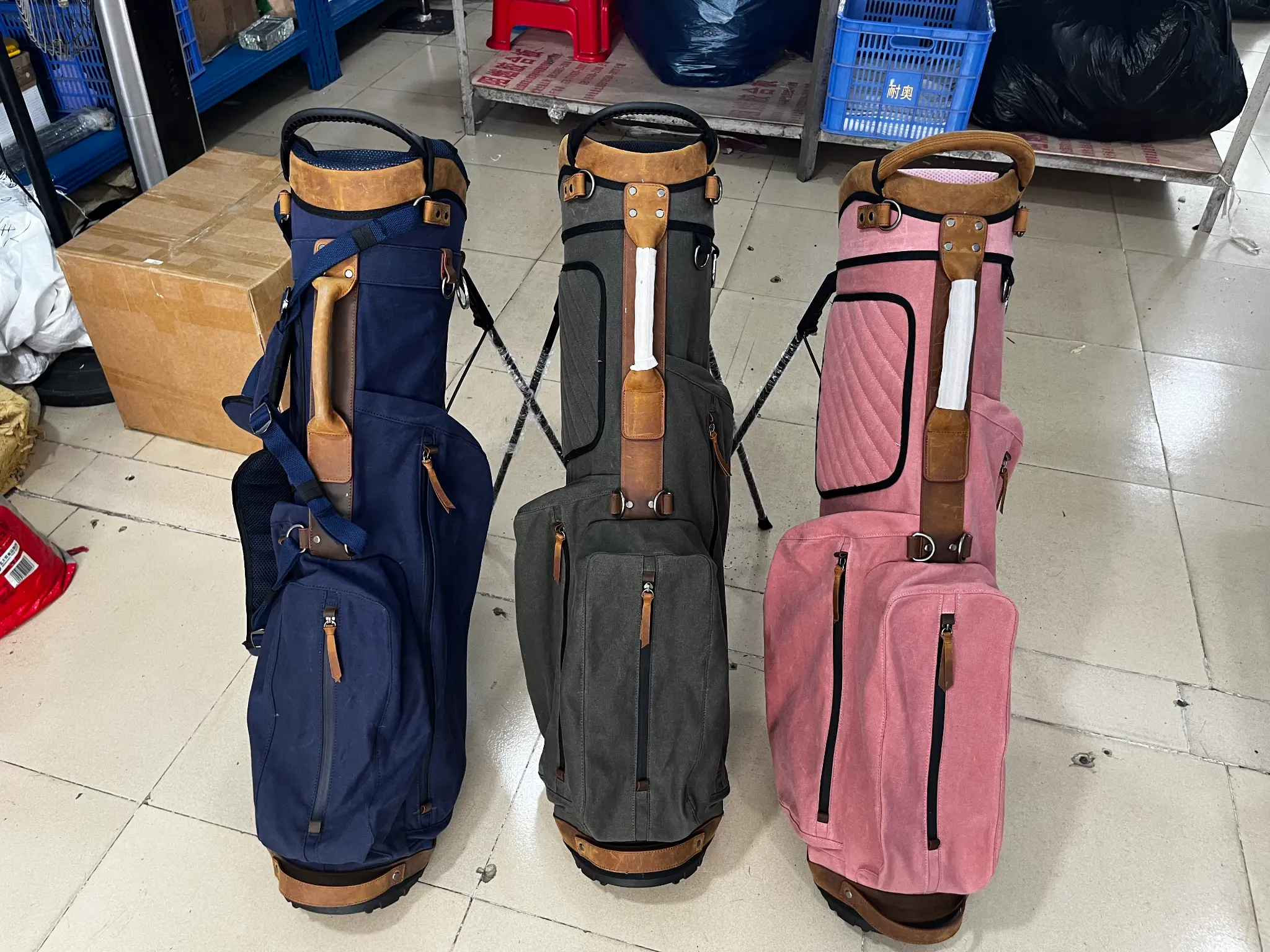
Example: A pro shop orders 30 Sunday bags: 10 in Forest Green, 10 in Navy, 10 in Tan. MOQ met. Color variety reduces inventory risk.
Strategy 3: Consolidate Orders Across Multiple Buyers
Golf club buying groups, regional golf associations, and multi-course operators can consolidate orders across locations to hit MOQ thresholds while distributing inventory. This is particularly effective for cart bags and staff bags with higher MOQs.
Strategy 4: Order Seasonal Collections, Not One-Off SKUs
Manufacturers offer better pricing and more MOQ flexibility to buyers who commit to seasonal collections (spring/summer, fall/winter). A buyer who orders 4 styles per season at 30 units each is more valuable than a one-time buyer ordering 200 units of a single style.
Understanding the True Cost of MOQ
When evaluating whether a MOQ makes financial sense, pro shop buyers should model the full unit economics:
Sample calculation for a custom Sunday bag:
| Item | Cost |
|---|---|
| FOB unit cost (30 units) | $38 |
| Freight + import duty (est.) | $8 |
| Total landed cost | $46 |
| Retail price | $145 |
| Gross margin | 68% |
| Total investment (30 units) | $1,380 |
| Revenue if sold out | $4,350 |
At 68% gross margin, you need to sell just 10 of 30 units to recover your total investment. The remaining 20 units are pure margin.
The risk is not the MOQ — it's the retail price point and demand validation. This is why starting with accessories (lower investment, faster sell-through) is the recommended first step.
How to Negotiate MOQ With a Manufacturer
MOQ is almost always negotiable. Here's how to approach the conversation:
1. Lead with your long-term potential, not your immediate order. Manufacturers care about lifetime customer value. A buyer who orders 30 units now but commits to quarterly reorders is more valuable than a one-time buyer of 500 units.
2. Offer to pay a higher unit price for lower MOQ. This is the most straightforward trade-off. If standard MOQ is 50 units at $38 each, offer to pay $44 per unit for a 30-unit order. The manufacturer's fixed costs are covered; you get the flexibility you need.
3. Accept longer lead times. Manufacturers can often accommodate lower MOQ by batching your order with similar styles for other customers. This may add 2–3 weeks to your lead time but can halve your MOQ requirement.
4. Commit to a sample order first. A paid sample order (typically 1–3 units at $150–300 per unit) demonstrates seriousness and often leads manufacturers to offer more flexible MOQ on the production order.
What to Include in Your MOQ Negotiation Brief
When approaching a manufacturer, provide a clear brief that makes negotiation easier:
- Product type and style reference (photo or sketch)
- Target retail price (helps manufacturer understand your margin requirements)
- Desired colorways (1–3 colors)
- Customization requirements (logo placement, embroidery vs. embossing)
- Delivery timeline (when do you need goods?)
- Annual volume estimate (even a rough estimate helps)
A well-prepared brief signals professionalism and typically results in better pricing and more flexible MOQ terms.
MOQ Red Flags to Watch For
Not all MOQ policies are created equal. Watch for these warning signs:
- MOQ that seems too low (under 10 units): Usually indicates a trading company sourcing from multiple factories, with no quality control consistency.
- MOQ that never moves regardless of price: Inflexible manufacturers often have capacity constraints or are not genuinely interested in small-to-medium buyers.
- No sample policy: A manufacturer unwilling to produce a paid sample before a production order is a significant risk.
- MOQ per color that is the same as MOQ per style: This effectively multiplies your minimum investment by the number of colorways — a common hidden cost.
Links Sports Co MOQ Policy
At Links Sports Co, we've structured our MOQ policy specifically to serve pro shops, golf clubs, and boutique brands:
| Product Category | MOQ | Mixed Colors |
|---|---|---|
| Golf Bags (Sunday, Stand) | 30 units | Yes, min 10/color |
| Golf Bags (Cart, Staff) | 50 units | Yes, min 15/color |
| Headcovers | 30 sets | Yes, min 10/color |
| Shoe Bags | 30 units | Yes, min 10/color |
| Accessories (pouches, covers) | 30 units | Yes, min 10/color |
| Tennis Bags | 30 units | Yes, min 10/color |
We also offer a sample program: order 1–3 units of any style at a fixed sample fee, with the sample cost credited against your first production order.
Getting Started
The best way to understand what MOQ works for your business is to have a direct conversation. Share your product ideas, target price point, and annual volume estimate — we'll provide a transparent quote with no obligation.
Share this article