
The Fitting Studio Bag Brief: Designing a Custom Golf Bag for Clubfitter Workflow
A workflow-first buyer guide for fitting studios specifying custom golf bags for demo clubs, shafts, appointment essentials and polished customer handover.
Links Sports Co
Product Specialist & OEM Consultant · Links Sports Co
10+ years in golf & tennis bag manufacturing. Specialises in OEM/ODM custom branding, material sourcing, and B2B wholesale for brands across 30+ countries.
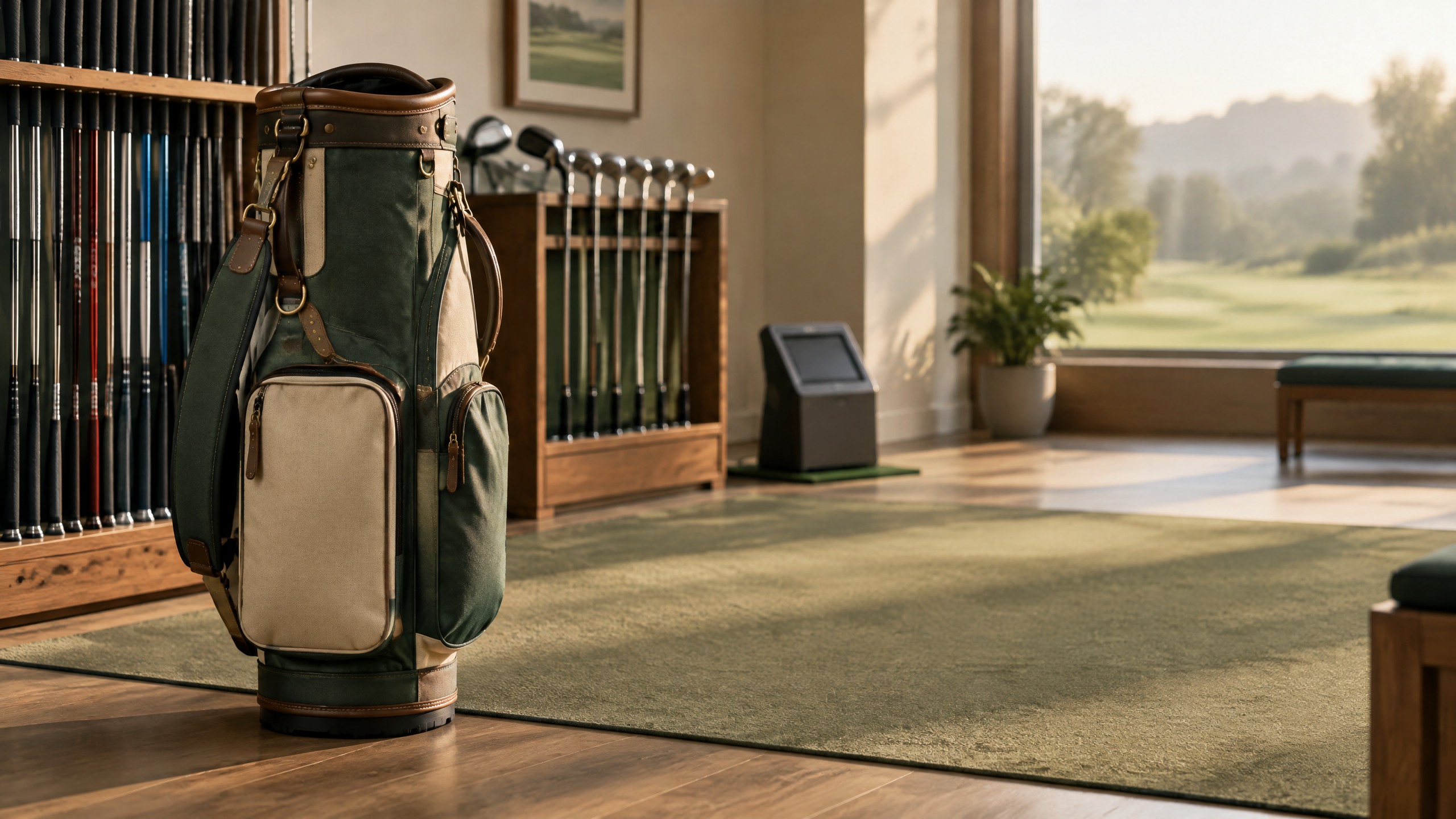
A custom golf bag for a fitting studio should be specified around the fitter’s sequence of work, not simply around the number of clubs it can carry. A strong brief makes demo clubs, interchangeable shafts, heads, fitting accessories and customer-facing handover items easier to identify, stage and return to the right place. That gives the studio a more repeatable operating routine without implying that the bag itself changes a player’s fitting result.
That distinction matters now. Circana reported in June 2026 that 80% of serious golfers had been custom fit at some point, including 30% in the previous year. Its summary also estimated that fitting accounts for 30% to 50% of premium club sales. As fitting becomes a more familiar part of the purchase journey, the physical environment around the launch monitor deserves the same design discipline as the appointment itself.
For a clubfitter, a bag is not only a finished retail object. It can be a compact work surface that moves between a fitting bay, a simulator, a practice area and a final customer conversation. The right question is not “How many pockets?” It is “What needs to happen in the next 30 seconds?”
Start with the fitter’s five movements
Before asking for materials, colours or logo locations, map the motions a fitter repeats during a normal session. The map need not be complicated. It should simply make the equipment flow visible.
| Fitting moment | What the fitter needs | Brief question for the bag |
|---|---|---|
| Before the appointment | To stage a defined set of demo components | Which items must be visible before the first swing? |
| During comparison | To switch between clubs or shafts without searching | Which components need their own labelled, separated zone? |
| Between sessions | To reset quickly and spot missing parts | Can the fitter see what has not been returned? |
| Practice-area movement | To move a selected set safely and neatly | Which carry handle, strap or base behaviour fits that route? |
| Customer handover | To present the selected configuration clearly | What needs to be removed from the working bag before the conversation? |
This turns a vague request for a “clubfitter golf bag” into a usable design brief. A studio may decide that full-length club dividers are more important than numerous lifestyle pockets. Another may prefer removable pouches for a small selection of heads, tools or sleeves. The answer depends on the studio’s actual inventory and service sequence.
Design around visibility, not maximum storage
A fitting bag can become less useful when every item disappears into deep compartments. More capacity is not automatically better. The goal is to give the right item a clear home, so the fitter can see the current setup, notice an incomplete reset and protect small parts from being mixed into a general pocket.
Consider separating the brief into four functional zones:
- Demo-club zone. This is the upright area for the active club set. Decide whether the fitter needs top-view recognition, separated sleeves or a simple visual order by shaft length.
- Component zone. A shallow, contained space can be more useful for selected heads, adapters or adjustment tools than one large catch-all pocket. The buyer should define which components are actually used in the studio; do not assume every fitting system requires the same layout.
- Session-essential zone. This is for the items used during nearly every appointment: a towel, notes, measuring tape, cleaning cloth or small accessories. It should be accessible without disturbing the selected clubs.
- Handover zone. A clean pocket or removable pouch can hold the appointment-specific notes or customer-ready accessories. Keeping it separate helps the studio avoid turning its working bag into a cluttered presentation item.
The zones do not have to be visible to the end customer. They do need to be intelligible to the person resetting the space between appointments.
A practical brief: describe the workflow before the features
A manufacturer can review a request more effectively when the buyer supplies context before asking for a pocket count. Include the following in a custom golf bag fitting-studio brief:
- The primary setting: permanent indoor bay, mobile fitting unit, practice range or mixed environment.
- The active equipment set: approximate club types, shaft lengths and the small items that require separation.
- The reset routine: who returns equipment, how frequently the bag moves and where it is stored overnight.
- The outward role: purely operational equipment, a studio-branded display piece, or a bag that may be shown during a customer handover.
- The identity direction: discreet studio mark, a club crest, a fitting-service name or a private-label approach.
- The sample questions: which movements, access points and visual details must be evaluated on the first physical version.
Avoid describing a compartment as “large” or “easy.” Replace those terms with an actual object and action. For example: “The fitter needs to retrieve a chosen adapter from a separate zip pocket while the bag remains upright beside the launch monitor.” That instruction is clearer than “add a convenient accessory pocket.”
An illustrative three-bay scenario
Imagine a three-bay fitting studio. Each bay uses a selected range of demo clubs, a small set of interchangeable components and a compact set of session tools. The studio does not need a bag that carries every piece of stock at once. It needs a defined bag for the live appointment set.
A disciplined first brief might say:
Use case: Move a selected demo set from storage to one fitting bay and then to a nearby practice tee.
Priority: Fast identification of the active clubs and separation of session accessories from small selected components.
Customer-facing moment: The bag may sit beside a client during the final comparison, so the visible materials and logo placement should feel considered.
Sample check: One fitter will stage the bag, run a representative comparison sequence, move it to the practice area and reset it without referring to a drawing.
This is an illustrative workflow, not a claim about a particular club or customer. Its value is that it gives every stakeholder the same reference point before development begins.
Make the sample review a workflow rehearsal
A physical sample should be reviewed in the environment where it will work. That does not mean a short review proves long-term durability or compatibility with every component system. It means the fitting team can observe the tasks that product photos cannot answer.
During the review, ask one fitter to run a normal sequence while another records observations. Look for the following:
- Can the active clubs be identified at a glance from the normal working position?
- Is there a clear home for each appointment-essential item, or do tools migrate into unrelated pockets?
- Do zippers, pullers and handles remain reachable when the bag is upright beside the monitor or practice mat?
- Can small components be kept separate from general accessories without creating unnecessary complexity?
- Does the bag still look orderly when it moves from a back-of-house task into a customer-facing setting?
Close the review with three lists: approve, revise before production and consider for a later version. That keeps the feedback factual and prevents a good operational requirement from being lost among personal design preferences.
For a broader physical-use comparison, use our custom golf bag sample field-test guide. For the initial procurement document, the custom golf bag RFQ template helps turn the workflow into an organised supplier conversation.
Match material and identity to the studio’s role
A fitting-studio bag may be highly functional, but it still represents the club, retailer or private-label partner in a premium equipment environment. Select the exterior only after the workflow is clear.
A restrained canvas-and-trim combination can suit a heritage-led club studio. A clean synthetic surface may fit a mobile, high-use setting. A quiet logo on a front panel can work when the bag is seen by clients, while an internal identifier may be enough for a back-of-house asset. None of these choices should be approved solely from a screen. Ask to see how the proposed material, thread, trim and mark read together on a physical sample.
The principle is simple: the exterior communicates the studio’s standards; the interior and access points support the team’s routine.
From fitting tool to branded equipment system
Some studios may later want a matching accessory pouch, shaft cover or staff carry piece. Treat this as a system only after the core bag has earned its place in the workflow. Adding matching items before the operating problem is solved can create visual consistency without practical value.
Begin with one bag, one documented workflow and one clear sample decision. A supplier can then assess whether the same material direction, construction details or logo treatment can translate to a wider programme. Browse relevant custom golf bag directions as a starting point, then share the studio’s use case with Links Sports Co for a project-specific review.
Frequently Asked Questions
Q: Is a fitting-studio bag the same as a retail golf bag?
Not necessarily. A retail bag is usually specified around a player’s carrying and storage needs. A fitting-studio bag is specified around the fitter’s appointment flow, active demo set and reset routine. A programme may need both, but they should not be assumed to have the same pocket plan.
Q: Should a fitting studio carry every demo club in one bag?
Usually the more useful question is which equipment is needed for one live appointment or fitting zone. A buyer can define an active set and a separate storage process instead of forcing every available component into one working bag.
Q: What should be tested on the first sample?
Test the movements that the team repeats: staging the active set, accessing session essentials, separating small selected components, moving to the relevant practice space and resetting the bag afterward. Record observations rather than treating a short test as proof of universal performance.
Q: Can a club logo be added to a fitting-studio bag?
A club crest, studio identifier or private-label mark can be considered after the intended surface, placement and application method are reviewed. The final appearance should be approved on the physical sample, particularly where the mark sits near seams, pockets or textured materials.
Share this article