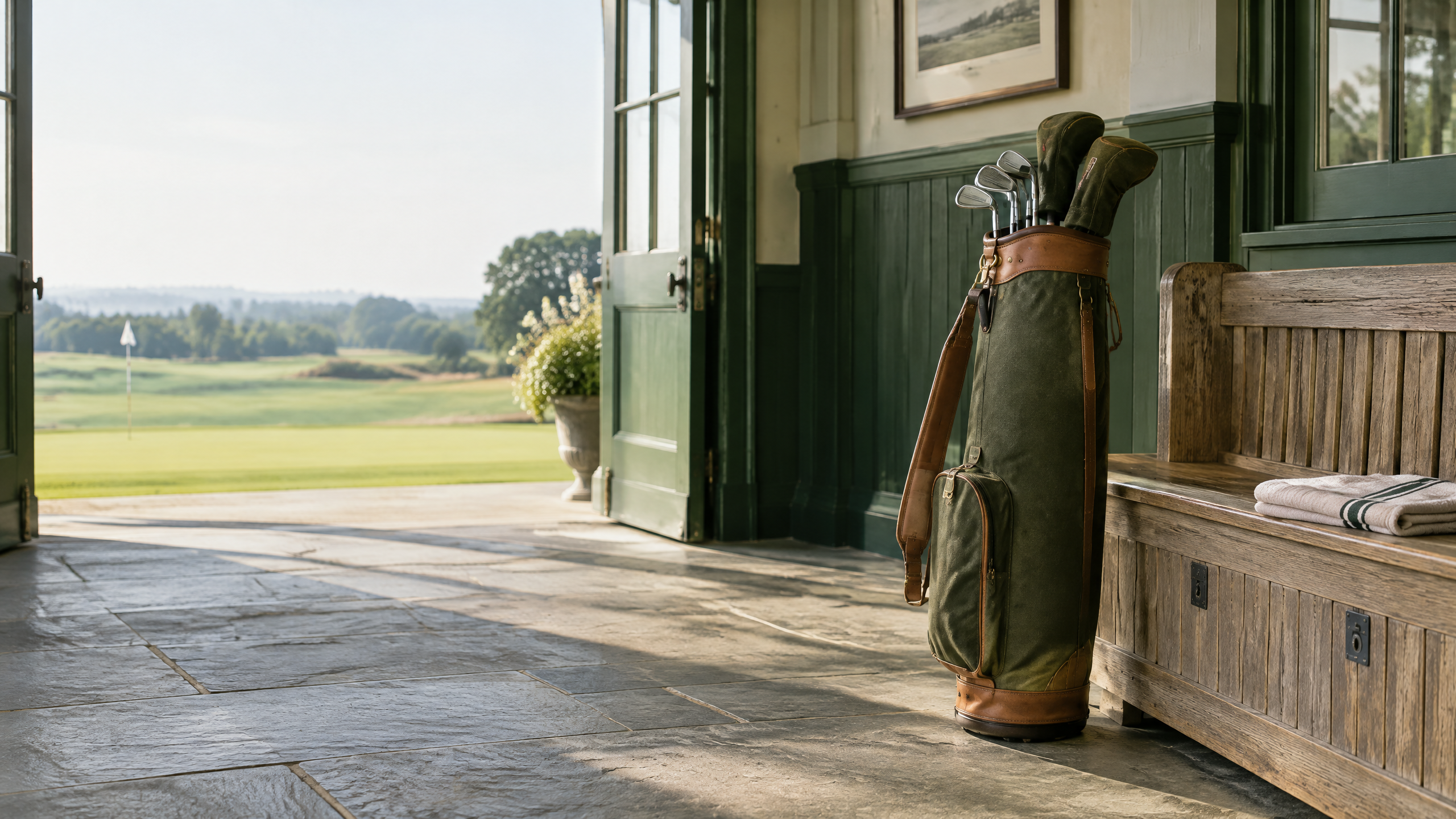
How to Choose the Right Golf Bag for Your Club Brand
Choosing the right golf bag for your club brand is more than a purchasing decision — it's a statement of identity. From material selection to logo placement, this guide walks through everything club managers and brand owners need to know, with real-world examples from Augusta National, Stitch Golf, and Haggin Oaks.
Links Golf Sports
Product Specialist & OEM Consultant · Links Sports Co
10+ years in golf & tennis bag manufacturing. Specialises in OEM/ODM custom branding, material sourcing, and B2B wholesale for brands across 30+ countries.

How to Choose the Right Golf Bag for Your Club Brand
A golf bag is never just a bag. For a golf club or brand, it is the single most visible piece of equipment a member carries across 18 holes — a walking advertisement, a mark of belonging, and a daily expression of the club's values. Getting this decision right can elevate a brand's reputation for years. Getting it wrong means members quietly switch to something else.
This guide breaks down the key decisions involved in choosing the right golf bag for your club brand, drawing on real examples from clubs and brands that have done it exceptionally well.
Why the Golf Bag Is Your Brand's Most Powerful Asset
Consider Augusta National Golf Club. The club does not sell merchandise widely — its branded items are famously exclusive, available only to patrons during Masters week. Yet the Augusta National staff bag, in its iconic white with the club's logo, is one of the most recognisable objects in world golf. The restraint and quality of that bag communicates everything about the club's identity: tradition, exclusivity, and uncompromising standards.
At the other end of the spectrum, Haggin Oaks Golf Complex in Sacramento, California, took a different approach. In 2023, the club partnered with Founders Club to produce a line of retro-styled canvas bags that referenced the club's 1920s heritage. The bags sold out within weeks and generated significant social media coverage — not because they were the most technically advanced bags on the market, but because they told a story that resonated with the club's community.
These two examples illustrate the central truth: the right bag for your brand is the one that authentically reflects who you are.
Step 1: Define Your Brand Identity Before You Define Your Bag
Before discussing materials or MOQ, a club or brand needs to answer a more fundamental question: what do we stand for?
Augusta National stands for tradition and exclusivity. Haggin Oaks stands for community and heritage. Stitch Golf, the Colorado-based brand founded in 2013, stands for craftsmanship and individuality — their bags are handmade in small batches with premium leather and canvas, and they have built a loyal following among golfers who want something genuinely different from the mass-market options.
Once your identity is clear, every subsequent decision — colour, material, hardware, logo placement — follows logically.
Step 2: Choose the Right Bag Type for Your Members
The golf bag market broadly divides into four categories, each suited to a different context.
| Bag Type | Best For | Key Features |
|---|---|---|
| Staff Bag | Tour professionals, prestige clubs | Largest storage, premium materials, maximum logo visibility |
| Stand Bag | Walking members, everyday play | Lightweight, dual-strap, built-in stand legs |
| Cart Bag | Clubs with high cart usage | Optimised for cart attachment, maximum pockets |
| Sunday / Carry Bag | Casual rounds, junior programmes | Minimal design, lightweight, low cost |
For most private clubs targeting mid-to-high-end members, a premium stand bag in canvas or leather is the most versatile choice. It works for walkers and cart users alike, photographs well, and carries enough storage for a full round.
For junior programmes — an increasingly important growth area for clubs in Australia, New Zealand, and Canada — a well-designed Sunday bag or junior stand bag creates early brand loyalty. Tyler Johnson, an Iowa entrepreneur who launched a toddler golf bag brand in 2024, found that parents were willing to pay a significant premium for a bag that matched the quality and aesthetic of adult equipment. His brand sold out its first production run within 90 days, demonstrating the market appetite for quality junior golf products.
Step 3: Select Materials That Match Your Brand Positioning
Material choice is where brand identity becomes tangible. The three primary options are canvas, nylon, and leather, each with distinct characteristics.
Canvas offers a classic, heritage aesthetic that photographs beautifully and ages gracefully. It is the material of choice for clubs that want a traditional, artisanal feel — think Stitch Golf's SL2 stand bag, which uses waxed canvas and full-grain leather trim to create a bag that feels genuinely handmade. Canvas is also highly customisable: it takes embroidery exceptionally well, allowing for detailed logo work that would be difficult to achieve on synthetic materials.
Nylon is the workhorse of the golf bag industry. Lightweight, weather-resistant, and durable, it is the practical choice for clubs in high-rainfall markets like the UK, New Zealand, and the Pacific Northwest. The trade-off is that nylon can look generic if not carefully designed — the difference between a premium nylon bag and a budget one often comes down to hardware quality and construction details.
Leather sits at the top of the market. A full-grain leather staff bag communicates luxury and permanence in a way no other material can match. TaylorMade's limited-edition Masters staff bags, released annually for Augusta week, use premium leather panels precisely because the material signals that this is something special — not an everyday product.
Step 4: Logo Placement and Customisation
The most common mistake clubs make with branded bags is treating the logo as an afterthought. Logo placement should be decided at the design stage, not added at the end.
For stand bags, the primary logo panel is typically the front pocket — the largest flat surface visible when the bag is standing upright. A secondary placement on the top cuff (the divider that holds the clubs) is increasingly popular, as it is visible from above when the bag is in a cart.
Embroidery remains the gold standard for premium bags. It creates a three-dimensional texture that elevates the bag's perceived quality and is far more durable than printed logos, which can crack or fade after repeated washing. For complex logos with multiple colours, embroidery also allows for precise colour matching using Pantone thread references.
Stitch Golf's approach is instructive here: they offer fully custom bags where the customer can specify not just the logo but the colour of every panel, the hardware finish (brushed gold, matte black, or antique brass), and the lining fabric. This level of customisation is what separates a truly branded product from a generic bag with a logo stuck on it.
Step 5: Understand MOQ, Lead Times, and Quality Control
For clubs and brands ordering custom bags for the first time, the commercial realities can be surprising. Most quality manufacturers require a minimum order quantity (MOQ) of between 50 and 200 units per style, with lead times of 60 to 120 days from design approval to delivery.
These numbers reflect the genuine complexity of producing a custom bag: pattern cutting, material sourcing, embroidery setup, assembly, and quality inspection all take time. Brands that try to rush this process typically end up with compromised quality.
The Victoria, Canada-based brand founded by realtor Zamian Parsons in 2026 — which produces waterproof golf bags with bold graphic designs — spent six months in the development phase before placing its first production order. That investment in pre-production time meant the finished product matched the original vision precisely.
When evaluating manufacturers, ask for physical samples before committing to a production order. Examine the stitching at stress points (handles, strap attachments, stand leg pivots), the quality of the zippers (YKK is the industry benchmark), and the accuracy of the embroidery against your artwork file.
Step 6: Think About the Full Product Ecosystem
The most successful club brands do not stop at the bag. They build a coordinated product ecosystem — matching headcovers, shoe bags, travel covers, and accessories — that reinforces the brand identity at every touchpoint.
Augusta National's merchandise range is the extreme example: every item, from the bag tag to the umbrella, is produced to the same standard and carries the same restrained aesthetic. But even smaller clubs can apply this principle. A matching set of canvas headcovers with the club's embroidered crest, offered alongside the bag, creates a cohesive look that members are proud to display.
For brands entering the market, this ecosystem approach also provides a more accessible entry point. A Sunday bag or a set of headcovers has a lower MOQ and lower unit cost than a full stand bag, allowing a new brand to test the market before committing to a larger production run.
Making the Right Choice
Choosing the right golf bag for your club brand ultimately comes down to three things: knowing your identity, understanding your members, and finding a manufacturing partner who can translate both into a finished product that exceeds expectations.
The clubs and brands that get this right — Augusta National, Stitch Golf, Haggin Oaks — share one thing in common: they treat the bag as a genuine expression of their values, not a commodity purchase. The result is a product that members are proud to carry, that generates word-of-mouth, and that builds brand equity with every round played.
For clubs and brands in the early stages of this process, working with a manufacturer who offers end-to-end support — from material selection and design development through to production and quality control — makes the difference between a bag that merely carries clubs and one that genuinely represents your brand. Links Golf Sports Co specialises in exactly this kind of partnership, producing canvas, nylon, and leather golf bags for club brands and private labels across Australia, New Zealand, Canada, and Europe, with full OEM and ODM capability and no minimum order requirements on sample runs.
Share this article