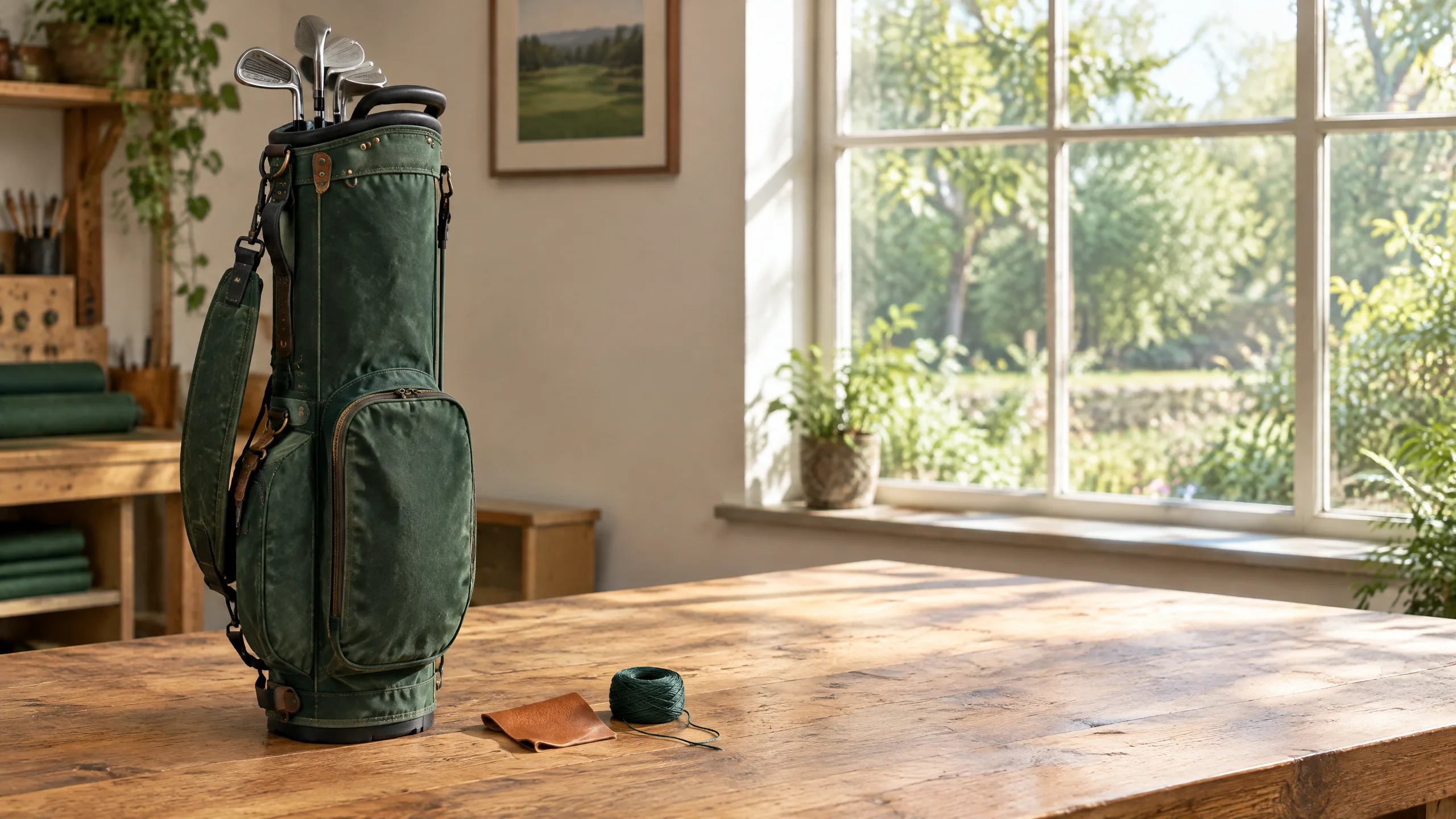
The Reference, Not the Replica: A Buyer’s Guide to Original Heritage-Inspired Golf Bag Design
A practical buyer guide for converting a heritage reference into an original private-label golf bag brief, sample plan and distinct brand direction.
Links Sports Co
Product Specialist & OEM Consultant · Links Sports Co
10+ years in golf & tennis bag manufacturing. Specialises in OEM/ODM custom branding, material sourcing, and B2B wholesale for brands across 30+ countries.
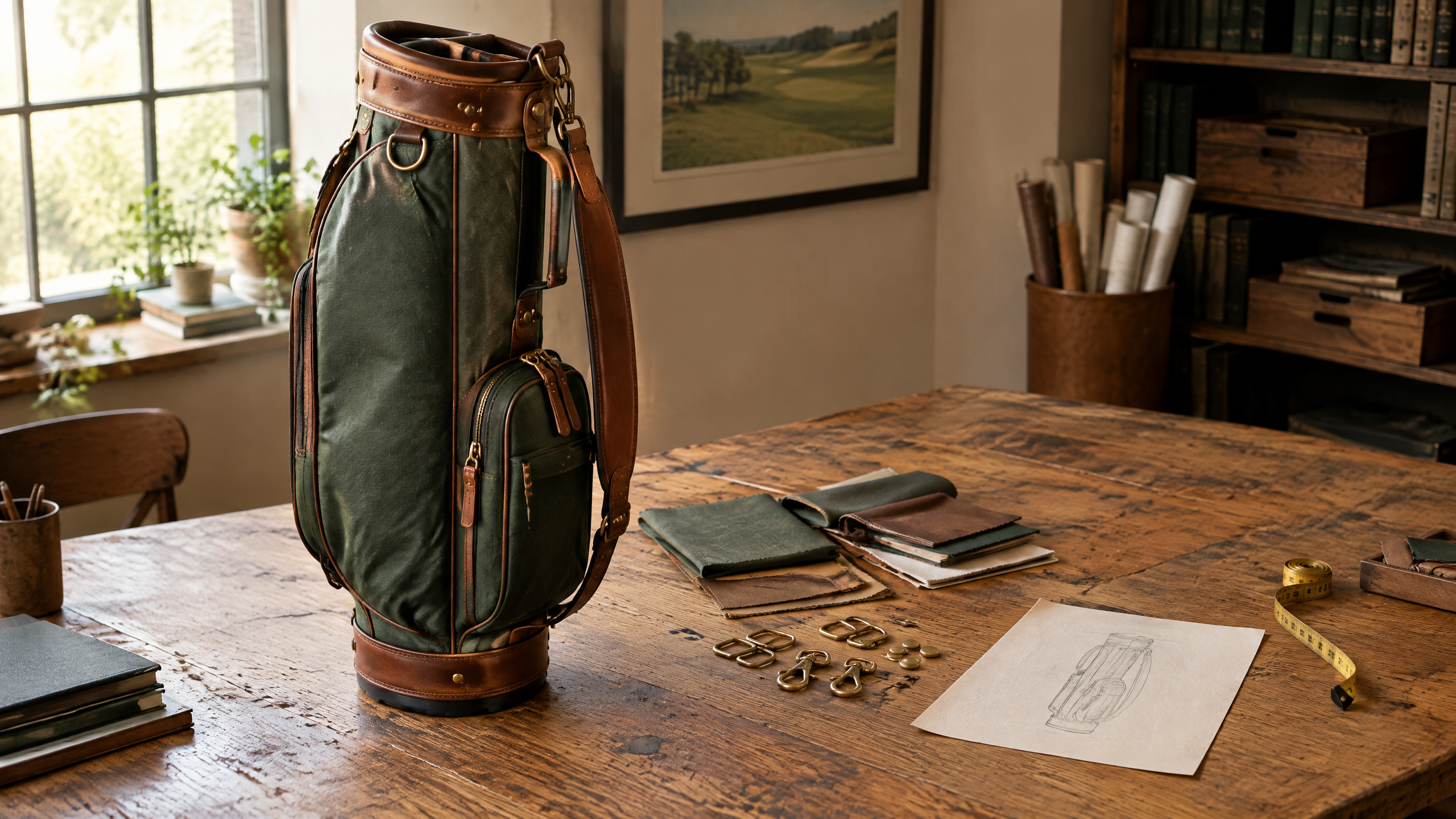
A heritage-inspired golf bag design begins with a reference, but it should not end there. Buyers often arrive with a moodboard of archive bags, club colours, old photography, tactile materials and carrying silhouettes that feel more lasting than a trend-led product. That can be a useful starting point. The disciplined next step is to identify what the reference communicates, then build an original product brief that belongs to the buyer’s own brand.
The distinction matters for both creative and commercial reasons. A private label does not need another brand’s exact panel layout, trim placement or signature detail to create a refined heritage character. It needs a deliberate point of view: how the bag carries, which materials do the visual work, what the club or brand mark means, and which details are unmistakably its own.
This guide is a sourcing and product-development framework, not legal advice. A manufacturer can help turn an approved brief into an original sample, while the buyer remains responsible for its own artwork, brand decisions and any design-rights review it requires.
Start by naming the feeling—not the product to copy
A reference image is most useful when it is translated into design language. Instead of writing “make this bag,” describe why the image made the moodboard.
A buyer might be responding to a quiet palette, a narrow walking-bag profile, the contrast between waxed canvas and leather, or a crest placed with restraint. Those are separate ideas. Once they are separated, the brand can choose which to keep, which to reject and where to add its own perspective.
Ask the team to annotate each reference with one sentence under these headings:
| What you notice | A useful brief statement |
|---|---|
| Carry character | “A compact walking silhouette that feels balanced on the shoulder.” |
| Material feeling | “A matte canvas field with limited warm-leather touchpoints.” |
| Colour logic | “One deep club colour, one neutral trim and no competing accents.” |
| Detail density | “Purposeful exterior pockets rather than a highly segmented surface.” |
| Identity approach | “A club mark that reads as an object of belonging, not a billboard.” |
This exercise prevents a moodboard from becoming a list of visual instructions taken from someone else’s product. It gives the designer and supplier a clear original brief instead.
Make five original decisions before discussing decoration
A crest, monogram or embroidered mark should not be used to disguise an otherwise derivative product. The core bag needs its own logic first. A practical original private-label golf bag brief makes five decisions in sequence.
1. Define the carrying role
Is the bag meant for a walking member, a resort guest, a weekend player, a clubfitter or a limited pro-shop release? The answer influences the weight target, divider plan, carry strap, stand or non-stand construction, exterior storage and base behaviour.
A heritage feeling does not require a historically accurate reproduction. A modern walking bag can use a clean, narrow profile while still allowing current carrying needs to shape the construction. The buyer should describe the intended route: from clubhouse to first tee, from car to practice range, or around a compact nine-hole round.
2. Choose a silhouette with your own proportions
A silhouette is more than the total height of a bag. It is the relationship between the top opening, body width, pocket depth, side profile and base. A useful buyer brief may ask for a tapered lower body, a broad front pocket, or a reduced side-panel visual—but those choices should be drawn and reviewed as a new composition.
Avoid treating a reference photo as a specification. Share a written description, rough sketch and preferred use case, then ask for an original pattern direction. The sample should be evaluated against the buyer’s own requirements, not against the source image.
3. Build material contrast with a purpose
Canvas, leather, webbing, lining, zipper tape and hardware can each contribute to a heritage tone. The strongest projects usually use fewer materials with clear jobs.
For example, waxed canvas may create the main field, while leather protects high-touch areas such as a carry handle or selected trim. Webbing may be chosen for the shoulder strap because it supports a different kind of movement and adjustment. Hardware finishes can be selected to support the palette without turning every functional component into a decorative feature.
A material board should answer these questions:
- Which surface is the visual anchor?
- Which material earns its place through touch, protection or structure?
- Where will the club or private-label mark sit most clearly?
- What will be visible when the bag is carried, stored upright or photographed for a product launch?
For a material-first development conversation, see our custom waxed-canvas stand-bag buyer brief. The point is not to reproduce its exact appearance; it is to use its decision process as a reference for your own brief.
4. Establish the brand hierarchy early
Heritage-inspired does not mean unbranded. It means the brand application should work with the object rather than fight it. A crest may belong on a front panel, a discreet leather patch or a side pocket. A wordmark may be enough on an interior label or a lower panel. The right choice depends on how the bag will be seen.
Describe the hierarchy in plain language: which mark is primary, which mark is secondary, what must remain clear around it and what should never compete with it. Keep logo artwork separate from the inspirational material board. The factory should receive approved brand files and a distinct placement reference, not an implied instruction to reuse another product’s visual language.
The same principle applies to club colours. Use a club palette because it is yours, not because it makes a reference look closer. Our quiet-branding design rulebook for private-club golf bags offers another way to think about visible identity with restraint.
5. Add one or two proprietary signatures
The original point of view often becomes clear in small, repeatable details. These might include a custom lining colour, a useful pocket opening, a named trim direction, a proprietary webbing stripe, a contrast binding rule or a considered piece of hardware. The choice should help the bag feel owned by the brand, not simply more complicated.
Do not add a new detail solely to make the product appear different. Ask how it improves the carry experience, reinforces the brand or establishes a recognisable internal design system for future accessories.
Turn the moodboard into a supplier-ready brief
A good custom golf bag moodboard approval process separates reference material from production instructions. It gives the factory enough clarity to quote, pattern and sample without reducing the project to a generic request for “something vintage.”
Use this compact worksheet:
| Brief area | What the buyer provides | What the supplier can review |
|---|---|---|
| User and setting | Who will carry the bag and where | Appropriate construction route and active-use questions |
| Inspiration | The desired feelings and selected design cues | An original direction, not a copied pattern |
| Materials | Preferred main material, trim approach and colour family | Available options, sample swatches and construction compatibility |
| Silhouette | Written proportion notes and rough original sketch | Pattern proposal and functional trade-offs |
| Branding | Final brand files and intended hierarchy | Suitable application method and placement review |
| Sample decision | The specific points to approve physically | A clear evaluation plan before production discussion |
The worksheet does not need to be a technical drawing on day one. It does need to distinguish what is fixed from what is exploratory. “Forest green is essential” is different from “we are open to several ways of using leather trim.” That clarity saves revision cycles later.
Review the sample as an original object
A physical sample is where a buyer can move beyond a moodboard. Inspect it on its own terms. Carry it, set it upright, open the active pockets and view it at the distance where a member, retailer or guest would actually see it.
Use a short review sequence:
- Does the overall silhouette work for the stated carrying role?
- Do the selected materials create the intended visual hierarchy without over-decoration?
- Does the logo application look balanced against real seams, pockets and material texture?
- Are the proprietary details visible enough to give the design a point of view?
- Does the sample still feel original when the inspiration sheet is put away?
The last question is especially useful. A product should make sense without explaining what it was inspired by. If its only story is that it resembles something else, the brief needs more work.
For a hands-on comparison method, use the custom golf bag sample field-test guide. Its task-based approach helps a team approve practical choices instead of reacting only to a first impression.
An illustrative private-label scenario
Imagine a small club retailer planning a 30-piece private-label walking-bag programme. The buying team likes understated canvas, warm leather touchpoints and a compact carry profile. Rather than submitting another bag’s images as the specification, it writes a new brief:
Carry role: A lightweight club walking bag for members using a compact course.
Visual direction: Deep green canvas as the main field; one warm neutral trim; no bright contrast piping.
Original signature: A club-specific lining colour and a front-pocket construction that frames the crest with generous negative space.
Sample decision: Approve silhouette, shoulder carry balance, trim placement and crest hierarchy before discussing the wider order.
This is an illustration, not a claim about an existing client or result. Its value is that it converts a visual preference into independent decisions that a supplier can understand.
Keep the source material inside the right boundary
A factory partner can work from your original brief, your approved artwork and your supplied materials. It should not be asked to imply affiliation with another brand, reproduce protected graphics or make claims about a product it did not develop. If a buyer has a question about rights, registrations or the appropriate use of a reference, that question belongs with its own qualified adviser.
The commercial benefit of the original route is also creative. It gives a brand a system it can continue: a walking bag now, then a matching shoe bag, headcover or accessory pouch later. The common thread becomes the brand’s own material, proportion and identity decisions.
When you are ready to move from inspiration to a product-specific conversation, explore relevant custom golf bag directions and share a structured brief with Links Sports Co. The most useful first conversation is about the user, the intended design language and the sample decision—not a promise to replicate a reference.
Frequently Asked Questions
Q: Can a manufacturer make a heritage-inspired golf bag without copying another brand?
A manufacturer can help develop an original bag from the buyer’s own user brief, design cues, brand files and sample decisions. The project should focus on independent silhouette, materials, logo hierarchy and proprietary details rather than reproducing another product. Buyers should handle any design-rights questions through their own qualified advisers.
Q: What should be in a private-label golf bag moodboard?
Include the intended user, setting, colour direction, material feeling, preferred level of detail and examples of the design cues you value. Keep final artwork and placement directions separate, so the factory receives an unambiguous original production brief.
Q: How can a club make a golf bag feel heritage-inspired but still current?
Start with the carrying role, then use a restrained material palette, a deliberate silhouette and a clear brand hierarchy. Current functionality can guide the pocket plan, strap and construction while the exterior uses timeless colour, texture and proportion.
Q: What should be approved on the first sample?
Approve the original silhouette, carry behaviour, material contrast, trim placement, logo balance and the distinct details that make the bag belong to the buyer’s brand. A sample should be assessed as an original object, not only by comparison with an inspiration image.
Share this article