From Heritage Detail to a Modern Carry System: Developing a Custom Waxed Canvas Stand Bag
A procurement-led Product Story on developing a custom waxed canvas stand golf bag with leather trim, practical carry features, original logo options and a 10-piece MOQ.
Links Golf Sports
Product Specialist & OEM Consultant · Links Sports Co
10+ years in golf & tennis bag manufacturing. Specialises in OEM/ODM custom branding, material sourcing, and B2B wholesale for brands across 30+ countries.
Quick answer for buyers
A custom waxed canvas stand golf bag can begin from a 10-piece MOQ when the buyer aligns the sample on canvas, leather trim, stand function, carry layout and logo application before bulk production. For clubs and private labels, the most useful first step is an original development brief—not a request to copy a reference bag—followed by a sample that is tested with a realistic club load. This project combines a handcrafted waxed-canvas body, leather trim, custom club or private-logo options and a modern stand-bag carry system.
| Buyer question | Practical answer |
|---|---|
| What makes the design “heritage-inspired”? | Waxed canvas, leather touchpoints, restrained colour and a purposeful silhouette—not decorative imitation. |
| What makes it modern? | A working stand system, usable pockets, reinforced carry points and a clear logo location. |
| Who is it for? | Golf clubs, emerging labels, member programmes and private clients developing a limited branded carry bag. |
| What should be approved first? | Material swatches, logo treatment, strap balance, stand stability, pocket access and packaging protection. |
For a golf brand, club professional or private-label buyer, a stand bag is rarely “just a bag.” It has to look credible beside premium apparel and equipment, feel practical through a full round, and be distinctive enough to earn its place in a small collection. That is the development question behind this custom waxed-canvas stand-bag program: how can a classic material palette become a modern carry product without turning into a costume piece or an over-engineered technical bag?
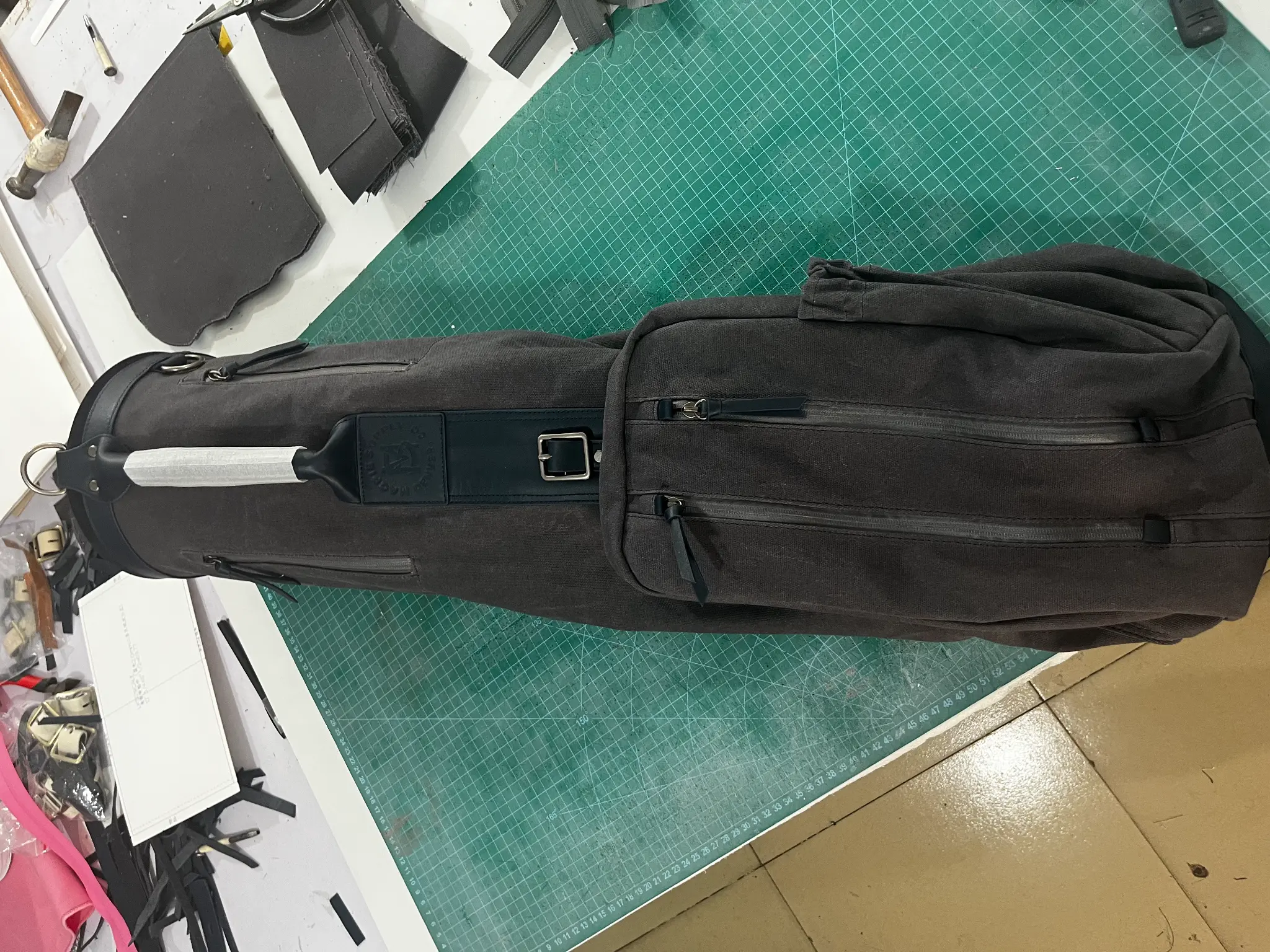
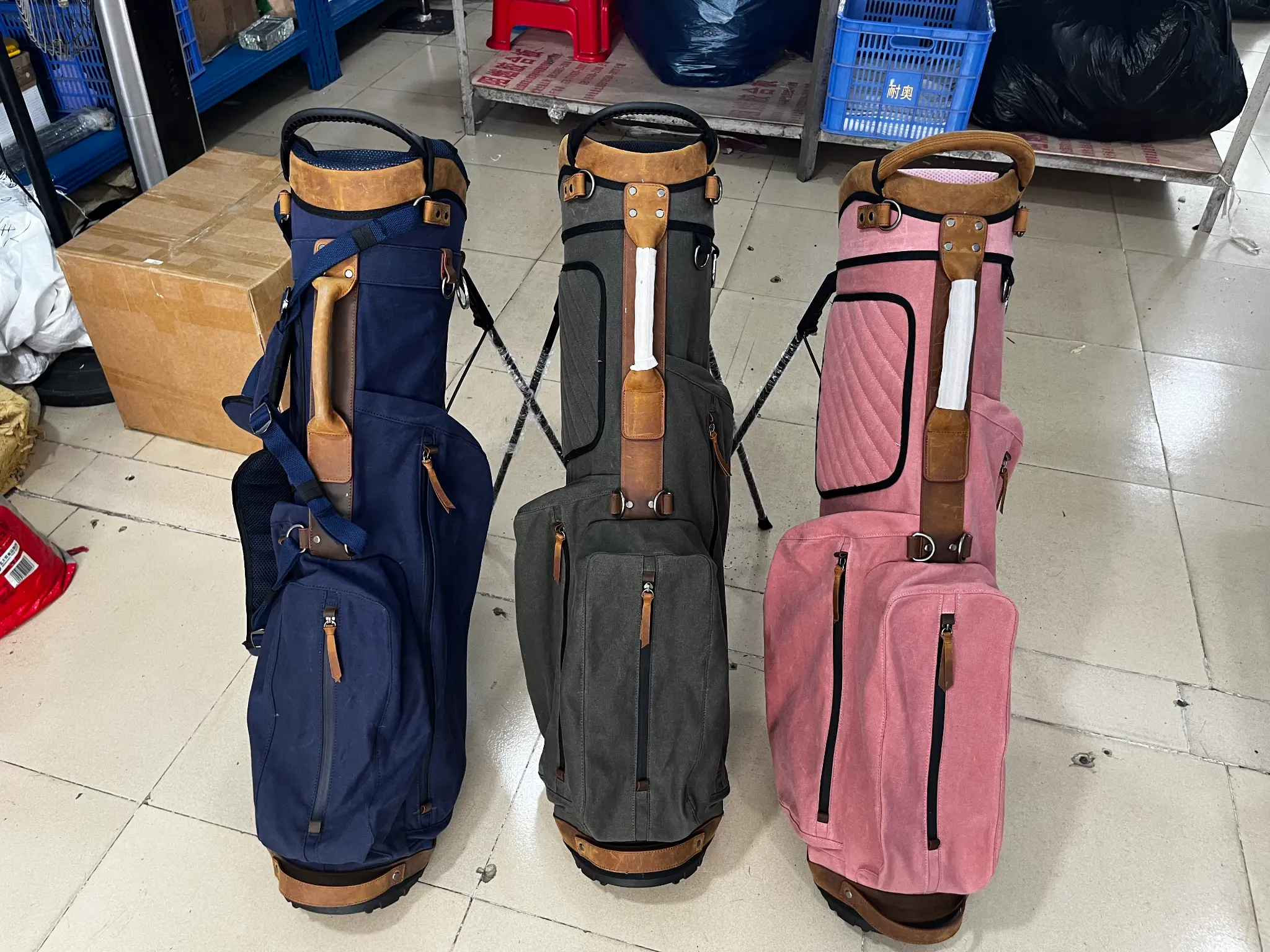
The sample direction shown here combines waxed canvas, leather trim, a structured carry profile and stand-bag functionality. It is available as a factory-direct custom program beginning at an MOQ of 10 pieces, with club or private-logo customization discussed during the specification and sample stage. The purpose of this story is not to reproduce another brand’s bag. It is to show procurement teams how to turn a heritage-inspired visual brief into an original, brand-ready product specification.
The category signal: golfers still respond to a bag made for the walk
The best contemporary canvas stand bags show that a classic look does not require old-fashioned usability. Shapland’s public positioning puts a “timeless look” alongside lightweight carry-bag details such as shoulder straps and a stand mechanism. Shoal Golf similarly frames its canvas bag around balance, durability and the experience of walking the course. For a buyer, the useful takeaway is not a list of brand claims. It is the design brief behind them: heritage appeal must be supported by carry comfort, stability and disciplined storage.
This matters because a buyer will evaluate a bag in two settings at once. In product photography and a shop display, the canvas and leather need to deliver warmth, texture and a recognisable silhouette. On the course, the same product needs a reliable stance, sensible access to pockets and a carry system that does not compete with the player’s movement. A strong private-label development project starts by treating these as equal requirements.
Turning the visual direction into a procurement brief
Waxed canvas and leather trim create a useful contrast. Canvas brings a matte, field-ready surface; leather can define the handle, trim, puller, reinforcement patch or brand panel. But the value of the combination is only realised when the buyer specifies where each material is doing a job rather than simply adding decoration.
| Design area | Procurement question | Practical decision to approve in the sample |
|---|---|---|
| Canvas body | Does the material have the intended hand-feel, surface character and colour consistency? | Approve the exact fabric swatch under indoor and natural light. |
| Leather trim | Which contact points need reinforcement or a premium visual edge? | Check trim thickness, edge finishing, stitch line and hardware attachment. |
| Carry system | Is the intended customer a walking golfer, cart user, or both? | Test strap adjustment, handle comfort and balance with a realistic club load. |
| Stand system | Does the bag stand securely on common turf and hard floor surfaces? | Test opening, closing, leg contact points and upright stability. |
| Pocket layout | Which items should be accessible without opening the main compartment? | Load a rangefinder, valuables, bottle and outerwear in the sample. |
| Brand application | Is the logo meant to read as discreet, club-specific or retail-led? | Approve artwork size, placement, thread/print colour and backing method. |
The most important approval point is to ask the team to use the bag as a bag, not merely view it as a showroom sample. Put it on the shoulder, open every pocket, set it on uneven ground and inspect the points where canvas meets leather and hardware. That is where a product story becomes a repeatable production brief.
Modern function should be visible, but not noisy
A heritage-inspired bag can quickly lose its point of view when it accumulates too many panels, colours and exposed features. The better approach is to define one clear visual hierarchy. On the supplied samples, the canvas body is the main field, while leather touchpoints and restrained contrast piping establish the structure. The resulting language can suit a golf club, a lifestyle retailer or a private client when the colour and branding are controlled.
For purchasing teams, “modern” should mean that the operational features are resolved: the stand opens consistently, storage is positioned with intent, strap anchoring is reinforced, and the branding has a defined location. It does not need to mean an overloaded exterior. This is especially relevant for smaller initial orders, where every added construction change can complicate sampling, material matching and repeat production.
What a 10-piece MOQ changes—and what it does not
An MOQ of 10 pieces gives a club, emerging label or private buyer room to validate a specific colourway and identity before committing to a larger programme. It can be a practical route for event gifting, a member collection, a limited retail release or a founder-led brand test. It should not be read as a promise that every material, hardware combination or logo treatment carries the same commercial conditions.
Before requesting a quotation, buyers should define a small number of non-negotiables: the bag format, preferred canvas and trim colours, logo application, target use, packaging expectation and required delivery window. The factory can then assess material availability and construction feasibility against a coherent brief rather than price a loose inspiration board.
Buyer principle: A small MOQ is most valuable when it reduces decision risk. Use the sample to approve construction details and brand execution before expanding colours, options or volume.
Custom identity: club, private label or one-off commission
The same base program can express very different identities. A club may prefer a discreet crest on a pocket panel or leather patch. A retail label may need a repeatable woven label, a considered colour specification and retail packaging. A private commission may focus on initials, a monogram or a limited colour choice. Each approach should be included in the quote request because the artwork method, backing, labour sequence and approval process may differ.
Artwork should be supplied in a scalable format where possible, and the buyer should ask for a digital placement proof before logo work begins. For embroidery, it is useful to discuss stitch density and the backing area in advance, especially on canvas or curved pocket panels. For printed or patch applications, confirm whether the visual mark is intended to age naturally with the materials or retain a cleaner, higher-contrast finish.
A sample approval checklist for procurement managers
The most useful sample review is structured, photographed and shared between design, purchasing and commercial teams. The following questions keep the review focused on details that affect both retail presentation and long-term usability.
- Does the canvas shade match the approved reference in the intended lighting conditions?
- Are leather trim pieces consistently cut, finished and aligned around high-visibility areas?
- Does the strap system feel balanced with a realistic club load?
- Does the stand mechanism operate cleanly and remain stable during repeated use?
- Are pocket openings, zipper pulls and hardware accessible while the bag is standing?
- Is the logo placement visually intentional and technically secure?
- Does the packaging protect leather and hardware without making a premium bag feel overpacked?
- Is every accepted change marked on a dated approval sheet before bulk production begins?
Frequently Asked Questions
Q: Can a club or private label begin a custom waxed canvas stand-bag project at 10 pieces?
Yes. This program starts at a 10-piece MOQ, subject to confirmation of the chosen materials, colours, hardware and logo method. A smaller opening order is most useful when it is treated as a controlled specification and sample-approval exercise rather than a collection with too many variants.
Q: How should a buyer refer to brands such as Shapland or Shoal Golf in a design brief?
Use reference brands to describe a direction—such as restrained canvas styling, walking-golf practicality or a heritage-meets-modern balance—not as a request to replicate protected branding, a specific product or a proprietary construction. Supply original artwork, preferred colours and clear functional requirements for an original development process.
Q: What logo options are suitable for a waxed canvas and leather-trim golf bag?
Club crests, private-label marks, monograms, woven labels, embroidered panels, printed marks and leather patches can be considered after the artwork, placement and material surface are reviewed. The final method should be approved on the sample, particularly when a mark is applied on a curved or textured panel.
Q: What should purchasing teams request before asking for a production quote?
Provide a reference brief, quantity estimate, preferred colours, required logo files, target use, packaging expectation, destination and required delivery window. This gives the factory a basis to assess feasible construction and quote the selected configuration accurately.
Final perspective: buy the system, not only the look
The opportunity in waxed canvas stand bags is not nostalgia alone. It is the chance to create a product that feels more personal than a generic technical carry bag while still respecting the realities of a walking round. Brands such as Shapland and Shoal Golf help demonstrate the broader market appetite for a restrained, course-aware canvas aesthetic. A private-label buyer can use that signal as inspiration for a category brief, then develop an original bag around their own materials, colours, logo and user needs.
For this program, the starting point is straightforward: handcrafted waxed canvas and leather-trim stand bags, customization for a club or private identity, and an MOQ of 10 pieces. The stronger result comes from what happens next—an exact brief, a disciplined sample review and a specification that makes vintage character and modern carry function work together.
For the next decision points, review a golf bag sample approval checklist, plan retail-ready protection with a custom golf bag packaging brief, or send a custom stand-bag development brief to the Links Sports Co. team.
Share this article