The Tournament Desk Brief: Designing Custom Tennis Bags for Officials, Volunteers & Check-In Teams
A practical buyer guide for clubs and tournament directors specifying custom tennis bags for officials, volunteers, check-in teams and courtside handoffs.
Links Sports Co
Product Specialist & OEM Consultant · Links Sports Co
10+ years in golf & tennis bag manufacturing. Specialises in OEM/ODM custom branding, material sourcing, and B2B wholesale for brands across 30+ countries.
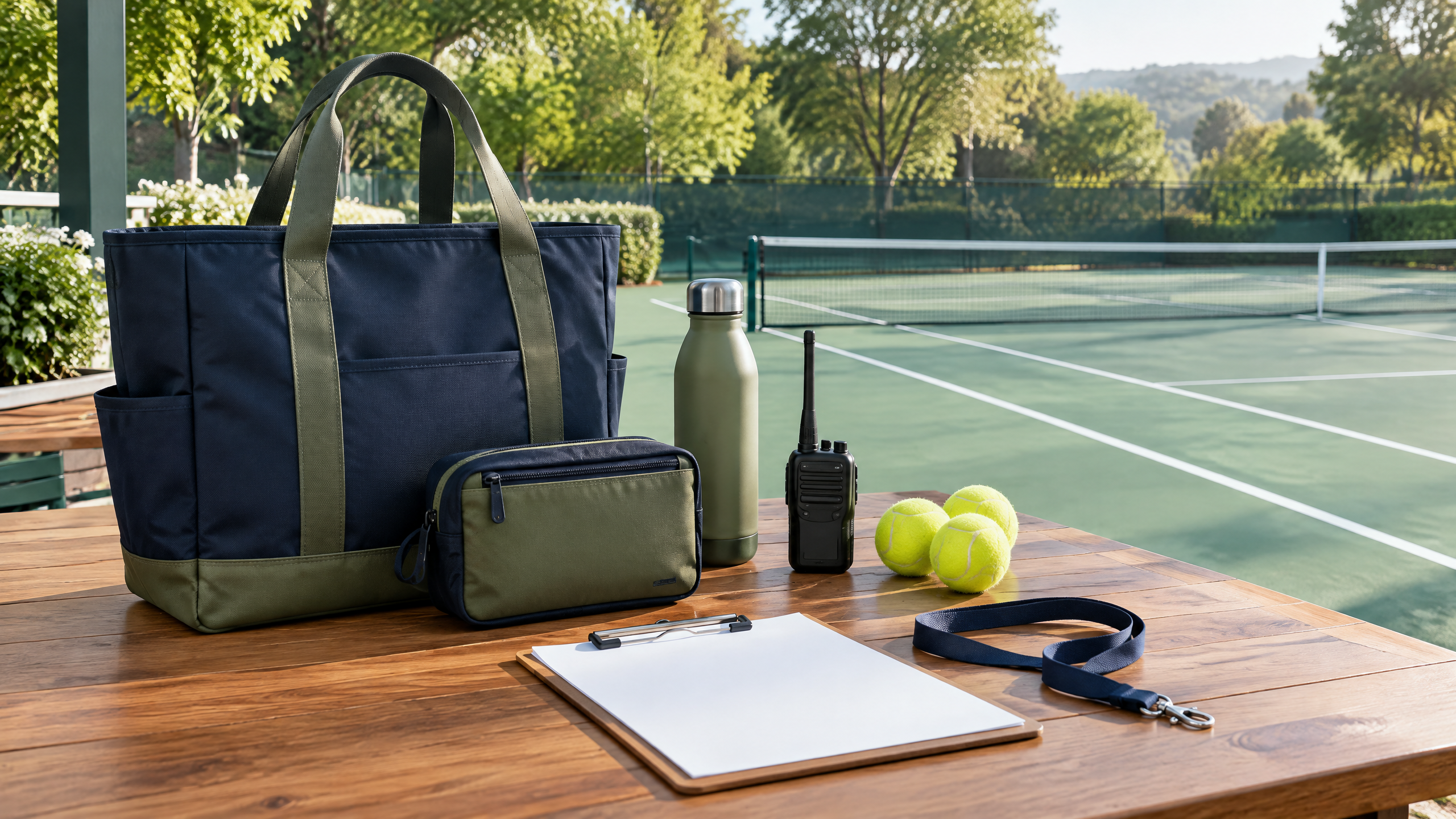
A custom tennis tournament staff bag is not a player bag with a different logo. It is a working tool for the people who move information, small equipment and essential supplies between the check-in desk, tournament office and courts. When a club designs it around roles and shift handoffs, the bag can make a temporary event operation feel more orderly without adding unnecessary bulk or turning the team into a walking advertisement.
A tournament day has many moving parts. Registration, draw updates, court assignments, player communications and results need a reliable physical rhythm as well as a digital one. USTA’s tournament-director tools reflect that reality by covering registration, player management, draws, updates, communications and a dedicated tournament desk. The bag does not replace those systems. It simply gives the staff using them a clear place for the physical items that move alongside the work.
The buyer’s first question should be: what must travel from the desk to the court, and what must be handed to the next shift without anything being lost?
Separate the staff bag from the player experience
Tournament operators already have several bag categories to consider. Player gifts may require a light, brand-facing tote. Coaches may need court-side organisation. Junior competitors may need a bag sized around racquets and personal gear. A staff or official bag has a different job.
| Bag role | Primary user | Core question |
|---|---|---|
| Player bag | Competitor or guest | Can a participant carry personal match essentials? |
| Coach bag | Coach or academy team | Can the coach organise training and court-side tools? |
| Sponsor or gift bag | Attendee, partner or recipient | Does the item present the event identity appropriately? |
| Tournament staff bag | Official, volunteer or check-in team | Can the shift carry, locate and hand over event essentials accurately? |
Making this distinction early prevents the most common mismatch: selecting a consumer tennis backpack that looks professional but does not support the day’s administrative and court-side movements.
For player-facing club programmes, see One Club, Three Courts: A Buyer’s Guide to Custom Tennis, Pickleball & Padel Bag Programs. This guide focuses instead on the staff workflow behind the event.
Map the role before selecting the bag format
“Tournament staff” is a broad label. A check-in volunteer, court monitor, referee coordinator and tournament-office assistant may need different access, storage and movement. The buyer does not need a separate bag for every individual, but it should identify the roles that share a common load.
Start with a role-to-load map:
| Role or shift | Typical physical items | Useful design implication |
|---|---|---|
| Registration and check-in | Clipboard, blank forms, pens, small signage, device cable, water | Structured main compartment plus fast-access front organisation |
| Court monitor | Radio, phone, balls, towel, court notes, small personal items | Secure quick-access zone and a carry mode that moves easily courtside |
| Tournament office | Charger, printed draw, headset or radio, spare stationery, shift notes | Protected internal divider and a defined handoff pocket |
| Volunteer lead | Roster, lanyards, spare supplies, site notes | Separate pouch or labelled interior section for grouped items |
| Changeover runner | A compact selection of balls, notices or essential supplies | Light, visible, uncomplicated format rather than excess storage |
The exact items belong to the club’s operating plan. A supplier should not assume that every event needs radios, credentials or printed materials. The point of this exercise is to expose the repeatable load before a pocket map is requested.
Build the bag around four event movements
A well-briefed tennis event check-in bag supports the actions people repeat, not an imagined maximum capacity.
1. Desk setup
At the start of a shift, the person needs to arrange the active materials without spreading everything across the table. A structured central compartment can hold a small document folder, organiser pouch or device. A front-facing section can keep frequently used items visible, such as pens, a power cable, tape or a simple sign holder.
Do not add compartments simply because they sound useful. Name the item, its approximate size and how often it is touched. “A pocket for event paperwork” is vague. “A flat, protected space for an A4 draw sheet that can be retrieved without emptying the bag” is a usable design instruction.
2. Court-side response
A shift lead may need to move from a desk to a court quickly, sometimes with only one hand free. This is where a carry handle, shoulder strap, cross-body adjustment or compact backpack form becomes relevant. The buyer should choose the movement before choosing the format.
Consider the route: paved paths, club corridors, stairs, grass beside a practice court, or several courts in a row. The bag should not be overloaded with a full office setup if its normal job is to carry only the active tools for a short response.
3. Shift handoff
The handoff is the central design moment. A volunteer finishing a two-hour shift should be able to tell the next person what is inside, what has been used and what needs attention. A dedicated handoff pocket or interior sleeve can hold a short paper note, updated roster or labelled pouch. A simple interior colour cue can help the team return items to their defined place.
The bag does not need to document the tournament. It needs to prevent small objects and responsibilities from disappearing during a transition.
4. End-of-day reset
At day’s end, staff need to remove event-specific materials, return devices and prepare reusable elements for the next round or next day. The buyer should define whether the bag is stored flat, hung, locked in an office or returned to a volunteer lead. That decision affects the desired structure, handle placement and whether removable pouches add value.
Give each zone a clear purpose
A practical tournament official equipment bag can be organised as a small system rather than one deep cavity. The following zones are a starting framework, not a universal specification.
- Desk zone: flat documents, blank forms or a small tablet sleeve where appropriate.
- Communication zone: radio, charger, cable or phone kept separate from loose stationery.
- Court zone: tennis balls, towel, small tape roll or active shift supplies.
- Handoff zone: an easily visible sleeve or pouch for the next person’s notes, roster or grouped items.
- Personal zone: a small protected space for the staff member’s personal essentials, kept distinct from event property.
The buyer should decide whether pouches are removable. A removable pouch can support a role change between the desk and the court, but it adds another item to track. A fixed divider is simpler. The correct choice is the one that matches the club’s actual staff routine.
Keep event artwork controlled and temporary
A tournament bag can carry the host club identity, a tournament name, a date, a staff role or a sponsor acknowledgement. The design decision should be made with distribution and reuse in mind.
If the bag will be used only for one event, a date-specific mark may make sense. If the club expects to use it across several events or seasons, an enduring club identity with a removable role tag may be more practical. A staff bag should not become visually crowded because several stakeholders each request a large mark.
Set a simple hierarchy before sampling:
- What is the primary club or tournament identifier?
- Is the role name permanent, removable or handled by a temporary lanyard instead?
- Which panel must remain clear for pockets, access and the bag’s original shape?
- Will the bag be seen in photographs, at player check-in or only behind the desk?
Use approved artwork and an explicit placement drawing. A supplier can then review how the application works on the selected material and seams. For a more general event procurement framework, compare this with our custom golf bag RFQ template, adapting only the process—not the golf-specific bag requirements.
Test the sample by running a short shift
A physical sample should be tested in a real event-like sequence. Invite a tournament director, a check-in volunteer, a court monitor and the person responsible for brand approval. Give them a short task list and record observations.
- Load the selected desk and court items.
- Set up a check-in table and retrieve the active items in order.
- Carry the bag to a nearby court and access one urgent item without unloading it.
- Hand the bag to another person with a one-minute verbal handoff.
- Reset the bag at the desk without a written instruction manual.
- Review the visible artwork from normal event-photo distance.
This is a decision rehearsal, not a promise that a short test proves all-weather performance or every event scenario. It helps the club decide which access points, internal dividers and visual details matter before a broader order is discussed.
Our custom tennis coach bag court-side organiser guide offers another role-based testing approach. The two bags should remain distinct: one serves a coach’s session routine; the other serves the tournament’s shared operation.
An illustrative club-tournament brief
Imagine a club running a weekend adult tournament across several courts. Its staff team includes a registration desk, rotating court monitors and a volunteer lead. The club wants reusable bags that can work again for future events.
A clear starting brief might read:
User: Check-in team, court monitor and volunteer lead.
Movement: Desk setup, short walks to courts, shift handoff and end-of-day reset.
Active load: Club-supplied forms, communications device, small stationery, balls, water and a distinct pouch for handoff notes.
Identity: Club crest as the primary permanent mark; temporary role identification handled separately.
Sample decision: Approve carry comfort, fast access, handoff visibility and artwork balance before production.
This is an illustrative operations pattern, not a claim about a specific club or tournament outcome. It gives the buyer, designer and supplier a shared vocabulary.
Make the next order easier than the first
If the club may later add volunteer kits, player welcome items or coach organisers, create a small visual system from the first staff bag: shared material direction, a consistent club mark and role-specific formats. The bags do not need to be identical. They need to look like they belong to one considered programme.
Explore relevant tennis and racquet-sport bag options and share the actual roles, movements and artwork requirements with Links Sports Co. Quantities, materials, customisation route and production timing should be confirmed from the approved brief rather than assumed from a generic tournament product.
Frequently Asked Questions
Q: What is the difference between a tennis tournament staff bag and a player bag?
A player bag is organised around racquets and personal match essentials. A staff bag is organised around the movement of event materials between the check-in desk, tournament office and courts. The buyer should define the staff roles and active load before choosing pockets or a carry format.
Q: Should tournament officials and volunteers use the same bag?
They can use the same core format when their active equipment and movement are similar. If roles have very different loads, removable pouches, interior zones or a complementary compact format may be more useful than forcing one layout to do every job.
Q: What should be checked on a first sample?
Test desk setup, court-side movement, fast access to active supplies, a shift handoff and end-of-day reset. Also review how the approved club or event artwork sits beside seams, pockets and the selected material.
Q: Can a tournament bag show both a club crest and a temporary event role?
It can, but the buyer should decide which identity is permanent and how the temporary role will be handled. A removable label, lanyard or insert may keep a reusable club bag cleaner than permanently applying several date-specific elements.
Share this article